
Mount Sinai Researchers Identify Molecular Glues That Protect Insulin-Producing Cells From Damage Related to Diabetes
Findings could improve long-term outcomes for patients
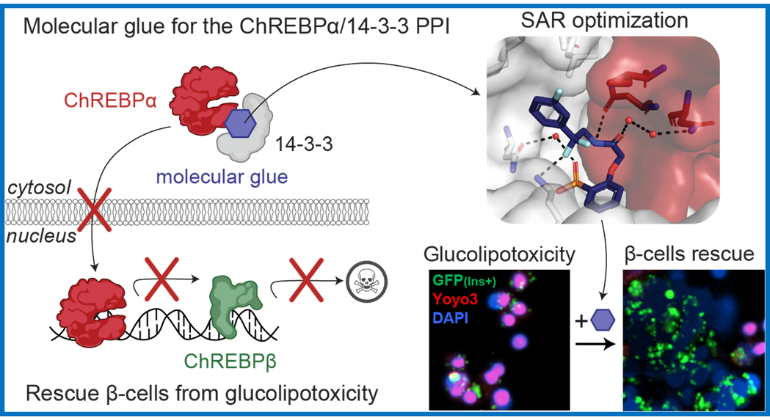
Illustrating the mechanism by which small molecule stabilizers of the ChREBPα/14-3-3 protein-protein interaction (PPI) protect insulin-secreting beta cells from glucolipotoxicity. The optimized "molecular glue" compounds retain ChREBPα in the cytoplasm, preventing its transcriptional activity and subsequent beta cell dedifferentiation and death. This approach highlights a novel therapeutic strategy for maintaining beta cell identity and function in the context of type 2 diabetes.
Researchers from the Icahn School of Medicine at Mount Sinai in New York have discovered a novel approach to protecting insulin-producing beta cells from the damaging effects of glucolipotoxicity—a harmful condition linked to the progression of type 2 diabetes (T2D). These findings, published on March 2, 2025 in Nature Communications, could lead to promising treatments targeting beta cell dysfunction.
For patients, this research could lead to new treatments that protect the insulin-producing cells in the pancreas, potentially slowing or even preventing the progression of diabetes, thus reducing the need for insulin therapy and improving long-term blood sugar control. Unlike current therapies that primarily manage blood sugar levels, this approach would allow doctors to directly target beta cell loss, which could improve long-term disease outcomes for their patients.
“This is an exciting step forward in our understanding of beta cell protection and the prevention of diabetes deterioration,” said lead author Liora S. Katz, PhD-Associate Professor of Medicine (Endocrinology, Diabetes and Bone Disease) at the Icahn School of Medicine. “For the first time, we’ve shown that it’s possible to use small molecules to fine-tune carbohydrate response element binding protein (ChREBP) activity in a way that could have major therapeutic implications.”
More than 500 million people worldwide are living with diabetes, a disease characterized by high blood sugar levels due to insulin resistance and/or beta cell failure. In T2D, long-term exposure to high glucose and fatty acid levels (glucolipotoxicity) can ultimately lead to beta cell dysfunction and death.
ChREBP is a transcription factor that plays a crucial role in regulating glucose metabolism. It exists in two main isoforms: ChREBPα and ChREBPβ. This is the first study to identify and develop small molecules—termed "molecular glues"—that enhance the interaction between ChREBPα and 14-3-3 proteins in pancreatic beta cells.
The molecular glues in this case increase the binding between 14-3-3 proteins and ChREBPα, which is anchored in the cytoplasm of the beta cell by the 14-3-3 proteins. Under conditions of glucolipotoxicity, ChREBPα goes into the nucleus and starts making too much of ChREBPβ, which acts to disable and even kill the patient’s beta cells. By using a molecular glue designed to increase the binding of ChREBPα to 14-3-3 proteins, ChREBPα never leaves the cytoplasm, cannot enter the nucleus, and therefore does not make ChREBPβ.
When tested in primary human beta cells, these molecular glues significantly reduced the toxic effects of glucolipotoxicity, thus preserving beta cell function and identity. This discovery represents a major shift in diabetes research, as transcription factors like ChREBP have long been considered "undruggable" targets. The study also highlights the broader potential of molecular glues for modulating similar interactions in other diseases.
“Our findings suggest a completely new strategy for preserving beta cell function in diabetes,” said Donald K. Scott, PhD, Professor of Medicine (Endocrinology, Diabetes and Bone Disease) at the Icahn School of Medicine. “This approach could complement existing diabetes treatments and help prevent disease progression.”
Researchers are now working to refine these compounds and evaluate their potential for clinical translation. Future studies will focus on optimizing the molecular glues for therapeutic use and testing them in preclinical diabetes models.
This study was done in collaboration with research teams from Eindhoven University of Technology in the Netherlands and the University of Duisburg-Essen in Germany. The work was supported in the United States by NIH/NIDDK R01DK130300 and the Human Islet and Adenoviral Core (HIAC) of P30DK020541, and in the European Union through ERC Advanced Grant PPI-Glue (101098234), the Netherlands Ministry of Education, Culture and Science (Gravity program 024.001.035), the Netherlands Organization for Scientific Research (ECHO grant 711.018.003), and by DFG-funded CRC1093 (Supramolecular Chemistry on Proteins).
Click HERE for a link to the full study.
About the Mount Sinai Health System
Mount Sinai Health System is one of the nation’s leading integrated academic health systems and one of the largest in the New York metropolitan area. Its comprehensive system includes seven hospitals, more than 400 outpatient practices, over 600 research and clinical laboratories, the Icahn School of Medicine at Mount Sinai, the Graduate School of Biomedical Sciences, and the Mount Sinai Phillips School of Nursing. Together, the Health System comprises approximately 48,000 employees, more than 9,000 physicians, and 8,600 nurses.
As a leading learning health system, Mount Sinai combines clinical expertise with scientific discovery to improve patient care while training the next generation of health care and biomedical leaders. The Health System provides care across every stage of life, from prenatal care through geriatrics, while advancing personalized medicine through artificial intelligence, data science, and biomedical research.
Mount Sinai is consistently recognized among the nation’s leading academic health systems for patient care, research, and education. The Mount Sinai Hospital is ranked No. 1 in New York by Newsweek and No. 5 on the magazine’s World’s Best Hospitals list. The Icahn School of Medicine at Mount Sinai ranks No. 11 among U.S. medical schools and No. 1 among freestanding medical schools for National Institutes of Health funding, reflecting the strength of its scientific enterprise and leadership in biomedical research.