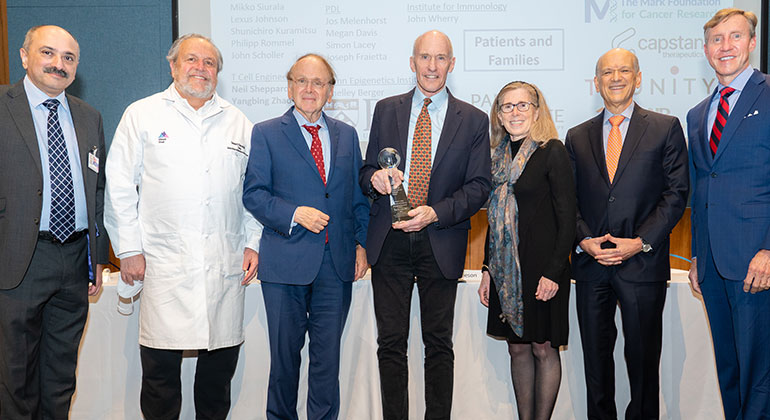
Mount Sinai Researcher Receives Prestigious International Award
Mone Zaidi, MD, PhD, is recognized for contributions to bone and mineral research
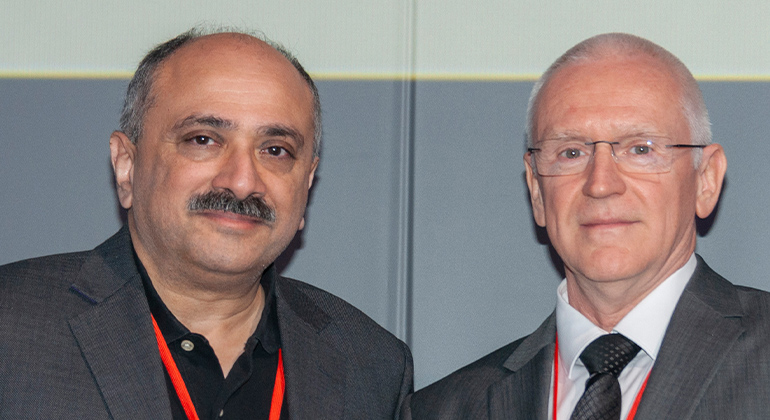
Mone Zaidi, MD, PhD, Director of the Center for Translational Medicine and Pharmacology and Professor of Medicine, and Pharmacological Sciences, at the Icahn School of Medicine at Mount Sinai, has received the 2022 International Research Prize from the Austrian Bone and Mineral Society, the largest medical society in Austria. The International Research Prize is the most coveted prize in bone and mineral research and is given once every three years.
Since its inception in 1988, the International Research Prize has been presented to individuals whose recent work in the fields of molecular, cellular, or material science, or the pathophysiological or clinical aspects of bone and mineral metabolism, has resulted in a novel finding or concept.
An international jury independently selected Dr. Zaidi as the prize winner, and he was awarded EUR 7,500 ($8,000 USD) at the Osteoporoseforum, the 30th annual Meeting of the Austrian Bone and Mineral Society, which was held in St. Wolfgang, Austria, on June 23-25. The following pieces of Dr. Zaidi’s work were featured during this conference.
- Oxytocin regulates body composition. Proceedings of the National Academy of Sciences 116: 26808-26815.
- First-in-class humanized FSH blocking antibody targets bone and fat. Proceedings of the National Academy of Sciences 117: 28971-28979.
- FSH blockade improves cognition in mice with Alzheimer’s disease. Nature 603: 470-476.
“It is a truly humbling experience to be awarded this prize and to join this small group of luminaries in my field—something that I could not have achieved without the exceptionally talented faculty and trainees and distinguished collaborators that I have had the honor of working with over these years,” said Dr. Zaidi.
Dr. Zaidi has made groundbreaking discoveries on mechanisms of skeletal homeostasis in health and disease. These studies, spanning more than 30 years, included the first description of calcium sensing in the osteoclast and the discovery that locally released nitric oxide acts to suppress bone cells. In 2003, Dr. Zaidi’s group published the first evidence for a pituitary-bone axis, a breakthrough in physiology in which pituitary hormones could affect the skeleton directly. In recent groundbreaking papers in Nature, he found that inhibiting the follicle-stimulating hormone (FSH) not only increased bone mass, but also reduced body fat and neurodegeneration—in essence laying a firm foundation for a single anti-FSH agent to treat osteoporosis, obesity, and Alzheimer’s disease.
The corpus of work relating FSH to body fat was selected by Nature Medicine as one of the eight “Notable Advances” in biomedicine for 2017. Constituting a total of more than 450 publications in journals, Dr. Zaidi’s research has been funded continuously by the National Institutes of Health (NIH). He has also chaired multiple Study Sections for the NIH and the Department of Veterans Affairs. He served as President of the Interurban Clinical Club and was elected to membership of the Association of American Physicians, the Practitioners’ Society (the oldest medical society in the United States) and the Association of Professors of Medicine. Dr. Zaidi is a Master of the American College of Physicians, received the Harrington Scholar-Innovator Award, was elected as Fellow of the American Association of Advancement of Science, and is the recipient of three honorary doctorates.
“Dr. Zaidi is an exceptional researcher who has made pioneering discoveries on the mechanisms of musculoskeletal homeostasis in health and disease throughout his career,” said Eric J. Nestler, MD, PhD, Nash Family Professor of Neuroscience, Director of The Friedman Brain Institute, and Dean for Academic Affairs of Icahn Mount Sinai, and Chief Scientific Officer of the Mount Sinai Health System. “I congratulate Dr. Zaidi on receiving one of the most prestigious awards in his field and we are thrilled that he is being recognized by the largest medical society in Austria.”
About the Mount Sinai Health System
Mount Sinai Health System is one of the nation’s leading integrated academic health systems and one of the largest in the New York metropolitan area. Its comprehensive system includes seven hospitals, more than 400 outpatient practices, over 600 research and clinical laboratories, the Icahn School of Medicine at Mount Sinai, the Graduate School of Biomedical Sciences, and the Mount Sinai Phillips School of Nursing. Together, the Health System comprises approximately 48,000 employees, more than 9,000 physicians, and 8,600 nurses.
As a leading learning health system, Mount Sinai combines clinical expertise with scientific discovery to improve patient care while training the next generation of health care and biomedical leaders. The Health System provides care across every stage of life, from prenatal care through geriatrics, while advancing personalized medicine through artificial intelligence, data science, and biomedical research.
Mount Sinai is consistently recognized among the nation’s leading academic health systems for patient care, research, and education. The Mount Sinai Hospital is ranked No. 1 in New York by Newsweek® and No. 7 in the U.S. on the magazine’s World’s Best Hospitals 2026 list. The Icahn School of Medicine at Mount Sinai ranks No. 9 among U.S. medical schools and No. 1 among freestanding medical schools for National Institutes of Health grant funding, reflecting the strength of its scientific enterprise and leadership in biomedical research.