Carl H. June Awarded the Inaugural Maria I. New International Prize for Biomedical Research
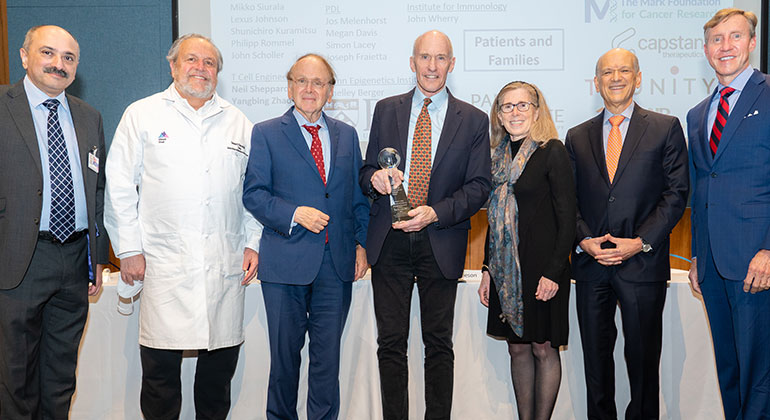
Carl H. June, MD, an inventor of CAR T cell therapy for cancer—which has already led to FDA-approved treatments for lymphoma, leukemia, and multiple myeloma—was awarded the inaugural Maria I. New International Prize for Biomedical Research on Thursday, November 10, at the Icahn School of Medicine at Mount Sinai.

Carl H. June, MD, recipient of the Inaugural Maria I. New International Prize for Biomedical Research, presenting the distinguished lecture at the prize ceremony on Thursday, November 10, at the Icahn School of Medicine at Mount Sinai. Photo credit: Mount Sinai Health System
Chimeric antigen receptor T cell immunotherapy (CAR T), which Dr. June helped create, is a type of cancer therapy that harnesses the body’s own immune system to fight cancer. T cells, a type of white blood cell, are removed from the patient and reprogrammed to recognize and attack cancer cells when returned to the body. Today, six CAR T cell therapies have been approved by the U.S. Food and Drug Administration, and clinical trials targeting many additional cancers are underway worldwide.
The prize is meant to honor medical pioneers in the tradition of Maria I. New, MD, a devoted member of the Mount Sinai community whose achievements have demonstrated her more than six decades of outstanding commitment to breakthrough research.
Over the past half-century, Dr. New has earned a reputation as one of the nation's leading pediatric endocrinologists. Her studies of congenital adrenal hyperplasia (CAH)—a deficiency in the adrenal system that causes gender ambiguity in females and precocious sexual development in males—have led to treatments to correct the disorder before the baby is born. Her groundbreaking identification of a new form of hypertension, “apparent mineralcorticoid excess,” has resulted in a new area of receptor biology.
The prize will be awarded annually to distinguished biomedical researchers for lifetime scientific achievements that have led, or may lead, to new ways to prevent and treat human disease. The award is generously supported by the Pulitzer Prize-winning author and economic historian Dr. Daniel Yergin, PhD, MA, and his wife, foreign policy expert Dr. Angela Stent, PhD, MS, MA.
The prize winners, who are selected by an international jury of prominent science community members, are awarded $20,000. The prize is administered by Mount Sinai’s Center for Translational Medicine and Pharmacology, under the dedicated leadership of Mone Zaidi, MD, PhD, in conjunction with the Department of Pediatrics, Department of Medicine, and Department of Pharmacological Sciences. Dr. Zaidi, who chaired the jury that awarded the Maria I. New International Prize, is Director of the Center for Translational Medicine and Pharmacology, and the Mount Sinai Professor of Clinical Medicine.
Dr. June is the Richard W. Vague Professor in Immunotherapy in the Department of Pathology and Laboratory Medicine, Director of the Center for Cellular Immunotherapies, and Director of the Parker Institute for Cancer Immunotherapy, all at the Perelman School of Medicine at the University of Pennsylvania.
Also see: Carl H. June Is Recipient of Inaugural Maria I. New International Prize for Biomedical Research
About the Mount Sinai Health System
Mount Sinai Health System is one of the nation’s leading integrated academic health systems and one of the largest in the New York metropolitan area. Its comprehensive system includes seven hospitals, more than 400 outpatient practices, over 600 research and clinical laboratories, the Icahn School of Medicine at Mount Sinai, the Graduate School of Biomedical Sciences, and the Mount Sinai Phillips School of Nursing. Together, the Health System comprises approximately 48,000 employees, more than 9,000 physicians, and 8,600 nurses.
As a leading learning health system, Mount Sinai combines clinical expertise with scientific discovery to improve patient care while training the next generation of health care and biomedical leaders. The Health System provides care across every stage of life, from prenatal care through geriatrics, while advancing personalized medicine through artificial intelligence, data science, and biomedical research.
Mount Sinai is consistently recognized among the nation’s leading academic health systems for patient care, research, and education. The Mount Sinai Hospital is ranked No. 1 in New York by Newsweek and No. 5 on the magazine’s World’s Best Hospitals list. The Icahn School of Medicine at Mount Sinai ranks No. 11 among U.S. medical schools and No. 1 among freestanding medical schools for National Institutes of Health funding, reflecting the strength of its scientific enterprise and leadership in biomedical research.
Mount Sinai Researcher Receives Prestigious International Award
Jul 06, 2022 View All Press Releases