
Mount Sinai Research Program Awarded $12.5 Million NIH Grant to Continue to Study the Role of Hormones in Menopause and Aging Biology
New program will look at the role of the Follicle Stimulating Hormone in obesity and osteoporosis
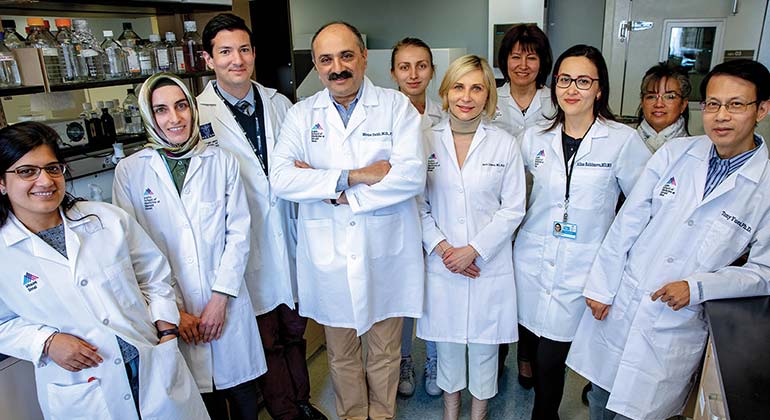
Researchers from the Icahn School of Medicine at Mount Sinai have been awarded a $12.5 million grant from the National Institute on Aging, part of the National Institutes of Health (NIH), for a five-year program called the U19 that consists of four multidisciplinary projects in aging biology.
The program’s goals are to establish follicle-stimulating hormone (FSH), an important part of the reproductive system whose levels rise at menopause, as a potential therapeutic target for the treatment of two public health hazards in older adults—osteoporosis and obesity—and also to investigate the role of FSH in fundamental physiological processes beyond reproduction. More than 200 million people worldwide suffer from osteoporosis, and its prevalence continues to rise with increasing life expectancy, according to the International Osteoporosis Foundation. Obesity is a public health problem in its own right, with more than 1.9 million adults (18 years and older) being overweight, including more than 650 million who are obese, according to the World Health Organization.
Mone Zaidi, MD, PhD, Professor of Medicine (Endocrinology, Diabetes and Bone Disease) at the Icahn School of Medicine at Mount Sinai and Director of the Mount Sinai Bone Program, is director of the U19 program. Dr. Zaidi will oversee all four projects taking place at Mount Sinai and across the country.
The first project will be carried out at Mount Sinai, and studies the role of FSH in regulating bone mass and body composition across the lifespan of mice. The second study, to be performed collaboratively between investigators at Mount Sinai and UT Southwestern Medical School, will determine whether monoclonal FSH-blocking antibodies will prevent fat accrual and bone loss, and whether they will also treat established obesity and osteoporosis. The third project at Maine Medical Center Research Institute (MMCRI) will study the effects of FSH on bone marrow fat deposits during aging and in menopause. The fourth study at University of California-San Francisco, is an epidemiology project that will use population-based datasets from the AGES-Reykjavik cohort of older men and women (66-93 years old) to study the relationships between FSH, body fat, bone mass and incident fracture.
This program builds upon a long-term, highly productive collaboration between Dr. Zaidi and Clifford Rosen, MD, senior scientist at MMCRI and Co-Director of the U19. Results of their work were published in the journal Nature in 2017, and named as one of the year’s eight “notable advances” in biomedicine by Nature Medicine. In this study, the investigators posit that FSH, whose levels rise at menopause, could be responsible for the weight gain and bone loss that many women experience in middle age, and that blocking FSH could reverse those effects. Mouse-based data that Drs. Zaidi and Rosen concurrently confirmed in each other’s laboratories also showed that blocking FSH reduces obesity and increases energy expenditure in both male and female mice fed on a high-fat diet.
“The impact of translating our findings to a potential therapy would be enormous. This grant will bring us a step further toward creating an effective therapy with an FSH-blocking antibody aimed at preventing and treating both obesity and osteoporosis,” said Dr. Zaidi. “We are thrilled to receive this grant, which will enable our unique, collaborative research program to continue the work that is accelerating this discovery.”
Dr. Zaidi hopes the program will move towards a phase I clinical trial at the end of two years.
“This pioneering study will have significant impact on current and future research on aging hormones, osteoporosis, and obesity in older adults,” said Dennis S. Charney, MD, Anne and Joel Ehrenkranz Dean, Icahn School of Medicine at Mount Sinai, and President for Academic Affairs, Mount Sinai Health System. “We thank the NIH for their support and recognition and are excited to be part of this endeavor.”
The research team from the Icahn School of Medicine at Mount Sinai includes Li Sun, MD, PhD, Professor, Medicine (Endocrinology, Diabetes and Bone Disease); Tony Yuen, PhD, Assistant Professor, Medicine (Endocrinology, Diabetes and Bone Disease); Jameel Iqbal, MD, PhD, Senior Faculty, Medicine (Endocrinology, Diabetes and Bone Disease), Se-Min Kim, MD, Assistant Professor, Medicine (Endocrinology, Diabetes and Bone Disease); and Daria Lizneva, MD, PhD, Instructor, Medicine (Endocrinology, Diabetes and Bone Disease) . Other institutions involved include Stanford University, Harvard Medical School, the U.S. Department of Agriculture, the University of Leiden, University College London, the Icelandic Heart Association, and the University of Colorado.
About the Mount Sinai Health System
Mount Sinai Health System is one of the nation’s leading integrated academic health systems and one of the largest in the New York metropolitan area. Its comprehensive system includes seven hospitals, more than 400 outpatient practices, over 600 research and clinical laboratories, the Icahn School of Medicine at Mount Sinai, the Graduate School of Biomedical Sciences, and the Mount Sinai Phillips School of Nursing. Together, the Health System comprises approximately 48,000 employees, more than 9,000 physicians, and 8,600 nurses.
As a leading learning health system, Mount Sinai combines clinical expertise with scientific discovery to improve patient care while training the next generation of health care and biomedical leaders. The Health System provides care across every stage of life, from prenatal care through geriatrics, while advancing personalized medicine through artificial intelligence, data science, and biomedical research.
Mount Sinai is consistently recognized among the nation’s leading academic health systems for patient care, research, and education. The Mount Sinai Hospital is ranked No. 1 in New York by Newsweek and No. 5 on the magazine’s World’s Best Hospitals list. The Icahn School of Medicine at Mount Sinai ranks No. 11 among U.S. medical schools and No. 1 among freestanding medical schools for National Institutes of Health funding, reflecting the strength of its scientific enterprise and leadership in biomedical research.