
Mount Sinai’s Richard Bakst, MD, Inducted to the Society of Honorary Police Surgeons of the City of New York
One of 22 physicians appointed as a member of the Society of Honorary Police Surgeons of the City of New York
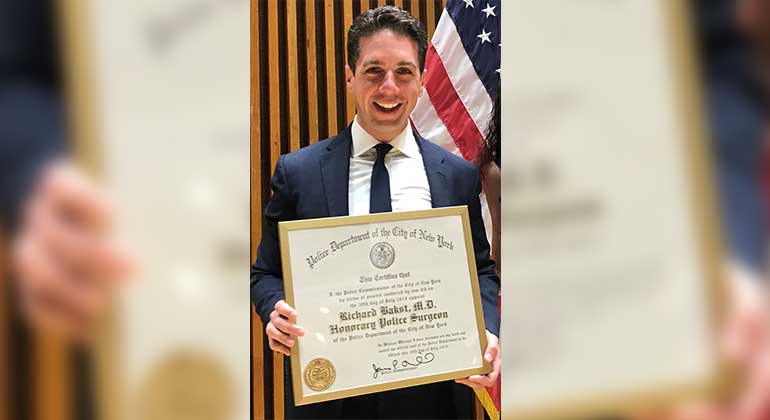
Richard Bakst, MD, Associate Professor of Radiation Oncology at the Icahn School of Medicine at Mount Sinai, was appointed as a member of the Society of Honorary Police Surgeons of the City of New York (NYPD) by Police Commissioner James P. O’Neill.
Members of the Society of Honorary Police Surgeons are physicians who exhibit outstanding service and expertise in a specific medical specialty. The selection process for new members of the Society is extremely rigorous, and nominees go through an extensive review process. When service members or their immediate family members are injured, the NYPD calls upon the closest and most appropriate Honorary Surgeon to tend to the patient upon his or her arrival at a medical facility.
“As a native New Yorker, it is an honor and privilege to be inducted into the Society and be part of one of the best police departments in the country” said Dr. Bakst, a board certified radiation oncologist whose clinical practice is focused on the personalized treatment of patients with head and neck cancer, breast cancer, and lymphoma.
Dr. Bakst works closely with his colleagues in surgery, pathology, radiology, and medical oncology to develop a treatment plan that minimizes both the risk of cancer recurrence and the risk of treatment-associated toxicity. His goal is to implement radiation therapy only when needed, and to use advances in technology to target radiation to areas at risk while minimizing radiation exposure to nearby normal tissues. His research interests include investigating mechanisms by which cancer invades and spreads along nerves, salivary gland cancers, optimizing the technical delivery of radiation for breast cancer patients to minimize toxicity, and investigating the optimal utilization of radiation for hematological malignancies.
Dr. Bakst attended New York University, where he earned his undergraduate and medical degree. He then completed his residency at Memorial Sloan Kettering Cancer Center, where he served as chief resident. He has published numerous peer-reviewed papers on a broad range of oncological topics and serves as a reviewer for a number of cancer journals.
About the Mount Sinai Health System
Mount Sinai Health System is one of the nation’s leading integrated academic health systems and one of the largest in the New York metropolitan area. Its comprehensive system includes seven hospitals, more than 400 outpatient practices, over 600 research and clinical laboratories, the Icahn School of Medicine at Mount Sinai, the Graduate School of Biomedical Sciences, and the Mount Sinai Phillips School of Nursing. Together, the Health System comprises approximately 48,000 employees, more than 9,000 physicians, and 8,600 nurses.
As a leading learning health system, Mount Sinai combines clinical expertise with scientific discovery to improve patient care while training the next generation of health care and biomedical leaders. The Health System provides care across every stage of life, from prenatal care through geriatrics, while advancing personalized medicine through artificial intelligence, data science, and biomedical research.
Mount Sinai is consistently recognized among the nation’s leading academic health systems for patient care, research, and education. The Mount Sinai Hospital is ranked No. 1 in New York by Newsweek and No. 5 on the magazine’s World’s Best Hospitals list. The Icahn School of Medicine at Mount Sinai ranks No. 11 among U.S. medical schools and No. 1 among freestanding medical schools for National Institutes of Health funding, reflecting the strength of its scientific enterprise and leadership in biomedical research.