
Mount Sinai Team Diagnoses Asthma With Nasal Brush Test
RNA sequencing and machine learning applied to develop new asthma biomarker
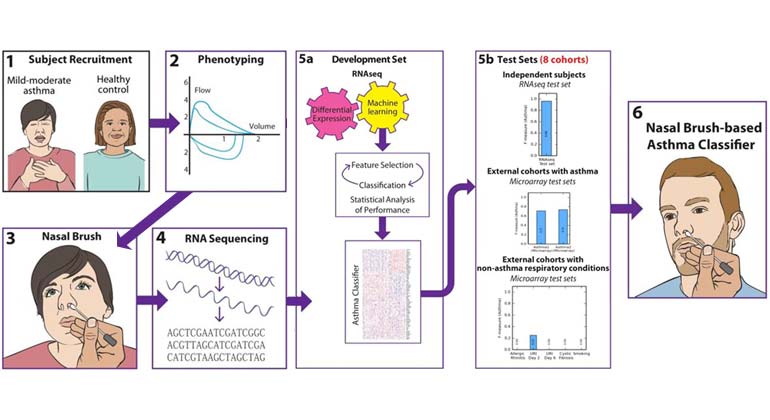
Study flow for the identification of a nasal brush-based classifier of asthma by machine learning analysis of RNAseq data.
Credit: By Jill Gregory, Mount Sinai Health System, licensed under CC-BY-ND
Mount Sinai researchers have identified a genetic biomarker of asthma that can be tested for using a simple nasal brush and basic follow-up data analysis. This inexpensive diagnostic test can accurately identify mild to moderate asthma and differentiate it from other respiratory conditions such as allergic rhinitis, smoking, upper respiratory infection, and cystic fibrosis. The research team, led by a collaboration of clinical and computational scientists in the Department of Genetics and Genomic Sciences, the Icahn Institute for Genomics and Multiscale Biology, and the Department of Pediatrics at the Icahn School of Medicine at Mount Sinai, published their results in June 2018 in Scientific Reports.
“Mild to moderate asthma can be difficult to diagnose because symptoms change over time and can be complicated by other respiratory conditions,” said Supinda Bunyavanich, MD, physician and researcher at the Icahn School of Medicine. “Our nasal brush test takes seconds to collect. For time-strapped clinicians, particularly primary care providers at the front lines of asthma diagnosis, this could greatly improve patient outcomes through early and accurate diagnosis.”
Currently, pulmonary function testing (PFT) is the most reliable diagnostic tool for asthma. However, the equipment and expertise needed to perform these tests are not always available in primary care settings where asthma is frequently diagnosed and treated. It is also difficult to differentiate between asthma and other respiratory diseases using PFT alone, while the nasal brush and subsequent analysis for this asthma biomarker provides a binary result of asthma or not asthma.
Data scientists leading the study applied machine learning algorithms to the genetic (RNA) data acquired from nasal brushes of patients with and without asthma. This robust data collection, and machine learning analysis, identified a 90-gene biomarker indicative of asthma status. “One of the most exciting components of this study is demonstrating the power of machine learning when applied to biomedical data,” said Gaurav Pandey, PhD, who led data science efforts to develop the biomarker. “Collaborations between computational scientists and biomedical researchers and clinicians are advancing medicine at an inspiring pace. We have the power of many insights we didn’t have in the past, and that opens a window to an entirely new world of diagnostic tools and treatments”
Similar genetic biomarker tests are currently being used in other disease areas, including MammaPrint and Oncotype DX®, both used for certain types of breast cancer prognosis. In fact, the Oncotype DX tool was used in the largest clinical trial of personalized breast cancer prognosis ever conducted, demonstrating that mammography testing is unnecessary to diagnose breast cancer in a large fraction of breast cancer patients. The positive clinical impact that biomarker tests such as this have shown indicates great potential for further diagnostic tools based on biomarkers.
Dr. Bunyavanich says the next step to bringing this test into clinical practice is a study in a larger population of patients. “With prospective validation in large cohorts, our asthma biomarker could lead to the development of a minimally invasive test to aid asthma diagnosis at clinical frontlines where time and resources often preclude pulmonary function testing.”
Asthma affects 10 percent of children and adults in the United States. When undiagnosed, it can lead to restricted activity, emergency room visits, and hospitalizations. “We’re hopeful that further studies can help bring this test into primary care settings, transforming the ease and accuracy of diagnosing asthma and our ability as doctors to appropriately treat our patients,” said Dr. Bunyavanich.
About the Icahn School of Medicine at Mount Sinai
The Icahn School of Medicine at Mount Sinai is an international leader in medical and scientific training, biomedical research, and patient care. It is the medical school for the Mount Sinai Health System, which includes seven hospital campuses, and has more than 5,000 faculty and nearly 2,000 students, residents and fellows. The School is made up of 36 multidisciplinary research, educational, and clinical institutes and 33 academic departments. It ranks 13th among U.S. medical schools for NIH funding and 2nd in research dollars per principal investigator among U.S. medical schools by the Association of American Medical Colleges (AAMC). The School was named 4th among "World's Most Innovative Companies in Data Science" by Fast Company magazine in 2016. For more information, visit http://icahn.mssm.edu
About the Mount Sinai Health System
Mount Sinai Health System is one of the nation’s leading integrated academic health systems and one of the largest in the New York metropolitan area. Its comprehensive system includes seven hospitals, more than 400 outpatient practices, over 600 research and clinical laboratories, the Icahn School of Medicine at Mount Sinai, the Graduate School of Biomedical Sciences, and the Mount Sinai Phillips School of Nursing. Together, the Health System comprises approximately 48,000 employees, more than 9,000 physicians, and 8,600 nurses.
As a leading learning health system, Mount Sinai combines clinical expertise with scientific discovery to improve patient care while training the next generation of health care and biomedical leaders. The Health System provides care across every stage of life, from prenatal care through geriatrics, while advancing personalized medicine through artificial intelligence, data science, and biomedical research.
Mount Sinai is consistently recognized among the nation’s leading academic health systems for patient care, research, and education. The Mount Sinai Hospital is ranked No. 1 in New York by Newsweek® and No. 7 in the U.S. on the magazine’s World’s Best Hospitals 2026 list. The Icahn School of Medicine at Mount Sinai ranks No. 9 among U.S. medical schools and No. 1 among freestanding medical schools for National Institutes of Health grant funding, reflecting the strength of its scientific enterprise and leadership in biomedical research.