Irradiation May Help CAR-T Cell Therapy Work Better Against Solid Tumors, Mount Sinai Researchers Find
New study in Nature Cancer shows focused irradiation helps immune cells keep cancer-fighting CAR T cells active and contained inside tumors
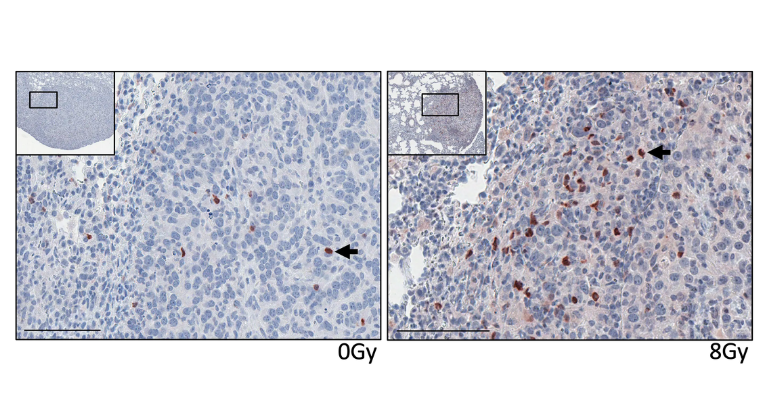
CAR-T cells (brown, arrowheads) infiltrating solid tumors. Left: unirradiated (0 Gy). Right: after focal irradiation (8 Gy).
Researchers from the Icahn School of Medicine at Mount Sinai have discovered a promising new way to improve CAR-T cell therapy for solid tumors such as lung cancer and melanoma. The study, published in Nature Cancer (https://www.nature.com/articles/s43018-026-01167-6), found that focused irradiation, a targeted therapy that delivers high-energy beams to stun rapidly growing cells such as cancer, can help CAR-T cells survive longer and work more effectively inside tumors.
CAR-T cell therapy involves removing the patient’s T cells (a type of immune cell), reprogramming them in the lab to fight cancer, and then infusing them back into the patient. It has transformed treatment for some blood cancers, but has not worked as well for solid tumors such as lung cancer and melanoma. Patients with solid tumors typically have bulky, treatment-resistant disease, and one of the central reasons CAR-T cells fail in this setting is that they do not persist or expand at the tumor long enough to eliminate it. Even when CAR-T cells initially reach the tumor, their numbers dwindle before they can finish the job.
The research team discovered that tumor irradiation does something unexpected: it turns dendritic cells, the immune system's most powerful antigen-presenting cells, into a local source of stimulation for CAR-T cells inside the tumor.
In mouse models of advanced lung cancer and melanoma, irradiation promoted dendritic cells to capture intact tumor surface proteins and display them on their own membranes, a process called "antigen dressing." These antigen-dressed dendritic cells then engaged the chimeric receptor on the CAR-T cells—the laboratory-engineered protein that gives these cells the ability to target specific proteins—keeping them alive and multiplying within the tumor over several weeks.
The result was durable control of advanced lung tumors that CAR-T cells alone could not eliminate.
“This study shows that irradiation can do more than kill cancer cells; it can enhance cell therapy," said corresponding author Jalal Ahmed, MD, PhD, who led the study and is Assistant Professor of Immunology and Immunotherapy, and Radiation Oncology, at the Icahn School of Medicine at Mount Sinai. "We found that dendritic cells can dress themselves in tumor proteins and use them to directly expand CAR-T cells through the engineered receptor. This was completely unexpected—dendritic cells normally engage T cells through an entirely different mechanism.”
A second finding addresses one of the most pressing safety challenges in the field. The researchers found that the CAR-T cell response stayed largely confined to the irradiated tumor. CAR-T cells expanded within the tumor but did not become more active in nearby healthy tissues, even when those tissues expressed the same protein targeted by the CAR-T cells. On-target activity against healthy organs has been one of the most serious safety barriers in solid tumor CAR-T cell therapy and has led to the termination of clinical trials. By selectively concentrating CAR-T cell activity at the tumor, focused irradiation may allow treatment of advanced tumors at lower and safer CAR-T cell doses.
“What is striking is that irradiation does not just amplify the immune response—it tells the immune system where to act," said study co-author Miriam Merad, MD, PhD, Robin Chemers Neustein Professor of Immunology and Chair of Immunology and Immunotherapy at the Icahn School of Medicine at Mount Sinai. "Confining CAR-T cell expansion to the tumor could open up a new generation of safer cell therapies for solid cancers.”
This approach is particularly relevant for patients with metastatic solid tumors, who currently have few options. The irradiation treatment used in the study is available in cancer care centers around the world. This means the strategy could be tested in clinical trials without requiring new equipment, new drugs, or new infrastructure.
“This work suggests that preparing the tumor environment is important to optimize the efficacy of CAR-T cells,” said study co-author Michel Sadelain, MD, PhD, who was previously at Memorial Sloan Kettering Cancer Center and is currently the founding director of Columbia University’s Institute for Cell Engineering and Therapy. “Irradiation may provide a practical way to help CAR-T cells succeed in solid tumors.”
The researchers caution that the findings are still preclinical and must be tested in human clinical trials. The team is now working to define the molecular mechanism of antigen dressing, identify the signals dendritic cells use to sustain CAR-T cells, and translate the approach into trials for patients with advanced solid tumors.
In addition to Mount Sinai and Columbia University, collaborators included researchers from Memorial Sloan Kettering Cancer Center and University of California San Francisco.
The study was funded by the NIH Director’s Early Independence Award, the American Society of Clinical Oncology Young Investigator Award, and the Lung Cancer Research Foundation Scientific Award.
About the Icahn School of Medicine at Mount Sinai
The Icahn School of Medicine at Mount Sinai is internationally renowned for its outstanding research, educational, and clinical care programs. It is the sole academic partner for the seven member hospitals* of the Mount Sinai Health System, one of the largest academic health systems in the United States, providing care to New York City’s large and diverse patient population.
The Icahn School of Medicine at Mount Sinai offers highly competitive MD, PhD, MD-PhD, and master’s degree programs, with enrollment of more than 1,200 students. It has the largest graduate medical education program in the country, with more than 2,700 clinical residents and fellows training throughout the Health System. The Graduate School of Biomedical Sciences offers 13 degree-granting programs, conducts innovative basic and translational research, and trains more than 470 postdoctoral research fellows.
Ranked 11th nationwide in National Institutes of Health (NIH) funding, the Icahn School of Medicine at Mount Sinai is among the 90th percentile of U.S. private medical schools in Sponsored Programs Direct Expenditures per Principal Investigator, according to the Association of American Medical Colleges. More than 6,900 scientists, educators, and clinicians work within and across dozens of academic departments and multidisciplinary institutes with an emphasis on translational research and therapeutics. Through Mount Sinai Innovation Partners (MSIP), the Health System facilitates the real-world application and commercialization of medical breakthroughs made at Mount Sinai.
-------------------------------------------------------
* Mount Sinai Health System member hospitals: The Mount Sinai Hospital; Mount Sinai Brooklyn; Mount Sinai Morningside; Mount Sinai Queens; Mount Sinai South Nassau; Mount Sinai West; and New York Eye and Ear Infirmary of Mount Sinai.
About the Mount Sinai Health System
Mount Sinai Health System is one of the nation’s leading integrated academic health systems and one of the largest in the New York metropolitan area. Its comprehensive system includes seven hospitals, more than 400 outpatient practices, over 600 research and clinical laboratories, the Icahn School of Medicine at Mount Sinai, the Graduate School of Biomedical Sciences, and the Mount Sinai Phillips School of Nursing. Together, the Health System comprises approximately 48,000 employees, more than 9,000 physicians, and 8,600 nurses.
As a leading learning health system, Mount Sinai combines clinical expertise with scientific discovery to improve patient care while training the next generation of health care and biomedical leaders. The Health System provides care across every stage of life, from prenatal care through geriatrics, while advancing personalized medicine through artificial intelligence, data science, and biomedical research.
Mount Sinai is consistently recognized among the nation’s leading academic health systems for patient care, research, and education. The Mount Sinai Hospital is ranked No. 1 in New York by Newsweek and No. 5 on the magazine’s World’s Best Hospitals list. The Icahn School of Medicine at Mount Sinai ranks No. 11 among U.S. medical schools and No. 1 among freestanding medical schools for National Institutes of Health funding, reflecting the strength of its scientific enterprise and leadership in biomedical research.

Researchers Identify Immune Cell That Builds Cancer-Fighting Hubs Inside Tumors
Jul 16, 2026 View All Press Releases
Lung Cancer Rewires Immune Cells in the Bone Marrow to Weaken Body’s Defenses
Sep 10, 2025 View All Press Releases
Nano Drug Accelerates Diabetic Wound Healing in Mice
May 20, 2024 View All Press Releases
A Type of Allergy Medicine Might Help Treat Lung Cancer, Research Suggests
Dec 06, 2023 View All Press Releases