
Icahn School of Medicine at Mount Sinai Secures $5 Million NIH Grant for Cutting-Edge Cancer Target Discovery and Development Center
Initiative aimed at identifying novel therapeutic targets for cancer treatment
The Department of Immunology and Immunotherapy and the Icahn Genomics Institute (IGI) at the Icahn School of Medicine at Mount Sinai have been awarded a $5 million grant from the National Cancer Institute (NCI) of the National Institutes of Health to establish a state-of-the-art center dedicated to the discovery and development of cutting-edge targets for cancer therapy.
The new Cancer Target Discovery and Development Center aims to find better ways to fight cancer and advance the field, bringing hope to patients and their families. Leveraging the expertise of the newly created Department of Immunology and Immunotherapy, the Center will harness cutting-edge technologies and interdisciplinary collaborations to accelerate the translation of scientific discoveries into potential clinical therapies.
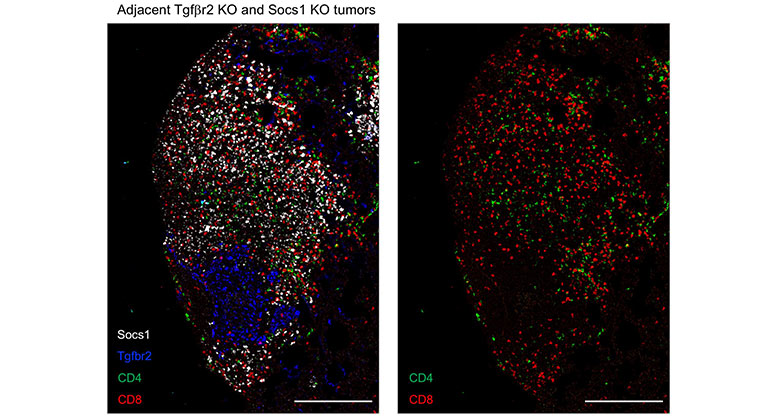
One such tool, Perturb-map used above, created in the lab of Brian Brown, PhD, enables scientists to see how cancer genes affect not only cancer cells but also how they impact the immune system within tumors. In this case, tumors without the Tgfbr2 gene repel immune cells, while those lacking the Socs1 gene attract cancer-fighting T cells. Credit: Lab of Brian Brown, PhD
Key objectives of the Center include:
- Identifying and validating novel cancer targets
- Developing innovative therapeutic approaches, including immunotherapies
- Advancing the understanding of cancer biology through comprehensive genomic analysis
- Collaborating with industry partners to accelerate the translation of discoveries into clinical trials
The project will be led by Principal Investigators Brian Brown, PhD, Director, IGI, and Associate Director, Marc and Jennifer Lipschultz Precision Immunology Institute (PrIISM); Miriam Merad, MD, PhD, Director, PrIISM, and Chair, Department of Immunology and Immunotherapy; and Robert Samstein, MD, PhD, Assistant Professor of Radiation Oncology, all at Icahn Mount Sinai.
“Cancer target discovery research has traditionally concentrated on pinpointing genes that facilitate cancer cell growth and survival. In contrast, our Center will emphasize understanding how cancer cells control the tumor environment to shield themselves from the immune system and develop resistance to immunotherapy medications,” says Dr. Brown. “A distinctive aspect of our work will be identifying the genes that enable cancer to establish an immune-suppressed tumor, hindering the effectiveness of immunotherapy for many patients.”
To uncover how these genes actively influence the microenvironment within real tumors and to pinpoint the specific cellular process changes that key genes use to control tumor growth, metastasis, and immune evasion, the team will evaluate candidate genes in preclinical models in different aggressive cancers, including ovarian and pancreatic cancer.
This analysis will be performed using a pioneering spatial functional genomics platform called Perturb-Map, developed at Icahn Mount Sinai by the Brown lab. The tool enables scientists to knock out dozens of genes simultaneously and study their function at a high resolution. It allows them to see how cancer genes affect not only cancer cells but also the immune system within tumors. This helps them design better treatments, find markers for patient response, and improve therapy combinations.
"This grant represents a notable achievement in our ongoing mission to combat cancer through immunotherapy and targeted therapies. Our Center will empower us to explore new avenues for treating cancer, with the ultimate goal of enhancing patient outcomes and advancing our understanding of this complex disease," says Dr. Merad. "In the long run, our understanding of cancer gene function will pave the way for highly personalized treatments, novel drug development, and innovative immunotherapy strategies targeting these genes and the key processes they influence."
Co-investigators include Luc G.T. Morris, MD, MSc, FACS, Associate Director, Immunogenomics and Precision Oncology Platform, at Memorial Sloan Kettering Cancer Center. Also from Icahn Mount Sinai are Alex Tsankov, PhD, Assistant Professor of Genetics and Genomic Sciences; Diego Chowell, PhD, Assistant Professor of Oncological Sciences; and Thomas J. Fuchs, Dr.sc., Dean for Artificial Intelligence and Human Health.
The Center will be part of the NCI’s Cancer Target Discovery and Development (CTD2) Network, a functional genomics initiative that bridges the gap between genomics and the development of effective therapeutics. The Network aims to understand tumor development, heterogeneity, drug resistance, and metastasis to develop optimal chemotherapy combinations with immunotherapy. Other CTD2 centers are at Harvard, Columbia, Stanford, the University of California San Francisco, and other sites.
The title of the NCI grant is “Spatial functional genomics to identify regulators of the tumor microenvironment and cancer immunity (grant number 1U01CA282114-01).
The Mount Sinai Department of Immunology and Immunotherapy is a leading research and clinical entity within the Mount Sinai Health System, dedicated to advancing the field of immunology and immunotherapy for the treatment of cancer and other diseases. With a focus on innovation, collaboration, and patient care, the department is at the forefront of cutting-edge research and therapeutic development.
About the Mount Sinai Health System
Mount Sinai Health System is one of the nation’s leading integrated academic health systems and one of the largest in the New York metropolitan area. Its comprehensive system includes seven hospitals, more than 400 outpatient practices, over 600 research and clinical laboratories, the Icahn School of Medicine at Mount Sinai, the Graduate School of Biomedical Sciences, and the Mount Sinai Phillips School of Nursing. Together, the Health System comprises approximately 48,000 employees, more than 9,000 physicians, and 8,600 nurses.
As a leading learning health system, Mount Sinai combines clinical expertise with scientific discovery to improve patient care while training the next generation of health care and biomedical leaders. The Health System provides care across every stage of life, from prenatal care through geriatrics, while advancing personalized medicine through artificial intelligence, data science, and biomedical research.
Mount Sinai is consistently recognized among the nation’s leading academic health systems for patient care, research, and education. The Mount Sinai Hospital is ranked No. 1 in New York by Newsweek and No. 5 on the magazine’s World’s Best Hospitals list. The Icahn School of Medicine at Mount Sinai ranks No. 11 among U.S. medical schools and No. 1 among freestanding medical schools for National Institutes of Health funding, reflecting the strength of its scientific enterprise and leadership in biomedical research.