
Researchers Construct First “Multiome”Atlas of Cell Development in the Human Cerebral Cortex From Before Birth to Adulthood
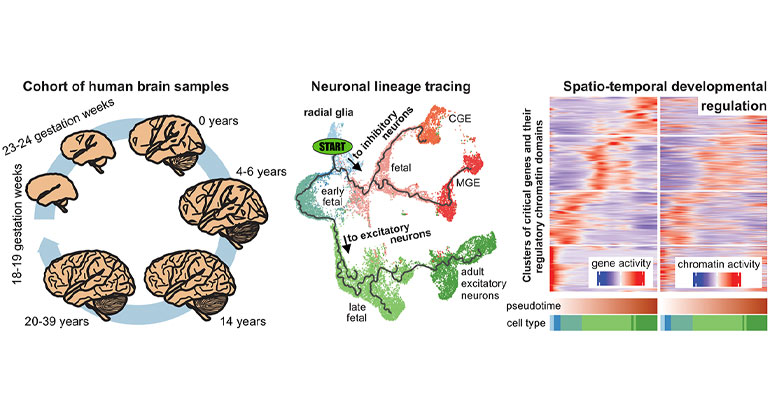
Study summary graphic
A team of researchers from the Icahn School of Medicine at Mount Sinai and Yale University School of Medicine has created the first “multiome” atlas of brain cell development in the human cerebral cortex across six broad developmental time points from fetal development into adulthood, shedding new light on their roles during brain development and disease.
“Multiome” refers to the simultaneous analysis of multiple types of genetic information within the same biological sample. They can include the genome, the DNA encoded in our cells; the transcriptome, the RNA copies that the cell makes from the genome; and the epigenome, chemical modifications and regulatory factors that determine the accessibility of chromatin.
As described in Science Advances, the researchers used new scientific tools to analyze and describe two kinds of information from each cell—gene expression (transcriptome) as well as DNA structure (epigenome)—enabling them to categorize cell types at different developmental stages. The data revealed specific changes in the structure of chromatin that precede gene expression. These changes are crucial for numerous processes, including the formation of neurons.
Additionally, their analysis pinpointed regions of chromatin associated with the regulation of genes known to play a pivotal role in human brain development. Notably, they revealed that these regulatory regions are often enriched for genetic signals associated with increased risk for neuropsychiatric disorders such as schizophrenia or bipolar disorder.
“Human brain development starts during embryogenesis and extends postnatally through infancy, childhood, adolescence, and young adulthood,” says Panos Roussos, MD, PhD, Professor of Psychiatry, and Genetics and Genomic Sciences, Director of the Center for Disease Neurogenomics at Icahn Mount Sinai, and senior author of the paper. “Given the variable age of onset of different neurodevelopmental disorders, it is critical to examine the effect of risk factors across the full spectrum of brain development. Through the development of this atlas, we have gained a deeper understanding of the intricate regulatory mechanisms underlying brain development and disease.”
This work was supported by the National Institutes of Health’s Brain Research Through Advancing Innovative Neurotechnologies® Initiative (The BRAIN Initiative®). The comprehensive atlas is now accessible to other researchers through an online repository so others can engage with the data, visualize it effectively, and use it for their own research. The paper is included in a package of 21 research studies across Science, Science Advances and Science Translational Medicine that detail research conducted as part of the National Institutes of Health’s BRAIN Initiative Cell Census Network (BICCN), a program launched in 2017 to create an atlas of the human and non-human primate brain at the cell-type level in unprecedented detail.
The basis for neuropsychiatric disease in adulthood can often be influenced by alterations in the cellular composition of the brain that arise during development. In addition to creating the first atlas of human brain cell development in the human cerebral cortex, the research team prioritized 152 risk genes that play a causal role in a range of neuropsychiatric disorders. Their findings go beyond existing knowledge by mapping cell type and temporally specific genetic loci implicated in neuropsychiatric disorders. For example, they discovered that Tourette syndrome is associated with oligodendrocytes, while obsessive-compulsive disorder is associated with astrocytes. Both of these associations between diseases and cell types were previously unknown, and the discoveries contribute to a deeper understanding of the complex relationships between different cell types and neuropsychiatric disorders.
“It is important to recognize that the most effective therapeutic interventions should be customized to target deficiencies in gene function as specific developmental stages,” says Jaroslav Bendl, PhD, Assistant Professor of Psychiatry, and Genetics and Genomic Sciences, at Icahn Mount Sinai and a co-author of the work. “Only by doing so will we be able to minimize further damage and improve outcomes for individuals affected by these disorders.”
Having demonstrated that an atlas of cellular development in the human cerebral cortex was possible, the team is currently expanding their study by analyzing a larger sample cohort and including different brain regions. By so doing, they aim to achieve increased resolution and gain deeper understanding of the intricate regulatory mechanisms and further unravel the complex regulatory logic underling brain development and disease.
Research reported in this press release was supported by the NIH BRAIN Initiative under award number: RF1MH128970. This publication was supported by and coordinated through the BICCN (biccn.org). This publication is part of the Human Cell Atlas (www.humancellatlas.org/publications/).
About the Mount Sinai Health System
Mount Sinai Health System is one of the nation’s leading integrated academic health systems and one of the largest in the New York metropolitan area. Its comprehensive system includes seven hospitals, more than 400 outpatient practices, over 600 research and clinical laboratories, the Icahn School of Medicine at Mount Sinai, the Graduate School of Biomedical Sciences, and the Mount Sinai Phillips School of Nursing. Together, the Health System comprises approximately 48,000 employees, more than 9,000 physicians, and 8,600 nurses.
As a leading learning health system, Mount Sinai combines clinical expertise with scientific discovery to improve patient care while training the next generation of health care and biomedical leaders. The Health System provides care across every stage of life, from prenatal care through geriatrics, while advancing personalized medicine through artificial intelligence, data science, and biomedical research.
Mount Sinai is consistently recognized among the nation’s leading academic health systems for patient care, research, and education. The Mount Sinai Hospital is ranked No. 1 in New York by Newsweek and No. 5 on the magazine’s World’s Best Hospitals list. The Icahn School of Medicine at Mount Sinai ranks No. 11 among U.S. medical schools and No. 1 among freestanding medical schools for National Institutes of Health funding, reflecting the strength of its scientific enterprise and leadership in biomedical research.