
Mount Sinai Health System and Guyana Ministry of Health Host Seminar on Practical, Responsible Integration of Artificial Intelligence in Health Care
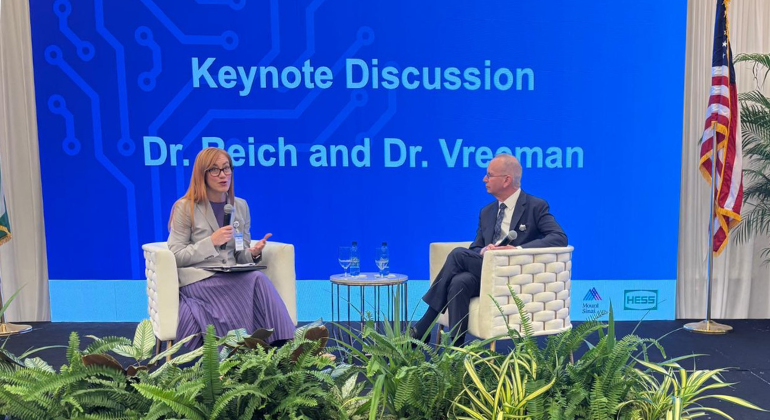
Mount Sinai’s Executive Director of the Guyana National Healthcare Initiative Rachel Vreeman, MD, MS, and Chief Clinical Officer of the Mount Sinai Health System and President of The Mount Sinai Hospital David L. Reich, MD, discuss AI in health care following his keynote address.
The Mount Sinai Health System and the Guyana Ministry of Health yesterday convened government, clinical, operational, and artificial intelligence (AI) leaders for a seminar, “Turning Promise Into Practice: Integrating AI Into Health Care—Foundations, Ethics, and Decision-Making,” in Georgetown, Guyana.
The seminar featured keynote speaker David L. Reich, MD, Chief Clinical Officer of the Mount Sinai Health System and President of The Mount Sinai Hospital, along with experts from the Windreich Department of Artificial Intelligence and Human Health at the Icahn School of Medicine at Mount Sinai.
The Mount Sinai Hospital, ranked No. 5 in the world and No. 1 in New York City among “World’s Best Smart Hospitals 2026” by Newsweek/Statista, is internationally recognized for successfully leveraging digital health to accelerate cures for diseases, improve patient care, and streamline operational processes.
The event explored how AI is rapidly becoming a priority for health care systems in Guyana and across the Caribbean, and how leaders can responsibly harness its potential. Through a series of expert-led sessions, the seminar demystified AI by focusing on practical foundations, ethical considerations, and real-world decision-making frameworks to support safe and effective adoption.
“It is an exciting time for health care in Guyana. We cannot build a world-class health care system if we don’t embrace AI,” said His Excellency Dr. Irfaan Ali, President of the Co-Operative Republic of Guyana. “Guyana is building a world-class health system. We are refashioning the old system. That is why we are building more hospitals. That is why we are supporting the development of specialist treatment and specialty hospitals. Qualitatively, we are also building a health care ecosystem that can detect risk early, respond intelligently, and deliver care equitably.”
 His Excellency Dr. Irfaan Ali, President of the Co-Operative Republic of Guyana, gives a presidential address at a seminar titled “Turning Promise Into Practice: Integrating AI Into Health Care—Foundations, Ethics, and Decision-Making,” in Georgetown, Guyana.
“We are not witnessing incremental changes. We are witnessing a transformation of the health architecture,” said Hon. Dr. Frank Anthony, Minister of Health, Guyana. “AI means early detection, it means fewer diagnoses, and it means better outcomes. More importantly, it means we are able to bring expertise to scale.”
Participants heard from a multidisciplinary group of speakers including Rachel Vreeman, MD, MS, Executive Director of Mount Sinai’s Guyana Healthcare Initiative and Director of the Arnhold Institute for Global Health at Mount Sinai; Joann Bond, Deputy Chief Parliamentary Counsel of Guyana; Ali Soroush, MD, MS, Assistant Professor of Artificial Intelligence and Human Health, and Medicine (Data Driven and Digital Medicine, and Gastroenterology) at the Icahn School of Medicine at Mount Sinai; Prem Timsina, ScD, Senior Director of Data Science and Engineering, and Associate Professor of Artificial Intelligence and Human Health, at the Icahn School of Medicine; and Jeb Weisman, PhD, Director of Global Health Informatics at the Arnhold Institute for Global Health at Mount Sinai.
Sessions covered core topics including AI fundamentals for clinicians and physicians; ethical and regulatory considerations, including Guyana’s groundbreaking Data Protection Act; practical applications of AI tools in clinical settings; and leadership approaches to evaluating and adopting emerging technologies. Dr. Reich also discussed integrating AI into clinical systems during the keynote address.
“Artificial intelligence offers tremendous potential to strengthen health systems, but its impact depends on thoughtful, responsible implementation,” said Dr. Reich. “We are honored to join our colleagues in Guyana to share practical insights and support leaders across the Caribbean as they assess how AI can enhance patient care, safety, and outcomes.”
“Guyana is taking important steps to modernize its health system, and AI is a critical part of that journey,” said Dr. Vreeman. “Through this seminar, we aim to provide leaders across the Caribbean and beyond with the knowledge and tools to make informed, ethical decisions about how AI can best serve patients and communities.”
This seminar is part of Mount Sinai’s broader work in Guyana through the Government of Guyana’s National Healthcare Initiative. The Government of Guyana, Mount Sinai, and Hess Corporation are collaborating to transform Guyana’s public health system by 2030, with world-class health services accessible to all citizens. Key areas of focus include community-centered care, digital health, national hospital quality improvement, cancer care, capacity-building and workforce development, and women’s and children’s health. By bringing together leaders from across sectors, the seminar reflects a shared commitment to advancing innovation while ensuring that technologies are implemented in ways that are safe, equitable, and responsive to the needs of patients and health systems.
About the Mount Sinai Health System
Mount Sinai Health System is one of the nation’s leading integrated academic health systems and one of the largest in the New York metropolitan area. Its comprehensive system includes seven hospitals, more than 400 outpatient practices, over 600 research and clinical laboratories, the Icahn School of Medicine at Mount Sinai, the Graduate School of Biomedical Sciences, and the Mount Sinai Phillips School of Nursing. Together, the Health System comprises approximately 48,000 employees, more than 9,000 physicians, and 8,600 nurses.
As a leading learning health system, Mount Sinai combines clinical expertise with scientific discovery to improve patient care while training the next generation of health care and biomedical leaders. The Health System provides care across every stage of life, from prenatal care through geriatrics, while advancing personalized medicine through artificial intelligence, data science, and biomedical research.
Mount Sinai is consistently recognized among the nation’s leading academic health systems for patient care, research, and education. The Mount Sinai Hospital is ranked No. 1 in New York by Newsweek and No. 5 on the magazine’s World’s Best Hospitals list. The Icahn School of Medicine at Mount Sinai ranks No. 11 among U.S. medical schools and No. 1 among freestanding medical schools for National Institutes of Health funding, reflecting the strength of its scientific enterprise and leadership in biomedical research.