
Mount Sinai Researchers Develop Safe and Effective Gene Therapy to Treat Severe Heart Failure
New gene therapy developed at Mount Sinai, shows clinical benefit in treating people with advanced heart failure in a Phase II clinical trial.
Researchers at Mount Sinai School of Medicine have found in a Phase II trial that a gene therapy developed at Mount Sinai stabilized or improved cardiac function in people with severe heart failure. Patients receiving a high dose of the therapy, called SERCA2a, experienced substantial clinical benefit and significantly reduced cardiovascular hospitalizations, addressing a critical unmet need in this population. The data are published online in the June 27 issue of the American Heart Association journal Circulation.
SERCA2a is delivered via an adeno-associated virus vector—an inactive virus that acts as a medication transporter—into cardiac cells. The therapy stimulates production of an enzyme within these cells that enables the heart to pump more effectively in people with advanced heart failure. After one year, patients who were administered a high dose SERCA2a demonstrated improvement or stabilization. Gene therapy with SERCA2a was also found to be safe in this sick patient population, with no increases in adverse events, disease-related events, laboratory abnormalities, or arrhythmias compared to placebo.
"Few treatment options have shown such improved clinical outcomes in this patient population in the last decade," said Roger J. Hajjar, MD, Research Director of Mount Sinai's Wiener Family Cardiovascular Research Laboratories, and the Arthur and Janet C. Ross Professor of Medicine, and Gene and Cell Medicine, Mount Sinai School of Medicine. "This study establishes a new paradigm for the treatment of heart failure by clinically validating SERCA2a as a novel target. In addition, by showing that adeno-associated vectors are safe to use in patients with advanced heart failure, this study ushers a new era for gene therapy for the treatment of failing hearts."
The CUPID (Calcium Up-regulation by Percutaneous administration of gene therapy In cardiac Disease) trial is a randomized, double-blind, placebo-controlled study, which enrolled 39 patients with advanced heart failure to study the safety and efficacy of SERCA2a. Patients were randomized to receive SERCA2a gene delivery in one of three doses or placebo, and were evaluated over one year. The treatment is delivered directly to the patient’s heart during a routine outpatient cardiac catheterization procedure.
Patients in the high-dose SERCA2a group demonstrated improvement and/or stabilization in symptoms, overall heart function, biomarker activity, and ventricular mechanics and function. They also saw a dramatic reduction in cardiovascular hospitalizations, averaging 0.4 days versus 4.5 days in the placebo group.
"Even though heart failure mortality has decreased over the last decade with the help of standard pharmacological and device therapies, patients with advanced heart failure continue to die at high rates. The CUPID trial offers a new therapeutic option for these patients," said Dr. Hajjar.
Led by Dr. Hajjar, the Mount Sinai team discovered the landmark potential of the cardiac-specific target in 1999 and has been pursuing its potential as a treatment delivered via gene therapy in state-of-the-art custom built laboratories at Mount Sinai School of Medicine in New York.
According to the U.S. Centers for Disease Control and Prevention, about 5.8 million Americans suffer from heart failure, and 670,000 new cases are diagnosed each year. One in five people who have heart failure die within one year of diagnosis. In 2010, heart failure will cost the United States $39.2 billion, including the cost of health care services, medications, and lost productivity. Heart failure is most often treated with aggressive medical and device therapy, but has no cure. The most common symptoms of heart failure are shortness of breath, feeling tired, and swelling in the ankles, feet, legs, and sometimes the abdomen.
The CUPID Trial is funded by Celladon Corporation. The company was co-founded by Dr. Hajjar who has an equity interest in Celladon Corporation and participates on an Advisory Board.
About The Mount Sinai Medical Center
The Mount Sinai Medical Center encompasses both The Mount Sinai Hospital and Mount Sinai School of Medicine. Established in 1968, Mount Sinai School of Medicine is one of few medical schools embedded in a hospital in the United States. It has more than 3,400 faculty in 32 departments and 15 institutes, and ranks among the top 20 medical schools both in National Institute of Health funding and by U.S. News & World Report. The school received the 2009 Spencer Foreman Award for Outstanding Community Service from the Association of American Medical Colleges.
The Mount Sinai Hospital, founded in 1852, is a 1,171-bed tertiary- and quaternary-care teaching facility and one of the nation's oldest, largest and most-respected voluntary hospitals. U.S. News & World Report consistently ranks The Mount Sinai Hospital among the nation's best hospitals based on reputation, patient safety, and other patient-care factors. Nearly 60,000 people were treated at Mount Sinai as inpatients last year, and approximately 530,000 outpatient visits took place.
For more information, visit http://www.mountsinai.org/.
Find Mount Sinai on:
Facebook: http://www.facebook.com/mountsinainyc
Twitter @mountsinainyc
YouTube: http://www.youtube.com/mountsinainy
About the Mount Sinai Health System
Mount Sinai Health System is one of the largest academic medical systems in the New York metro area, with more than 47,000 employees working across seven hospitals, more than 400 outpatient practices, more than 600 research and clinical labs, a school of nursing, and leading schools of medicine and graduate education. Mount Sinai advances health for all people, everywhere, by taking on the most complex health care challenges of our time—discovering and applying new scientific learning and knowledge; developing safer, more effective treatments; educating the next generation of medical leaders and innovators; and supporting local communities by delivering high-quality care to all who need it.
Through the integration of its hospitals, labs, and schools, Mount Sinai offers comprehensive health care from conception through geriatrics, leveraging innovative approaches such as artificial intelligence and informatics while keeping patients’ medical and emotional needs at the center of all treatment. The Health System includes more than 6,400 primary and specialty care physicians and 10 free-standing joint-venture centers throughout the five boroughs of New York City, Westchester, Long Island, and Florida. Hospitals within the System are consistently ranked by Newsweek’s® “The World’s Best Smart Hospitals,” “Best in State Hospitals,” “World’s Best Hospitals,” and “Best Specialty Hospitals” and by U.S. News & World Report's® “Best Hospitals” and “Best Children’s Hospitals.” The Mount Sinai Hospital is on the U.S. News & World Report® “Best Hospitals” Honor Roll for 2025-2026.
For more information, visit https://www.mountsinai.org or find Mount Sinai on Facebook, Instagram, LinkedIn, X, and YouTube.




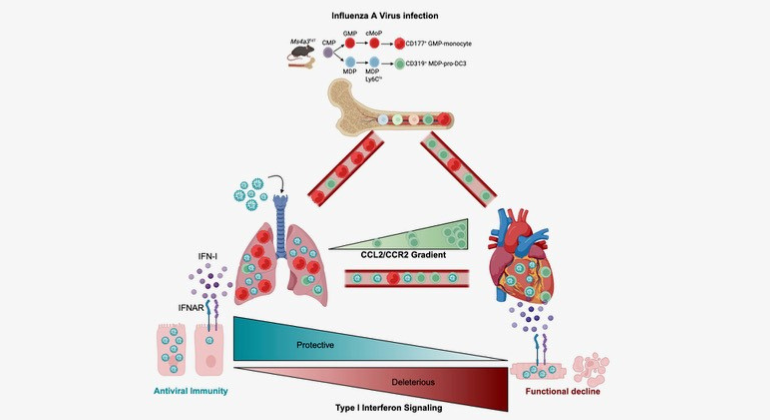
Mount Sinai Scientists Uncover Link Between Influenza and Heart Disease
Feb 09, 2026 View All Press Releases

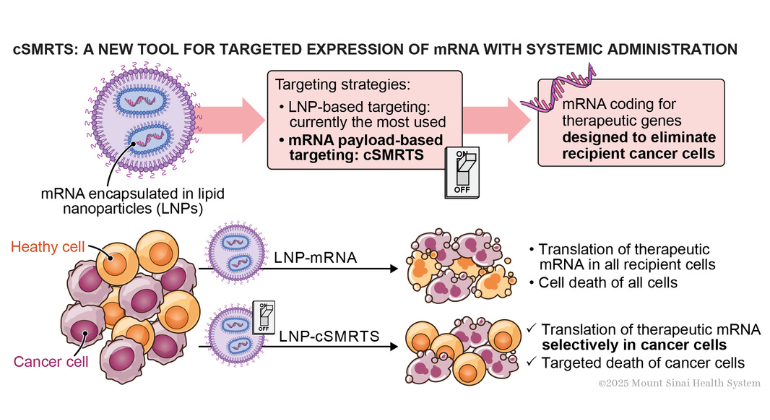
Scientists Develop a Smarter mRNA Therapy That Knows Which Cells to Target
Dec 15, 2025 View All Press Releases
A Specific Human Gene Can Help the Heart Repair Itself From Heart Attack or Heart Failure
Nov 03, 2025 View All Press Releases