
Scientists Develop a Smarter mRNA Therapy That Knows Which Cells to Target
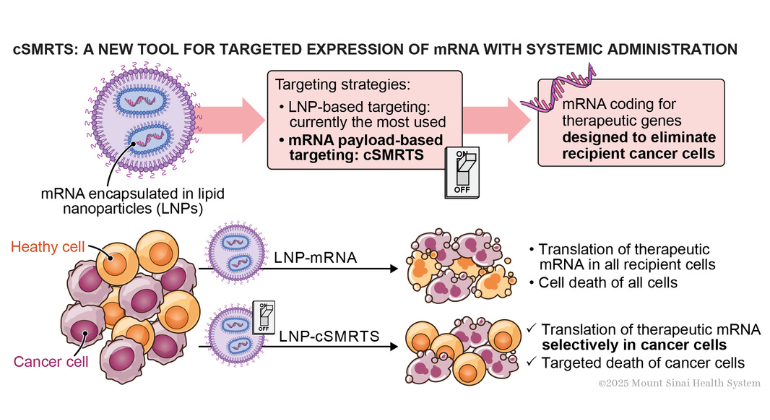
Researchers at the Icahn School of Medicine at Mount Sinai built an mRNA system that switches on therapeutic genes preferentially in targeted cells for greater precision and safety. Credit: Mount Sinai Health System
Researchers at the Icahn School of Medicine at Mount Sinai have developed a first-of-its-kind mRNA system that switches on therapeutic genes preferentially inside targeted cells—an advance demonstrated in studies in mice that could lay the groundwork for safer, more precise treatments for cancer and other diseases.
The system, called the cell-selective modRNA translation system (cSMRTS), is an engineered form of mRNA designed to activate in specific cell populations. The findings were reported in the November 15 online issue of Molecular Therapy, a Cell Press journal.
The approach builds on lessons from mRNA COVID-19 vaccines, which showed how cells can be turned into “protein factories” to produce helpful molecules. But unlike vaccines—where it doesn’t matter which cells produce the protein—treating cancer often requires hitting only tumor cells and sparing healthy ones. That level of precision has been difficult to achieve using current lipid nanoparticle (LNP) targeting technologies, say the investigators.
“Our goal was to rethink how mRNA therapies work. Right now, so much effort goes into trying to deliver mRNA to the right place, and even then you get a lot of off-target effects,” says first author Magdalena M. Żak, PhD, Instructor in the Cardiovascular Research Institute and the Department of Genetics and Genomic Sciences at the Icahn School of Medicine at Mount Sinai. “We wondered whether we could shift the burden from the delivery vehicle to the mRNA itself. So we engineered the mRNA to recognize whether it’s inside a cancer cell or a healthy one. If it senses that it’s in the wrong environment, it simply shuts off. That built-in decision-making is what makes this technology different.”
In the mouse studies, the researchers tested cSMRTS in two cancer models. The system acts like a built-in on/off switch that responds to the distinct patterns of microRNAs found in cancer cells. (MicroRNAs are tiny molecules that help control gene activity.)
The system uses two pieces of mRNA. One carries instructions for making Cas6, an enzyme that can cut RNA, and includes a spot that is recognized by cancer-related microRNAs. The other carries the therapeutic gene along with a short RNA loop (“hairpin”) that Cas6 can recognize and cut.
This setup lets the cancer-related microRNAs decide whether the treatment turns on. In cancer cells, these microRNAs attach to the Cas6 mRNA and shut it down, allowing the therapeutic gene to turn on. In healthy cells, where these microRNAs are missing, Cas6 is made and cuts the therapeutic mRNA, preventing the treatment from turning on in the wrong cells.
When delivered systemically in generic lipid nanoparticles, the platform showed striking selectivity:
- More than 100-fold higher gene activity in breast and colon tumors
- Over 380-fold lower activity in main organs including liver and spleen
- 45 percent reduction in tumor growth using a tumor-suppressor gene (Pten)
- Up to 93 percent tumor reduction when combined with mRNA-based immunotherapy
“What’s exciting about this system is how flexible it is. Because it’s designed to be cell-selective, it’s not tied to just one disease or one type of therapy. In principle, this platform could be adapted to many different precision medicines, from cancer to inflammatory and metabolic conditions,” says senior author Lior Zangi, PhD, Associate Professor of Medicine (Cardiology), and Genetics and Genomic Sciences, at the Icahn School of Medicine. “As someone who has studied mRNA therapeutics in cardiovascular settings for over 15 years and relied on direct intracardiac injections for delivery, I’m particularly intrigued by the potential of this technology to safely target specific cells or organs without unwanted gene expression, using delivery methods that don’t require invasive procedures.”
Current nanoparticle approaches limit most mRNA therapies to vaccines. By engineering the mRNA payload itself to be selective, the researchers hope that cSMRTS introduces a new strategy for reducing toxicity and expanding mRNA’s therapeutic reach. For patients, this could eventually mean access to more targeted, better-tolerated cancer treatments, with the long-term potential to adapt the technology to other diseases as well, say the researchers.
The team has filed patent applications and is now working toward commercialization and preclinical development.
The paper is titled “A tumor-selective mRNA system enables precision cancer treatment.” The study’s authors, as listed in the journal, are Magdalena M. Żak, Jimeen Yoo, Alberto Utrero-Rico, Wencke Walter, Gayatri Mainkar, Matthew Adjmi, Ann Anu Kurian, Ashikur Rahaman, Daniel Lozano Ojalvo, Jordi Ochando, Torsten Haferlach, Ramon E. Parsons, Filip K. Swirski, and Lior Zangi. The work was funded by a NantRNA-sponsored research agreement and NIH grants R01 HL142768-01 and R01 HL149137-01.
About the Icahn School of Medicine at Mount Sinai
The Icahn School of Medicine at Mount Sinai is internationally renowned for its outstanding research, educational, and clinical care programs. It is the sole academic partner for the seven member hospitals* of the Mount Sinai Health System, one of the largest academic health systems in the United States, providing care to New York City’s large and diverse patient population.
The Icahn School of Medicine at Mount Sinai offers highly competitive MD, PhD, MD-PhD, and master’s degree programs, with enrollment of more than 1,200 students. It has the largest graduate medical education program in the country, with more than 2,600 clinical residents and fellows training throughout the Health System. Its Graduate School of Biomedical Sciences offers 13 degree-granting programs, conducts innovative basic and translational research, and trains more than 560 postdoctoral research fellows.
Ranked 11th nationwide in National Institutes of Health (NIH) funding, the Icahn School of Medicine at Mount Sinai is among the 99th percentile in research dollars per investigator according to the Association of American Medical Colleges. More than 4,500 scientists, educators, and clinicians work within and across dozens of academic departments and multidisciplinary institutes with an emphasis on translational research and therapeutics. Through Mount Sinai Innovation Partners (MSIP), the Health System facilitates the real-world application and commercialization of medical breakthroughs made at Mount Sinai.
-------------------------------------------------------
* Mount Sinai Health System member hospitals: The Mount Sinai Hospital; Mount Sinai Brooklyn; Mount Sinai Morningside; Mount Sinai Queens; Mount Sinai South Nassau; Mount Sinai West; and New York Eye and Ear Infirmary of Mount Sinai
About the Mount Sinai Health System
Mount Sinai Health System is one of the nation’s leading integrated academic health systems and one of the largest in the New York metropolitan area. Its comprehensive system includes seven hospitals, more than 400 outpatient practices, over 600 research and clinical laboratories, the Icahn School of Medicine at Mount Sinai, the Graduate School of Biomedical Sciences, and the Mount Sinai Phillips School of Nursing. Together, the Health System comprises approximately 48,000 employees, more than 9,000 physicians, and 8,600 nurses.
As a leading learning health system, Mount Sinai combines clinical expertise with scientific discovery to improve patient care while training the next generation of health care and biomedical leaders. The Health System provides care across every stage of life, from prenatal care through geriatrics, while advancing personalized medicine through artificial intelligence, data science, and biomedical research.
Mount Sinai is consistently recognized among the nation’s leading academic health systems for patient care, research, and education. The Mount Sinai Hospital is ranked No. 1 in New York by Newsweek® and No. 7 in the U.S. on the magazine’s World’s Best Hospitals 2026 list. The Icahn School of Medicine at Mount Sinai ranks No. 9 among U.S. medical schools and No. 1 among freestanding medical schools for National Institutes of Health grant funding, reflecting the strength of its scientific enterprise and leadership in biomedical research.