
Colder Weather Linked to 40,000 Heart-Related Deaths Yearly in the United States, Study Finds
Mount Sinai-led research shows significantly more cardiac mortality occurs during cooler temperatures than in excessive heat
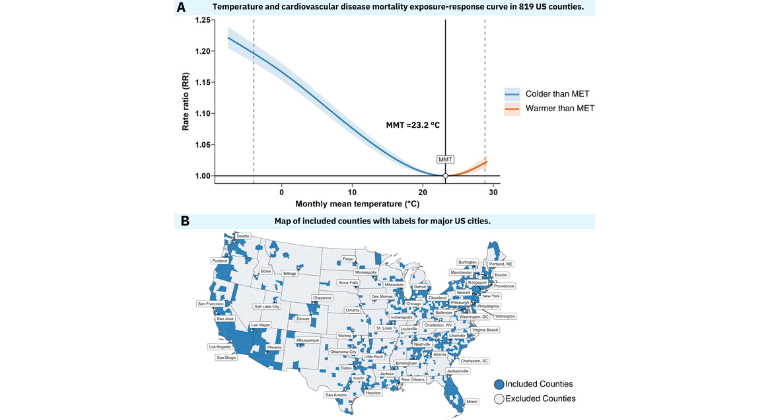
Mount Sinai-led research shows significantly more cardiac mortality occurs during cooler temperatures than in excessive heat
Study Title: “Cardiovascular disease mortality attributable to monthly non-optimal temperature in the United States: a county-level analysis”
Conference: American College of Cardiology Scientific Sessions - Young Investigators Award Competition Finalist: “Outcomes Research” Presentation (Monday, March 30, 9:30 am CDT in New Orleans)
Journal: Journal of the American Journal of Preventative Cardiology (simultaneous publication)
Bottom line of the study: Colder temperatures are responsible for significantly more cardiovascular deaths from heart attacks, strokes, and coronary artery disease than milder months/warm temperatures in the United States. Heat consistently gets more attention as a cause for concern for heart patients; however, this study shows colder weather is the larger and more consistent risk.
Why this study is important: Most public health messaging focuses on heat waves, but this study’s findings show that colder temperatures are associated with a substantially higher number of heart-related deaths each year. This highlights a major gap in awareness and prevention.
Why this study is unique: This research is the most comprehensive analysis of temperature-related trends to date across the United States. Previous studies have linked extreme temperatures with increased risk of cardiovascular death, but most have focused on other countries or smaller sections of the United States.
How the study was conducted: Researchers analyzed more than 14 million cardiovascular deaths of people over 25 years old across 819 counties in the United States (80 percent of the country’s population) between 2000 and 2020. They linked mortality data with local temperature data and used statistical models to estimate how deviations from optimal temperatures were associated with cardiovascular death risk. They then quantified how many deaths were attributable to cold versus heat exposure.
Results: The researchers determined that the optimal temperature for heart health—the temperature at which the least mortality occurred—was 74 degrees Fahrenheit. Mortality risk rose asymmetrically when moving away from that point, with temperatures under 74 degrees Fahrenheit accounting for approximately 40,000 cardiovascular deaths each year of the study period (6.3 percent), while temperatures over 74 degrees accounted for about 2,000 cardiovascular deaths each year (.33 percent). In total, colder weather was linked to roughly 800,000 deaths over two decades, compared to 40,000 deaths due to warm weather.
Put differently, one in 16 cardiovascular deaths were linked to colder weather compared to one in 300 linked to heat.
Further details and explanation of the analysis: Approximately 80 percent of the observations occurred at temperatures below 74 degrees. The researchers used statistical techniques to adjust for this, but even with the adjustments, and determined that heart mortality was more common on days below 74.
What this means for clinicians: Clinicians should recognize cold exposure as a meaningful cardiovascular risk factor. Risk increases during colder months, particularly among older adults and patients with underlying cardiovascular disease, and should be incorporated into seasonal risk assessment and preventive counseling.
What this means for heart patients: Cold weather can place additional strain on the heart. Patients, especially those with cardiovascular disease, should stay warm, avoid sudden exertion in the cold such as snow shoveling, and remain consistent with their medications. In some patients, medication adjustments may be needed during periods of extreme cold temperature.
Quotes from Lead Author/Presenter: Pedro Rafael Vieira De Olivera Salerno, MD, Internal Medicine Resident in the Icahn School of Medicine of Mount Sinai program at NYC Health + Hospitals/Elmhurst.
“This may be surprising to many, but most temperature-related cardiovascular deaths are associated with cold, not heat. While heat waves are a major focus for health issues, colder temperatures are associated with far more heart-related deaths over time,” says Dr. Salerno. “As clinicians, we see seasonal patterns in cardiovascular events, but this helps quantify how much cold exposure contributes at the population level. This isn’t just about extreme weather. Even routine cold exposure, especially in vulnerable patients, can increase cardiovascular risk.”
Institutions involved in the study: The study was led by researchers at the Icahn School of Medicine of Mount Sinai and NYC Health + Hospitals/Elmhurst and done in collaboration with Houston Methodist and Case Western Reserve University.
About the Icahn School of Medicine at Mount Sinai
The Icahn School of Medicine at Mount Sinai is internationally renowned for its outstanding research, educational, and clinical care programs. It is the sole academic partner for the seven member hospitals* of the Mount Sinai Health System, one of the largest academic health systems in the United States, providing care to New York City’s large and diverse patient population.
The Icahn School of Medicine at Mount Sinai offers highly competitive MD, PhD, MD-PhD, and master’s degree programs, with enrollment of more than 1,200 students. It has the largest graduate medical education program in the country, with more than 2,700 clinical residents and fellows training throughout the Health System. Its Graduate School of Biomedical Sciences offers 13 degree-granting programs, conducts innovative basic and translational research, and trains more than 560 postdoctoral research fellows.
Ranked 11th nationwide in National Institutes of Health (NIH) funding, the Icahn School of Medicine at Mount Sinai is among the 99th percentile in research dollars per investigator according to the Association of American Medical Colleges. More than 4,500 scientists, educators, and clinicians work within and across dozens of academic departments and multidisciplinary institutes with an emphasis on translational research and therapeutics. Through Mount Sinai Innovation Partners (MSIP), the Health System facilitates the real-world application and commercialization of medical breakthroughs made at Mount Sinai.
-------------------------------------------------------
* Mount Sinai Health System member hospitals: The Mount Sinai Hospital; Mount Sinai Brooklyn; Mount Sinai Morningside; Mount Sinai Queens; Mount Sinai South Nassau; Mount Sinai West; and New York Eye and Ear Infirmary of Mount Sinai.
About the Mount Sinai Health System
Mount Sinai Health System is one of the nation’s leading integrated academic health systems and one of the largest in the New York metropolitan area. Its comprehensive system includes seven hospitals, more than 400 outpatient practices, over 600 research and clinical laboratories, the Icahn School of Medicine at Mount Sinai, the Graduate School of Biomedical Sciences, and the Mount Sinai Phillips School of Nursing. Together, the Health System comprises approximately 48,000 employees, more than 9,000 physicians, and 8,600 nurses.
As a leading learning health system, Mount Sinai combines clinical expertise with scientific discovery to improve patient care while training the next generation of health care and biomedical leaders. The Health System provides care across every stage of life, from prenatal care through geriatrics, while advancing personalized medicine through artificial intelligence, data science, and biomedical research.
Mount Sinai is consistently recognized among the nation’s leading academic health systems for patient care, research, and education. The Mount Sinai Hospital is ranked No. 1 in New York by Newsweek and No. 5 on the magazine’s World’s Best Hospitals list. The Icahn School of Medicine at Mount Sinai ranks No. 11 among U.S. medical schools and No. 1 among freestanding medical schools for National Institutes of Health funding, reflecting the strength of its scientific enterprise and leadership in biomedical research.