
AI-Powered ECG Could Help Guide Lifelong Heart Monitoring for Patients With Repaired Tetralogy of Fallot
Mount Sinai-led multicenter study shows a simple, low-cost test may help prioritize cardiac MRI for patients who need it most
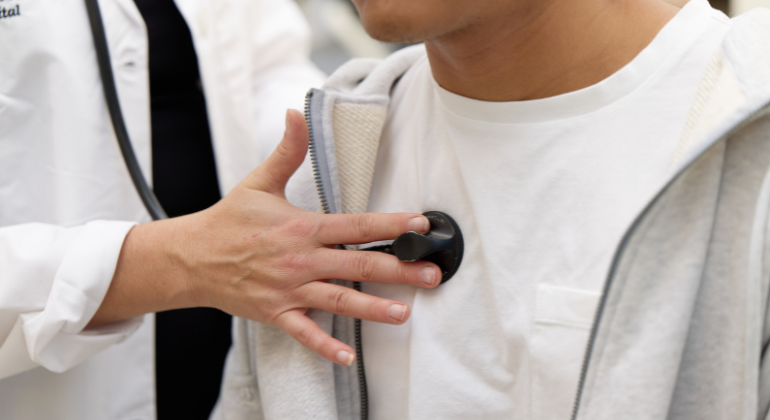
Researchers at the Mount Sinai Kravis Children’s Heart Center led a multicenter effort to develop and validate an artificial intelligence (AI) tool that can analyze a standard electrocardiogram (ECG) to identify patients with repaired tetralogy of Fallot who may be at risk for harmful heart changes typically detected by cardiac MRI. The study, supported by the National Institutes of Health, was published in the European Heart Journal: Digital Health.
Tetralogy of Fallot is a congenital heart defect that requires surgical repair in childhood, but patients need lifelong monitoring to detect changes in heart size and function. Cardiac MRI is the gold-standard imaging test for this follow-up care; however, MRI scans are expensive, time-consuming, and not always easily accessible. Many patients miss recommended imaging.
In this multicenter study, investigators trained an AI model using ECG and MRI data from patients with repaired tetralogy of Fallot and validated the model across five additional hospitals in North America. The AI learned patterns in ECG signals linked to ventricular remodeling—changes in heart size and pumping function that can signal worsening health.
Key findings
- AI plus ECG can estimate risk of ventricular remodeling: A quick, widely available test may help identify patients who need MRI sooner.
- There is potential to improve access and efficiency: The tool could help doctors prioritize MRI scans for higher-risk patients while safely delaying scans for lower-risk patients.
- Performance varied by hospital: Results highlight the importance of validating AI tools locally before clinical use.
“This research shows how artificial intelligence can unlock new value from a routine ECG,” said Son Duong, MD, MS, lead author and Assistant Professor of Pediatrics, and Artificial Intelligence and Human Health at Icahn School of Medicine at Mount Sinai. “Our goal is to make lifelong heart monitoring more accessible and efficient for people born with congenital heart disease.”
The researchers emphasize that the model is not intended to replace cardiac MRI. Instead, it could help clinicians decide when imaging is most urgently needed.
“As AI becomes more integrated into health care, it is critical to rigorously validate these tools across diverse clinical settings,” said Girish Nadkarni, MD, MPH, co-senior author and Barbara T. Murphy Chair of the Windreich Department of Artificial Intelligence and Human Health, at Mount Sinai Health System. “Our findings show both the promise of AI-enabled screening and the importance of testing performance at each site before real-world implementation.” Dr. Nadkarni is also the Director of the Hasso Plattner Institute for Digital Health and Chief AI Officer, Icahn School of Medicine at Mount Sinai.
Why this matters
Patients with congenital heart disease often require lifelong specialized follow-up care. By combining AI with a simple ECG, the researchers hope to:
- Reduce unnecessary testing and health care costs
- Improve access to advanced imaging for patients who need it most
- Personalize follow-up care and improve long-term outcomes
Next steps
The research team plans to test the AI-ECG approach in prospective clinical studies and trials and refine the model for younger patients. The long-term goal is to integrate the tool into routine clinical care.
For more Mount Sinai artificial intelligence news, visit: https://icahn.mssm.edu/about/artificial-intelligence.
About the Mount Sinai Health System
Mount Sinai Health System is one of the nation’s leading integrated academic health systems and one of the largest in the New York metropolitan area. Its comprehensive system includes seven hospitals, more than 400 outpatient practices, over 600 research and clinical laboratories, the Icahn School of Medicine at Mount Sinai, the Graduate School of Biomedical Sciences, and the Mount Sinai Phillips School of Nursing. Together, the Health System comprises approximately 48,000 employees, more than 9,000 physicians, and 8,600 nurses.
As a leading learning health system, Mount Sinai combines clinical expertise with scientific discovery to improve patient care while training the next generation of health care and biomedical leaders. The Health System provides care across every stage of life, from prenatal care through geriatrics, while advancing personalized medicine through artificial intelligence, data science, and biomedical research.
Mount Sinai is consistently recognized among the nation’s leading academic health systems for patient care, research, and education. The Mount Sinai Hospital is ranked No. 1 in New York by Newsweek® and No. 7 in the U.S. on the magazine’s World’s Best Hospitals 2026 list. The Icahn School of Medicine at Mount Sinai ranks No. 9 among U.S. medical schools and No. 1 among freestanding medical schools for National Institutes of Health grant funding, reflecting the strength of its scientific enterprise and leadership in biomedical research.
Mount Sinai Study Finds Safety Prompts Can Help AI Models Make Safer Clinical Choices
Oct 08, 2026 View All Press Releases
AI System Finds Crucial Clues for Diagnoses in Electronic Health Records
Oct 15, 2025 View All Press Releases
Adding a Lookup Step Makes AI Better at Assigning Medical Diagnosis Codes
Sep 25, 2025 View All Press Releases
Like Humans, AI Can Jump to Conclusions, Mount Sinai Study Finds
Jul 22, 2025 View All Press Releases
Physical Activity Boosts Mental Health in Women With Chronic Pelvic Pain Disorders
Feb 26, 2025 View All Press Releases