
Mount Sinai Genetic Testing Laboratory Nearly Doubles Diseases Covered by Ashkenazi Jewish Carrier Screening Panel
With expanded screening test, 50 percent of Ashkenazi Jewish individuals are expected to be identified as carriers of at least one of the 38 diseases.
The Icahn School of Medicine at Mount Sinai today announced the launch of its Expanded Carrier Screening Panel for people of Ashkenazi Jewish descent. This test increases the number of diseases covered from 20 to 38, giving Ashkenazi Jewish individuals a 1 in 2 chance of being a carrier for at least one of the diseases. The 18 new diseases were added based on population screening studies performed by scientists at the Mount Sinai Genetic Testing Laboratory.
There are several genetic diseases that occur at increased frequencies in the Ashkenazi Jewish population. Because disease inheritance can be autosomal recessive or X-linked, many people are carriers without knowing it. Mount Sinai has been setting the bar for Ashkenazi Jewish carrier screening since 1997, when the Genetic Testing Laboratory initiated the triple-screen for Tay-Sachs disease, cystic fibrosis, and Gaucher disease. Additional disorders have been added steadily over the years as new genes were discovered.
Scientists at the Genetic Testing Laboratory recently conducted targeted mutation screening for disorders that were previously not included in standard Ashkenazi Jewish panels or were newly discovered in these patients. Based on screening of more than 2,000 Ashkenazi Jewish individuals, scientists identified 18 disorders as recurrent, with frequencies ranging from 1 in 36 to 1 in 373. For three of the disorders — Alport syndrome, multiple sulphatase deficiency, and dyskeratosis congenita — patients were seen by members of the Division of Medical Genetics at Mount Sinai, and the causative mutations were discovered through research studies and additional clinical testing.
“We have made consistent incremental progress with carrier screening for the Ashkenazi Jewish population since 1997, but this new screening panel represents the first major expansion of the test,” said Lisa Edelmann, PhD, Director of the Mount Sinai Genetic Testing Laboratory. “This is a giant step forward in helping people of Ashkenazi Jewish descent to comprehensively determine their risk for passing on one of these diseases.”
In addition to conducting the carrier screening panel at Mount Sinai, the Genetic Testing Laboratory will partner with additional commercial entities to make the testing more widely available.
“Feedback from clients, advocacy groups, and commercial testing organizations about this expanded panel has been very encouraging,” said Ruth Kornreich, PhD, Director of Molecular Genetics at the Mount Sinai Genetic Testing Laboratory. “The positive responses have been due in part to our reputation in delivering comprehensive carrier screening to the Ashkenazi Jewish community.”
About the Mount Sinai Health System
Mount Sinai Health System is one of the nation’s leading integrated academic health systems and one of the largest in the New York metropolitan area. Its comprehensive system includes seven hospitals, more than 400 outpatient practices, over 600 research and clinical laboratories, the Icahn School of Medicine at Mount Sinai, the Graduate School of Biomedical Sciences, and the Mount Sinai Phillips School of Nursing. Together, the Health System comprises approximately 48,000 employees, more than 9,000 physicians, and 8,600 nurses.
As a leading learning health system, Mount Sinai combines clinical expertise with scientific discovery to improve patient care while training the next generation of health care and biomedical leaders. The Health System provides care across every stage of life, from prenatal care through geriatrics, while advancing personalized medicine through artificial intelligence, data science, and biomedical research.
Mount Sinai is consistently recognized among the nation’s leading academic health systems for patient care, research, and education. The Mount Sinai Hospital is ranked No. 1 in New York by Newsweek and No. 5 on the magazine’s World’s Best Hospitals list. The Icahn School of Medicine at Mount Sinai ranks No. 11 among U.S. medical schools and No. 1 among freestanding medical schools for National Institutes of Health funding, reflecting the strength of its scientific enterprise and leadership in biomedical research.
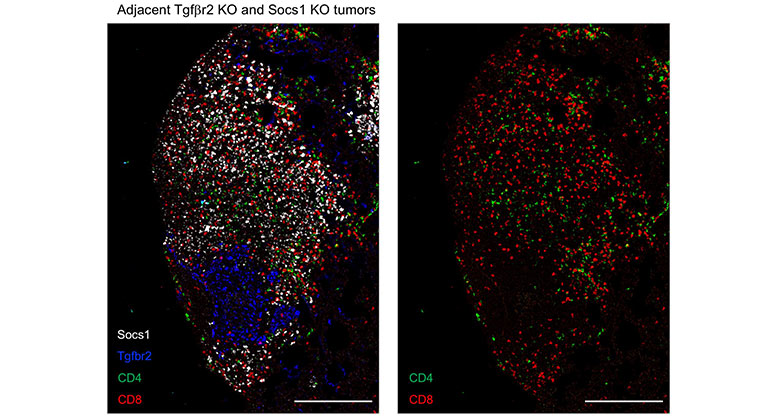

Targeting One Type of Immune Cell With Another Slows Cancer Growth in Preclinical Studies
Oct 25, 2022 View All Press Releases


Novel CRISPR Imaging Technology Reveals Genes Controlling Tumor Immunity
Mar 15, 2022 View All Press ReleasesMount Sinai Researchers: Why COVID-19 May Be Less Common in Children Than Adults
May 22, 2020 View All Press ReleasesMount Sinai Researchers Identify 20 Novel Gene Associations With Bipolar Disorder
May 01, 2019 View All Press Releases
Mount Sinai and IBM Researchers Uncover Key to Greater Efficacy in Cancer Treatment
Mar 21, 2019 View All Press Releases