World Trade Center Responders at Heightened Risk for Atherosclerosis
Mount Sinai researchers have found that responders at the World Trade Center site with earlier exposure to the dust cloud have greater risk of developing arterial plaque.
In the first study using magnetic resonance imaging (MRI) to evaluate cardiovascular risk in World Trade Center (WTC) first responders, researchers from Mount Sinai School of Medicine have found that the responders who experienced high levels of exposure to the initial dust cloud on September 11, 2001, demonstrate high-risk features of atherosclerosis (plaque in arteries). The data were presented at the American Heart Association's Scientific Sessions 2011 in Orlando, Florida.
Mary Ann McLaughlin, MD, MPH, Associate Professor of Medicine is the primary investigator for this study and has been evaluating the cardiovascular health of the WTC responders since 2007. In addition to the current study, her research has shown more impaired cardiac relaxation and coronary calcification in responders at Ground Zero, compared with the general population.
First author, Venkatesh Mani, PhD, and colleagues, used MRI to evaluate the blood vessels of 19 responders exposed to the high levels of particulate matter from the dust cloud, and 12 exposed to the lower levels. They found that WTC workers who were exposed to the initial dust cloud had higher blood vessel formation in their artery plaque compared to people with lower exposure. Co-investigator, Simonette Sawit, MD also demonstrated impaired vascular reactivity, or dysfunction of the inner lining of blood vessels, in those with higher dust exposure. This dysfunction may accelerate the progression of atherosclerosis. The Mount Sinai team discovered this association in WTC workers independent of other clinical factors.
"Using noninvasive MRI imaging, we were able to see a significant impact of the events of 9/11 on the cardiovascular health of the brave men and women who responded that day," said Zahi Fayad, PhD, Professor of Radiology, and Medicine in the Division of Cardiology, and the Director of the Translational and Molecular Imaging Institute at Mount Sinai School of Medicine. "Now that we have visualized the risk and early development of vascular lesions, in a subset of subjects, we look forward to studying the use of imaging in the greater patient population."
"This study defines physiologic change associated with greater exposure to the dust cloud at the WTC site," said Dr. McLaughlin. "We are currently evaluating other predictors of cardiovascular risk in this population to gain a better understanding of the impact of particulate matter exposure on cardiovascular health."
This research is funded by Clinical and Translational Science Award, the Translational and Molecular Imaging Institute, Mount Sinai School of Medicine.
The WTC Clinical Center of Excellence at Mount Sinai is a treatment and monitoring program for emergency responders, recovery workers, residents, and area workers who were affected by the terrorist attacks in New York City on September 11, 2001. The program identifies mental and physical health problems needing timely treatment; evaluates the health of first responders; monitors the development of symptoms; and researches the effects of 9/11 through data collection and analysis. Located at Mount Sinai and several other clinics in the tri-state area, the Clinical Centers of Excellence and Data Centers are the result of the James Zadroga 9/11 Health and Compensation Act, which provides $4.3 billion in federal funding to serve the health needs of the brave men and women impacted by the WTC tragedy.
About The Mount Sinai Medical Center
The Mount Sinai Medical Center encompasses both The Mount Sinai Hospital and Mount Sinai School of Medicine. Established in 1968, Mount Sinai School of Medicine is one of the leading medical schools in the United States. The Medical School is noted for innovation in education, biomedical research, clinical care delivery, and local and global community service. It has more than 3,400 faculty in 32 departments and 14 research institutes, and ranks among the top 20 medical schools both in National Institutes of Health (NIH) funding and by U.S. News & World Report.
The Mount Sinai Hospital, founded in 1852, is a 1,171-bed tertiary- and quaternary-care teaching facility and one of the nation’s oldest, largest and most-respected voluntary hospitals. In 2011, U.S. News & World Report ranked The Mount Sinai Hospital 16th on its elite Honor Roll of the nation’s top hospitals based on reputation, safety, and other patient-care factors. Of the top 20 hospitals in the United States, Mount Sinai is one of 12 integrated academic medical centers whose medical school ranks among the top 20 in NIH funding and US News & World Report and whose hospital is on the US News & World Report Honor Roll. Nearly 60,000 people were treated at Mount Sinai as inpatients last year, and approximately 560,000 outpatient visits took place.
For more information, visit http://www.mountsinai.org.
Find Mount Sinai on:
Facebook: http://www.facebook.com/mountsinainyc
Twitter @mountsinainyc
YouTube: http://www.youtube.com/mountsinainy
About the Mount Sinai Health System
Mount Sinai Health System is one of the largest academic medical systems in the New York metro area, with more than 47,000 employees working across seven hospitals, more than 400 outpatient practices, more than 600 research and clinical labs, a school of nursing, and leading schools of medicine and graduate education. Mount Sinai advances health for all people, everywhere, by taking on the most complex health care challenges of our time—discovering and applying new scientific learning and knowledge; developing safer, more effective treatments; educating the next generation of medical leaders and innovators; and supporting local communities by delivering high-quality care to all who need it.
Through the integration of its hospitals, labs, and schools, Mount Sinai offers comprehensive health care from conception through geriatrics, leveraging innovative approaches such as artificial intelligence and informatics while keeping patients’ medical and emotional needs at the center of all treatment. The Health System includes more than 6,400 primary and specialty care physicians and 10 free-standing joint-venture centers throughout the five boroughs of New York City, Westchester, Long Island, and Florida. Hospitals within the System are consistently ranked by Newsweek’s® “The World’s Best Smart Hospitals,” “Best in State Hospitals,” “World’s Best Hospitals,” and “Best Specialty Hospitals” and by U.S. News & World Report's® “Best Hospitals” and “Best Children’s Hospitals.” The Mount Sinai Hospital is on the U.S. News & World Report® “Best Hospitals” Honor Roll for 2025-2026.
For more information, visit https://www.mountsinai.org or find Mount Sinai on Facebook, Instagram, LinkedIn, X, and YouTube.
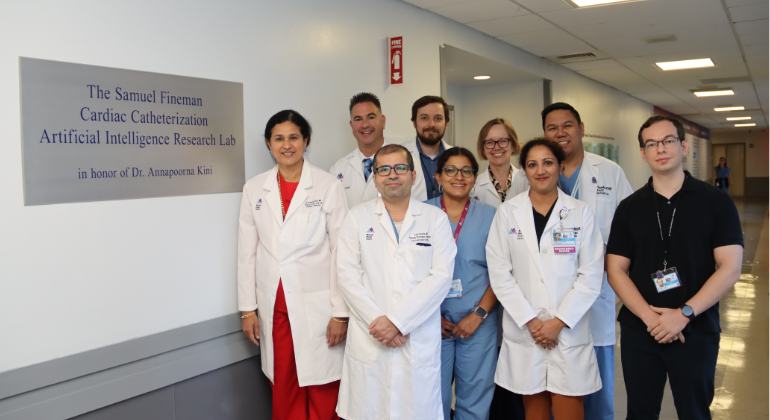
Mount Sinai Launches Cardiac Catheterization Artificial Intelligence Research Lab
Sep 15, 2025 View All Press Releases
Mount Sinai Surgeons Perform First Heart-Liver-Kidney Transplants in New York State
May 20, 2025 View All Press Releases