American Heart Association Presents 2012 Research Achievement Award to Mount Sinai’s Valentin Fuster, MD, PhD
The award was presented Sunday, November 4 at the American Heart Association’s Scientific Sessions.
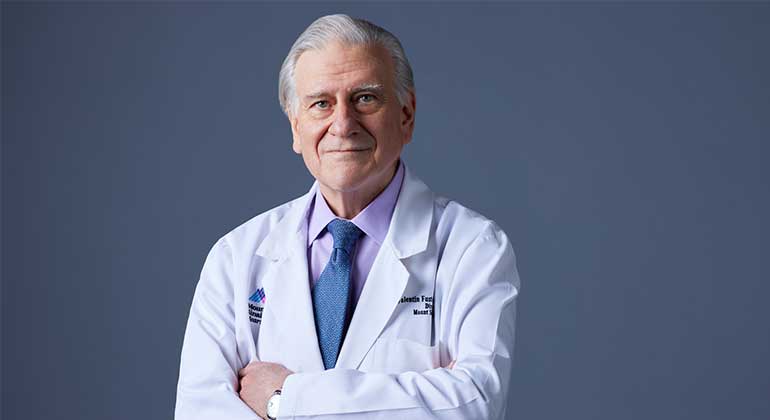
The American Heart Association (AHA) presented its 2012 Research Achievement Award to Valentin Fuster, MD, PhD, for his significant and enduring contributions to a broad spectrum of cardiovascular medicine, achievements that have accelerated progress toward conquering disease and enriching the human condition worldwide. Dr. Fuster, who serves as the Director of Mount Sinai Heart, is the Richard Gorlin, MD/Heart Research Foundation Professor at the Mount Sinai School of Medicine. The award was presented Sunday, November 4, at the American Heart Association's Scientific Sessions in Los Angeles, California.
"With a laser-like focus on translational research, Dr. Fuster has added greatly to our understanding of the pathogenesis of coronary artery disease and thrombosis," said Donna Arnett, MD, President of the American Heart Association. "Among his laboratory's provocative advancements in medical science are numerous "firsts" including the original understanding of the role of platelets in heart disease and the revelation that plaque composition is plays a crucial role in propensity for a heart lesion to rupture."
Specifically, the AHA applauds Dr. Fuster for the following achievements:
- The original understanding of the major role platelets play in thrombotic artery disease, including that von Willebrand factor deficiency causes platelet dysfunction and resistance to arterial thrombosis;
- The experimental finding that was later documented in humans that platelets can create blockages following coronary artery bypass surgery, and that those blockages can be significantly prevented by aspirin;
- The discovery that plaque rupture often occurs in paradoxically small lesions that appear inactive and thus are unpredictable and, most importantly, that plaque composition is more important than the extent of vessel narrowing in determining a lesion's propensity to rupture;
- The identification and characterization of the vulnerable/high-risk plaques and reversibility by statins using new MRI technology (black-blood);
- Subsequent in vivo demonstration by Dr. Fuster and his colleagues of HDL cholesterol's role in reversing lipid and macrophage-rich plaques;
- Initially demonstrating that Rapamycin in the pig model can be a powerful inhibitor of artery cell wall activity and vessel blockage following injury, leading to the critical confirmation that drug-eluting stents can deter restenosis.
Kenneth L. Davis, MD, Mount Sinai's President and Chief Executive Officer, commented: "We at Mount Sinai are all proud of Dr. Fuster's unparallel accomplishments, building from the ground up our Cardiovascular Institute and elevating cardiovascular care, not only here, but across the nation, and around worldwide."
"Dr. Fuster has made a critical contribution to innovation, learning, and research at Mount Sinai. As a mentor, he has instilled in traineesa passion for building new strategies for cardiovascular research and care of the future," said Dennis S. Charney, MD, the Anne and Joel Ehrenkranz Dean of Mount Sinai School of Medicine and Executive Vice President for Academic Affairs at The Mount Sinai Medical Center.
Upon receiving the award, Dr. Fuster said, "Mount Sinai has been enormously supportive, providing invaluable resources to building a first-class cardiovascular institute."
Overall, more than 800 published research articles document Dr. Fuster's studies of coronary artery disease, atherosclerosis and thrombosis. He is the lead editor of two major cardiology textbooks.
A past President of the AHA and the World Heart Federation, Dr. Fuster holds numerous distinctions including honorary doctorates from 30 universities across the globe. As the Chair of the Committee on Preventing the Global Epidemic of Cardiovascular Disease for the Institute of Medicine (IOM), he is a prominent advocate for cardiovascular health. He is the only cardiologist to receive two gold medal awards and all four major research awards from the four major cardiovascular organizations worldwide.
Among his many international accolades are two Distinguished Researcher awards of the Inter-American Society of Cardiology; the Principe de Asturias Award of Science and Technology, the highest honor given to Spanish-speaking scientists; the Andreas Gruntzig Scientific Award and the Gold Medal Award of the European Society of Cardiology, and the Kurt Polzer Cardiovascular Award from the European Society of Science and the Arts.
In the United States, the AHA has honored him with the Lewis A. Conner Memorial and the Gold Medal Award, and Dr. Fuster has received the Herrick Award of the Association's Council on Clinical Cardiology. The American College of Cardiology has named him a Distinguished Scientist and Legend in Cardiovascular Medicine. As Chair of the American College of Cardiology's Fellowship Training Directors Program, he has shaped medical training in cardiovascular care throughout the United States.
While Dr. Fuster's research has significantly elevated coronary disease knowledge and treatment, he has championed the perspective -- now recognized by the United Nations -- that obesity-related conditions such as cardiovascular disease are global problems. Dr. Fuster chaired a committee of the Institute of Medicine of the National Academy of Sciences that is responsible for developing guidelines for promoting cardiovascular health worldwide. He has also served on the National Heart, Lung and Blood Institute Advisory Council and numerous other cardiovascular care organizations.
At Mount Sinai, Dr. Fuster has been admired as a mentor and role model by generations of aspiring cardiovascular specialists, and a VF Alumni Society was founded in his honor. His positive impact on clinical practice is widely evident, in the lecture hall, clinic, and patient's bedside, as well as in the research laboratory. He is in demand as consultant to physicians handling difficult medical questions. His non-intimidating style, extraordinary breadth of knowledge and attention to the individual needs of students and patients alike are the readily recognized attributes of an exceptional leader and educator.
About The Mount Sinai Medical Center
The Mount Sinai Medical Center encompasses both The Mount Sinai Hospital and Mount Sinai School of Medicine. Established in 1968, Mount Sinai School of Medicine is one of the leading medical schools in the United States. The Medical School is noted for innovation in education, biomedical research, clinical care delivery, and local and global community service. It has more than 3,400 faculty in 32 departments and 14 research institutes, and ranks among the top 20 medical schools both in National Institutes of Health (NIH) funding and by U.S. News & World Report.
The Mount Sinai Hospital, founded in 1852, is a 1,171-bed tertiary- and quaternary-care teaching facility and one of the nation's oldest, largest and most-respected voluntary hospitals. In 2012, U.S. News & World Report ranked The Mount Sinai Hospital 14th on its elite Honor Roll of the nation's top hospitals based on reputation, safety, and other patient-care factors. Mount Sinai is one of 12 integrated academic medical centers whose medical school ranks among the top 20 in NIH funding and U.S. News & World Report and whose hospital is on the U.S. News & World Report Honor Roll. Nearly 60,000 people were treated at Mount Sinai as inpatients last year, and approximately 560,000 outpatient visits took place.
For more information, visit http://www.mountsinai.org/.
Find Mount Sinai on:
- Facebook: http://www.facebook.com/mountsinainyc
- Twitter: @mountsinainyc
- YouTube: http://www.youtube.com/mountsinainy
About the Mount Sinai Health System
Mount Sinai Health System is one of the largest academic medical systems in the New York metro area, with 48,000 employees working across seven hospitals, more than 400 outpatient practices, more than 600 research and clinical labs, a school of nursing, and a leading school of medicine and graduate education. Mount Sinai advances health for all people, everywhere, by taking on the most complex health care challenges of our time—discovering and applying new scientific learning and knowledge; developing safer, more effective treatments; educating the next generation of medical leaders and innovators; and supporting local communities by delivering high-quality care to all who need it.
Through the integration of its hospitals, labs, and schools, Mount Sinai offers comprehensive health care solutions from birth through geriatrics, leveraging innovative approaches such as artificial intelligence and informatics while keeping patients’ medical and emotional needs at the center of all treatment. The Health System includes approximately 9,000 primary and specialty care physicians and 10 free-standing joint-venture centers throughout the five boroughs of New York City, Westchester, Long Island, and Florida. Hospitals within the System are consistently ranked by Newsweek’s® “The World’s Best Smart Hospitals, Best in State Hospitals, World Best Hospitals and Best Specialty Hospitals” and by U.S. News & World Report's® “Best Hospitals” and “Best Children’s Hospitals.” The Mount Sinai Hospital is on the U.S. News & World Report® “Best Hospitals” Honor Roll for 2025-2026.
For more information, visit https://www.mountsinai.org or find Mount Sinai on Facebook, Instagram, LinkedIn, X, and YouTube.
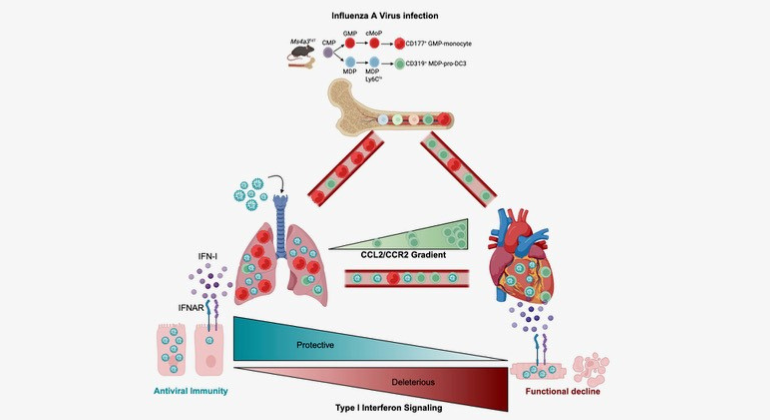
Mount Sinai Scientists Uncover Link Between Influenza and Heart Disease
Feb 09, 2026 View All Press Releases
Scientists Develop a Smarter mRNA Therapy That Knows Which Cells to Target
Dec 15, 2025 View All Press Releases
After a Heart Attack, the Heart Signals to the Brain to Increase Sleep to Promote Healing
Oct 30, 2024 View All Press Releases
Skipping Breakfast May Compromise the Immune System
Feb 23, 2023 View All Press Releases.jpg)