
Mount Sinai Ophthalmologist Unveils Hospital’s First-in-Human Technology Enabling Real-Time Outflow Measurement During Eye Surgery
miDOC system being introduced during prestigious lecture at the American Society of Cataract and Refractive Surgery (ASCRS) Conference
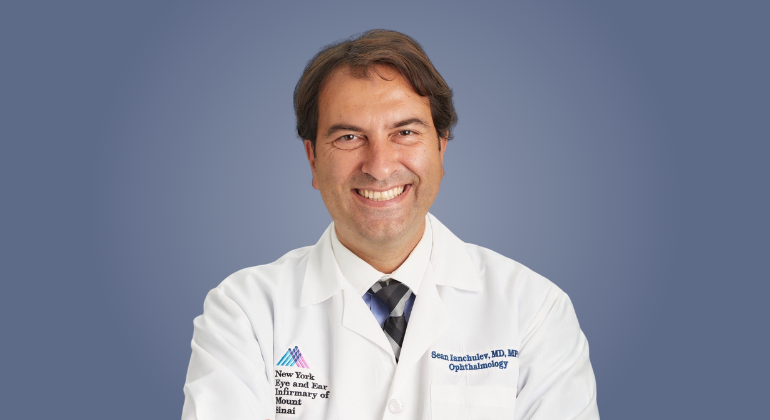
Sean Ianchulev, MD, MPH, Director of Ophthalmic Innovation and Technology at New York Eye and Ear Infirmary of Mount Sinai, will unveil new technology called miDOC during the Charles D. Kelman Innovator’s Lecture at the American Society of Cataract and Refractive Surgery (ASCRS) annual meeting
A Mount Sinai ophthalmologist will unveil a novel surgical technology that allows eye surgeons to measure and respond to critical fluid dynamics inside the eye in real time—an advance that may significantly improve precision and outcomes in glaucoma and other ophthalmic procedures.
The technology, called miDOC (micro-interventional Dynamic Outflow Curve), will be introduced by Sean Ianchulev, MD, MPH, Professor of Ophthalmology at the Icahn School of Medicine at Mount Sinai and Director of Ophthalmic Innovation and Technology at New York Eye and Ear Infirmary of Mount Sinai (NYEE), during the prestigious Charles D. Kelman Innovator’s Lecture at the American Society of Cataract and Refractive Surgery (ASCRS) annual meeting in Washington, D.C., on Sunday, April 12. The lecture is designed to highlight visionary leaders in cataract and refractive surgery and celebrate their contributions to the field.
Developed by Dr. Ianchulev at NYEE with funding from Mount Sinai Innovation Partners, miDOC is designed to provide continuous intraoperative measurement of ocular flow and pressure—parameters that have historically been difficult to assess during surgery. The system enables surgeons to monitor changes in real time and adjust procedures accordingly for each patient.
"This is the equivalent of what optical biometry did for cataract surgery. miDOC brings precision to glaucoma surgery that simply has not existed before," says Dr. Ianchulev. ¨We are certainly on the verge of something very exciting—bringing glaucoma surgery into the age of digital-guided precision, high fidelity, and biometric feedback. This will allow glaucoma surgeons to one day achieve similar outcomes as we see in cataract surgical interventions.”
Early Clinical Experience
NYEE is the only eye center in the country to use this technology and conduct the first-in-human clinical study. Surgeons started using it in patients in July 2025 and have completed the first 20 cases. According to investigators, all procedures were successfully completed with intraoperative biometric guidance.
During surgery, miDOC enabled continuous measurement of key parameters including:
- Pressure
- Flow
- Outflow facility
- Ocular rigidity/Compliance
These measurements provide new insight into how surgical interventions affect the eye in real time.
Addressing a Critical Gap in Glaucoma Surgery
While performing glaucoma procedures without miDOC, surgeons have no way of checking a patient’s exact ocular flow and pressure, a critical variable in the operating room. They can only check intraocular pressure before and after the procedure, which leaves outcomes unpredictable.
This has held back the precision of glaucoma surgery, where, currently, more than 50 percent of the patients undergoing trabeculectomy and drainage device implants fail to achieve complete postoperative success and medication independence. In some cases, it is not until the follow-up appointment that ophthalmologists discover the procedure may not have worked and/or has possible complications.
This contrasts significantly to cataract surgery, where 95 percent of patients achieve a successful refractive outcome within 0.5D of emmetropia—a very small amount of refractive error—because accurate biometry is available and critical to these outcomes.
“Intraoperative measurement of aqueous outflow has not previously been possible during ophthalmic surgery. This capability has the potential to transform outflow-based surgical interventions by advancing the field toward high-precision biometry and improved clinical outcomes,” says Gautam Kamthan, MD, Assistant Clinical Professor of Ophthalmology at the Icahn School of Medicine and Assistant Director of Ophthalmic Innovation and Technology at NYEE, who co-invented this technology and is the Principal Investigator of the study.
Potential Applications Across Ophthalmology
While initially developed for glaucoma surgery, miDOC may have broader applications across ophthalmic procedures.
Despite the great potential for successful refractive outcomes after cataract surgery, vision can still be jeopardized if a patient has a dangerously high spike in eye pressure during the immediate recovery period. Using the miDOC for cataract surgery—the most common surgery in the world—could help identify these patients and prevent permanent vision damage.
As surgeons at NYEE use miDOC in more procedures, they have discovered that it can possibly detect choroidal blood flow – this is the high-volume vascular supply to the eye's uveal tract, providing essential oxygen and nutrients to the outer retina, particularly the macula which is responsible for sharp, detailed, and high-resolution central vision. Understanding the health of the choroid could inform retinal surgeons about potential chorioretinal diseases.
Researchers are also exploring whether the system can provide additional insights into cerebrovascular, cardiac, and lymphatic physiology, which could have implications for the rest of the body.
Future Development
Investigators at NYEE plan to further refine the technology and pursue regulatory pathways for broader clinical use. The device is currently investigational and has not yet received clearance from the U.S. Food and Drug Administration.
*Dr. Sean Ianchulev and Dr. Gautam Kamthan are named co-inventors of the technology “Micro-interventional Dynamic Outflow Curve (miDOC).” A patent for this technology was filed through Mount Sinai and the technology is currently unlicensed. The inventors and Mount Sinai would financially benefit if this technology is approved and commercialized.
About Mount Sinai Innovation Partners
Mount Sinai Innovation Partners (MSIP) is responsible for advancing the real-world application and commercialization of Mount Sinai discoveries and inventions, and the development of research partnerships with industry. Our aim is to translate discoveries and inventions into healthcare products and services that benefit patients and society. MSIP is accountable for the full spectrum of commercialization activities required to bring Mount Sinai inventions to life. These activities include evaluating, patenting, marketing, and licensing new technologies, building research collaborations and partnerships, coaching innovators to advance commercially relevant translational discoveries, and fostering an ecosystem of entrepreneurship within Mount Sinai and beyond. For more information, please visit https://ip.mountsinai.org.
About the Mount Sinai Health System
Mount Sinai Health System is one of the nation’s leading integrated academic health systems and one of the largest in the New York metropolitan area. Its comprehensive system includes seven hospitals, more than 400 outpatient practices, over 600 research and clinical laboratories, the Icahn School of Medicine at Mount Sinai, the Graduate School of Biomedical Sciences, and the Mount Sinai Phillips School of Nursing. Together, the Health System comprises approximately 48,000 employees, more than 9,000 physicians, and 8,600 nurses.
As a leading learning health system, Mount Sinai combines clinical expertise with scientific discovery to improve patient care while training the next generation of health care and biomedical leaders. The Health System provides care across every stage of life, from prenatal care through geriatrics, while advancing personalized medicine through artificial intelligence, data science, and biomedical research.
Mount Sinai is consistently recognized among the nation’s leading academic health systems for patient care, research, and education. The Mount Sinai Hospital is ranked No. 1 in New York by Newsweek and No. 5 on the magazine’s World’s Best Hospitals list. The Icahn School of Medicine at Mount Sinai ranks No. 11 among U.S. medical schools and No. 1 among freestanding medical schools for National Institutes of Health funding, reflecting the strength of its scientific enterprise and leadership in biomedical research.