
Icahn School of Medicine at Mount Sinai Remains Among Top Institutions for NIH Funding
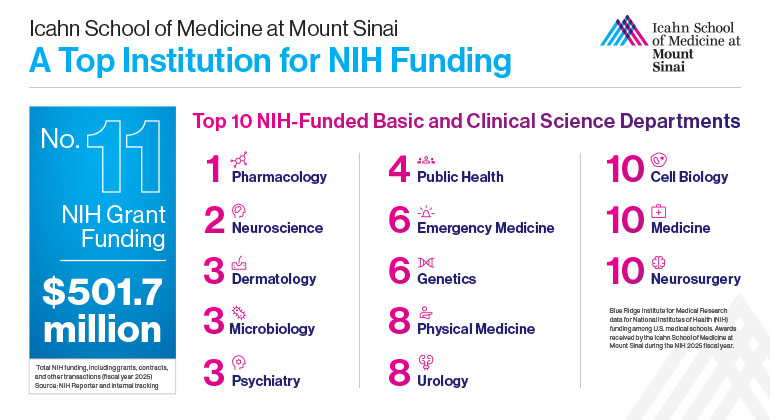
The Icahn School of Medicine at Mount Sinai, part of the Mount Sinai Health System in New York City, continues to rank among the top institutions for National Institutes of Health (NIH) research funding, sustaining its overall standing as No. 11 nationally.
Including grants and contracts, the School received $501.7 million from the NIH in the most recent federal fiscal year, placing it in the 99th percentile among private U.S. medical schools in research dollars per investigator, according to the Association of American Medical Colleges.
Additionally, recently released department rankings published by the Blue Ridge Institute for Medical Research (BRIMR) further underline the institution’s expanding prominence in biomedical research across multiple disciplines. The BRIMR rankings are derived from data gleaned from the NIH for the federal fiscal year ending in September 2025.
Overall, 13 departments representing basic and clinical science at Mount Sinai placed within the top 10 nationwide for NIH funding, a strong indicator of sustained institutional momentum in high-impact research. Notably, the Department of Pharmacology moved up to No. 1 in the standings from No. 2 in 2024. The Department, part of the Graduate School of Biomedical Sciences, succeeded in the standings largely due to its advances into understanding the mechanisms of disease, in addition to leveraging these discoveries for the development of novel therapeutics.
“I am tremendously proud of our faculty, staff, and trainees whose relentless pursuit of discovery continues to elevate Mount Sinai’s research enterprise,” said Eric J. Nestler, MD, PhD, Anne and Joel Ehrenkranz Dean of the Icahn School of Medicine and Executive Vice President and Chief Scientific Officer of the Mount Sinai Health System. “These NIH rankings reflect our enduring commitment to scientific excellence and the translational impact of our work across basic science, clinical research, education, and patient-focused innovation.”
Highlights of NIH Funding Performance and Departmental Standings
- Overall, eight clinical and five basic science departments or fields were ranked among the top 10 across the United States. The clinical departments/fields were Dermatology, Emergency Medicine, Medicine, Neurosurgery, Physical Medicine, Psychiatry, Public Health, and Urology; in the basic sciences, Genetics, Microbiology, Neuroscience, Pharmacology, and Stem Cell Biology and Regenerative Medicine. Twelve departments moved up in the standings in 2025, reflecting strong progress year over year.
- Mount Sinai is now ranked No. 1 in Pharmacology; No. 2 in Neuroscience; No. 3 in Dermatology, Microbiology, and Psychiatry; and No. 4 in Public Health funding.
- The Department of Microbiology secured the largest dollar increase, adding $8.1 million to its funding base for a total of $26.5 million last year.
- The Department of Dermatology’s continuing excellence in skin biology and translational research propelled the Department in securing high-level NIH funding and a top spot in the rankings.
Mount Sinai’s No. 4 ranking in Public Health reflects the established excellence of the Department of Environmental Medicine along with a department established just two years ago, the new Department of Public Health. The former is led by Robert O. Wright, MD, MPH, Ethel H. Wise Professor of Community Medicine, Chair of the Department of Environmental Medicine, and Co-Director of the Institute for Exposomic Research at the Icahn School of Medicine at Mount Sinai. And the Department of Public Health, which emphasizes a transdisciplinary team approach in understanding and treating disease, underscoring a deeper integration of public health and translational sciences, is led by Rosalind J. Wright, MD, MPH, the Horace W. Goldsmith Professor in Children’s Health Research at the Icahn School of Medicine at Mount Sinai.
In addition to institutional ranking success, Icahn School of Medicine researchers continue to secure targeted NIH awards that advance discovery across health priorities. Recent support includes multimillion-dollar grants for studies on neurological aging, congenital heart disease outcomes, and several translational research programs that bridge basic science with potential new interventions.
About the Icahn School of Medicine at Mount Sinai
The Icahn School of Medicine at Mount Sinai is internationally renowned for its outstanding research, educational, and clinical care programs. It is the sole academic partner for the seven member hospitals* of the Mount Sinai Health System, one of the largest academic health systems in the United States, providing care to New York City’s large and diverse patient population.
The Icahn School of Medicine at Mount Sinai offers highly competitive MD, PhD, MD-PhD, and master’s degree programs, with enrollment of more than 1,200 students. It has the largest graduate medical education program in the country, with more than 2,600 clinical residents and fellows training throughout the Health System. Its Graduate School of Biomedical Sciences offers 13 degree-granting programs, conducts innovative basic and translational research, and trains more than 560 postdoctoral research fellows.
Ranked 11th nationwide in National Institutes of Health (NIH) funding, the Icahn School of Medicine at Mount Sinai is among the 99th percentile in research dollars per investigator according to the Association of American Medical Colleges. More than 4,500 scientists, educators, and clinicians work within and across dozens of academic departments and multidisciplinary institutes with an emphasis on translational research and therapeutics. Through Mount Sinai Innovation Partners (MSIP), the Health System facilitates the real-world application and commercialization of medical breakthroughs made at Mount Sinai.
-------------------------------------------------------
* Mount Sinai Health System member hospitals: The Mount Sinai Hospital; Mount Sinai Brooklyn; Mount Sinai Morningside; Mount Sinai Queens; Mount Sinai South Nassau; Mount Sinai West; and New York Eye and Ear Infirmary of Mount Sinai
About the Mount Sinai Health System
Mount Sinai Health System is one of the nation’s leading integrated academic health systems and one of the largest in the New York metropolitan area. Its comprehensive system includes seven hospitals, more than 400 outpatient practices, over 600 research and clinical laboratories, the Icahn School of Medicine at Mount Sinai, the Graduate School of Biomedical Sciences, and the Mount Sinai Phillips School of Nursing. Together, the Health System comprises approximately 48,000 employees, more than 9,000 physicians, and 8,600 nurses.
As a leading learning health system, Mount Sinai combines clinical expertise with scientific discovery to improve patient care while training the next generation of health care and biomedical leaders. The Health System provides care across every stage of life, from prenatal care through geriatrics, while advancing personalized medicine through artificial intelligence, data science, and biomedical research.
Mount Sinai is consistently recognized among the nation’s leading academic health systems for patient care, research, and education. The Mount Sinai Hospital is ranked No. 1 in New York by Newsweek® and No. 7 in the U.S. on the magazine’s World’s Best Hospitals 2026 list. The Icahn School of Medicine at Mount Sinai ranks No. 9 among U.S. medical schools and No. 1 among freestanding medical schools for National Institutes of Health grant funding, reflecting the strength of its scientific enterprise and leadership in biomedical research.