
First-in-Human Study Reveals Dopamine and Serotonin Have Overlapping, Yet Distinctive Roles That Influence Social Behavior
Demonstrates sophisticated interactions of these neurotransmitters in higher-order mental functions, shedding new light on social decision-making
Nature Human Behavior
New research conducted by researchers from the Icahn School of Medicine at Mount Sinai in collaboration with an international team of neuroscientists, clinicians, and computational scientists reveals, for the first time, the roles of the neurotransmitters dopamine and serotonin in human social behaviors.
The study, published Monday, February 26, in Nature Human Behavior, provides direct evidence from the human brain that rapid changes in these two neurotransmitters reflect context and value signals during social interaction in a distinct yet complementary manner.
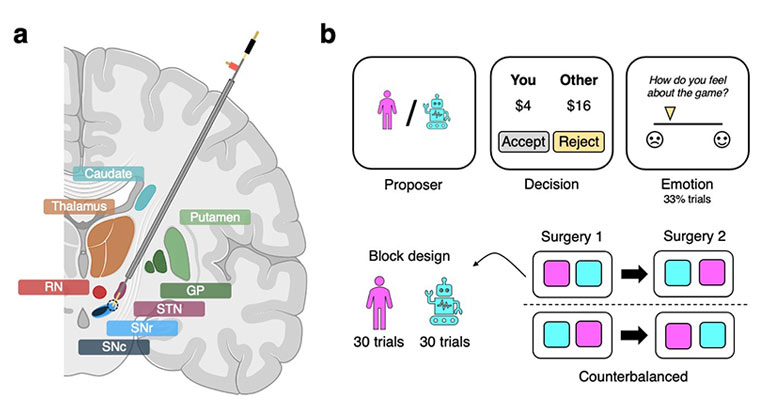
The research was conducted in four Parkinson’s disease patients who were undergoing awake neurosurgery for their condition at Mount Sinai West in New York City. It focused on the substantia nigra, a deep brain region associated with motor control and reward processing. During the surgery, participants played a well-established behavioral economics task called the ultimatum game, in which they had to accept or reject monetary offers of varying levels of fairness from both human and computer players.
The Mount Sinai team collaborated with a team at Virginia Tech who pioneered a technique called voltammetry in human patients. This novel technique provides a rapid readout of neurochemicals from an electrode placed deep within the brain of a patient undergoing deep brain surgery while awake. The raw data collected is processed through machine learning tools that decode the level of neurotransmitters based on their electrical signatures in the brain. Through this partnership, the team was able for the first time to measure more than one neurotransmitter at a time.
“We found that dopamine levels are overall higher when people interact with another human as opposed to a computer. We also found that dopamine seems to closely follow and react to whether the current offer is better or worse than the previous one, while serotonin appears to focus solely on the current value of the specific offer at hand. Together, these signals contribute to our overall assessment of value during social interactions,” said Xiaosi Gu, PhD, Associate Professor of Psychiatry, and Neuroscience, at Icahn Mount Sinai; Director of the Center for Computational Psychiatry; and co-senior author of the paper. “This work highlights the importance of artificial intelligence in pushing the boundary for neurotechnology and elevating our understanding of complex brain functions such as our social cognition. The research also demonstrates the power of collaborative, cross-disciplinary science, as these findings would not have been possible without bringing together experts from computational neuroscience, neurosurgery, neurology, and psychiatry.”
Although previous studies suggested the dopamine and serotonin systems play central roles in human social interaction, these studies were either based on animal studies (conducted in mice) or on pharmacological manipulations that are not precise (drugs that affect the entire system), so the contribution of these neuromodulators to social behavior had not yet been studied at short timescales in humans.
In Parkinson’s disease, a significant loss of dopamine-producing neurons in the brainstem is a key characteristic that usually coincides with the onset of symptoms. This loss impacts the striatum, a brain region that’s heavily influenced by dopamine, but the mechanism is unknown. This study enabled researchers to delve into the sophisticated dynamics of these chemical neurotransmitters in humans. Future studies in larger cohorts will help to uncover the pathology of Parkinson’s disease that the team hopes will help guide clinical treatment of the disease.
“This study highlights the unique opportunity that occurs by doing this sort of work in the operating room. In this capacity, we bridge the gap between laboratory science and clinical care to foster knowledge and innovation that will impact patients in a meaningful way,” said Brian Kopell, MD, Director of the Center for Neuromodulation at Mount Sinai West and a co-author of the paper, who performed the awake brain surgery on study participants. “Through our Nash Family Center for Advanced Circuit Therapeutics at Mount Sinai, we are proud to bring together neuroscientists, neurosurgeons, psychiatrists, data engineers, and others to do work that gleans knowledge that would otherwise be impossible without such collaboration.”
About the Mount Sinai Health System
Mount Sinai Health System is one of the nation’s leading integrated academic health systems and one of the largest in the New York metropolitan area. Its comprehensive system includes seven hospitals, more than 400 outpatient practices, over 600 research and clinical laboratories, the Icahn School of Medicine at Mount Sinai, the Graduate School of Biomedical Sciences, and the Mount Sinai Phillips School of Nursing. Together, the Health System comprises approximately 48,000 employees, more than 9,000 physicians, and 8,600 nurses.
As a leading learning health system, Mount Sinai combines clinical expertise with scientific discovery to improve patient care while training the next generation of health care and biomedical leaders. The Health System provides care across every stage of life, from prenatal care through geriatrics, while advancing personalized medicine through artificial intelligence, data science, and biomedical research.
Mount Sinai is consistently recognized among the nation’s leading academic health systems for patient care, research, and education. The Mount Sinai Hospital is ranked No. 1 in New York by Newsweek® and No. 7 in the U.S. on the magazine’s World’s Best Hospitals 2026 list. The Icahn School of Medicine at Mount Sinai ranks No. 9 among U.S. medical schools and No. 1 among freestanding medical schools for National Institutes of Health grant funding, reflecting the strength of its scientific enterprise and leadership in biomedical research.


Our Brains May Think Two Steps Ahead When Trying to Sway Others
Nov 01, 2021 View All Press Releases