Mount Sinai Researchers Develop a First-in-Class Humanized Antibody Targeting Bone and Fat
Blocking the Follicle-Stimulating Hormone (FSH) whose levels rise at menopause could solve bone loss and weight gain
A treatment for obesity and osteoporosis could be on the horizon as researchers at the Icahn School of Medicine at Mount Sinai have developed a first-in-class humanized antibody to the pituitary hormone—follicle-stimulating hormone (FSH), which they predict will reduce body fat, increase bone mass, enhance metabolism, and lower cholesterol. The study was published October 26 in the Proceedings of the National Academy of Sciences.
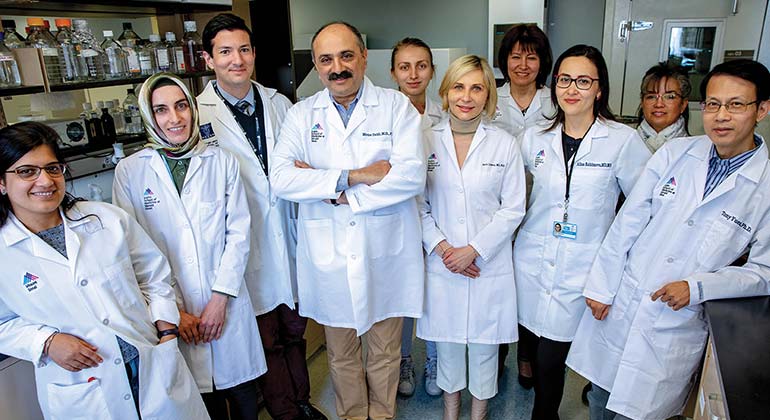
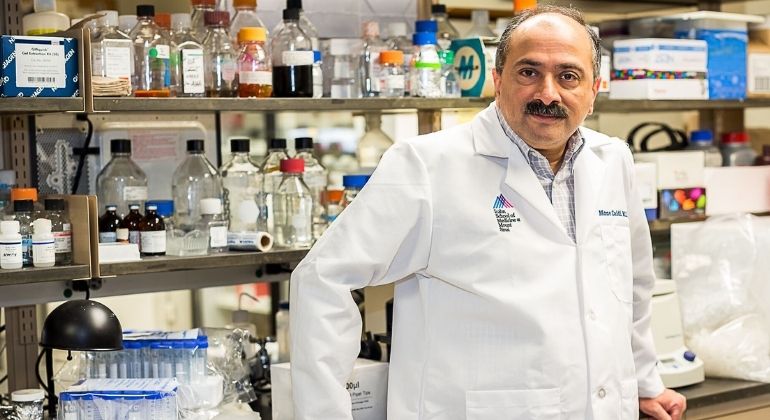
“Obesity and osteoporosis affect nearly 650 million and 200 million people worldwide. Yet the resources for preventing and treating these disorders remains limited, particularly when compared with public health epidemics of similar magnitude. This humanized anti-FSH antibody has the potential of preventing and treating not one, but three diseases—obesity, osteoporosis, and hypercholesterolemia,” said lead author Mone Zaidi, MD, PhD, MACP, Director of the Mount Sinai Bone Program and Professor of Medicine (Endocrinology, Diabetes and Bone Disease) at the Icahn School of Medicine at Mount Sinai.
It has become increasingly clear that obesity and osteoporosis track together clinically. Women, when they undergo menopause, lose bone and gain body fat. FSH, which rises at menopause, could be responsible for the weight gain and bone loss that many women experience in their middle ages.
The FSH research builds on a long-term collaboration spanning nearly two decades between Dr. Zaidi and Clifford Rosen, MD, senior scientist at Maine Medical Center Research Institute. The results of their previous work were published in the journal Nature in 2017 and were among the eight “notable advances” in biomedicine named that year by Nature Medicine. Mouse-based data that Drs. Zaidi and Rosen concurrently confirmed in each other’s laboratories showed that blocking FSH reduces obesity and increases energy expenditure in both male and female mice fed on a high-fat diet.
In the most recent study, researchers explain the development of a “humanized” monoclonal antibody to block FSH signaling.
“This next stage brings us even closer to an effective therapy aimed at preventing and treating both obesity and osteoporosis,” said Dr. Zaidi. “What would be fascinating and incredibly rewarding is if we can actually show a significant increase in lifespan while regulating obesity and osteoporosis through a single, FSH-blocking agent.”
Dr. Zaidi has also been appointed as a Deputy Editor in Medicine for eLife to lead the journal’s expansion into medical research and to explore fresh approaches to peer review and publishing. He will be leading expert review of significant translational research and clinical studies that deal with etiology, pathophysiology, diagnosis, genetics, prevention and treatments to improve human health. eLife is an internationally revered journal that is supported by the Howard Hughes Medical Institute, the Welcome, Max Planck and the Wallenberg Foundation.
Dr. Zaidi says he is “deeply committed” to supporting physician-scientists across the world who are in the early stages of their career. He has initiated national efforts to sustain and promote the workforce, especially through his leadership of the Research Committee of the Alliance of Academic Internal Medicine. “I look forward to helping make eLife’s medicine section a highly respected and popular platform for publishing interdisciplinary lines of investigation focused on improving human health,” he added.
About the Mount Sinai Health System
Mount Sinai Health System is one of the nation’s leading integrated academic health systems and one of the largest in the New York metropolitan area. Its comprehensive system includes seven hospitals, more than 400 outpatient practices, over 600 research and clinical laboratories, the Icahn School of Medicine at Mount Sinai, the Graduate School of Biomedical Sciences, and the Mount Sinai Phillips School of Nursing. Together, the Health System comprises approximately 48,000 employees, more than 9,000 physicians, and 8,600 nurses.
As a leading learning health system, Mount Sinai combines clinical expertise with scientific discovery to improve patient care while training the next generation of health care and biomedical leaders. The Health System provides care across every stage of life, from prenatal care through geriatrics, while advancing personalized medicine through artificial intelligence, data science, and biomedical research.
Mount Sinai is consistently recognized among the nation’s leading academic health systems for patient care, research, and education. The Mount Sinai Hospital is ranked No. 1 in New York by Newsweek® and No. 7 in the U.S. on the magazine’s World’s Best Hospitals 2026 list. The Icahn School of Medicine at Mount Sinai ranks No. 9 among U.S. medical schools and No. 1 among freestanding medical schools for National Institutes of Health grant funding, reflecting the strength of its scientific enterprise and leadership in biomedical research.