Icahn Institute partners in $6.5 million NIH award to advance precision medicine and bioengineering capabilities
The National Institutes of Health (NIH) have awarded $6.5 million to a consortium that includes the Icahn Institute for Genomics and Multiscale Biology at the Icahn School of Medicine at Mount Sinai, the University of Washington, the University of Connecticut, and the University of Auckland, New Zealand, to establish the Center for Reproducible Biomedical Modeling. The multi-institution biomedical technology resource center will accelerate the development of predictive models of biological systems to guide precision medicine and bioengineering and provide much-needed model building resources to the research community. Icahn Institute Assistant Professor Jonathan Karr, PhD, will direct the consortium’s effort to develop computational tools for building reproducible models.
Making significant advances in precision medicine and bioengineering requires detailed knowledge of biological entities, such as cells. Computer models of biological systems that can predict phenotype from genotype can help scientists understand the molecular basis of behavior, help clinicians personalize therapy, and help bioengineers design microorganisms for a wide range of applications. However, there remain limitations to building such predictive models, including the lack of data and tools needed to carry out modeling systematically and scalably and the lack of comprehensible, reusable, and reproducible models.
In an effort to address these limitations and enable more comprehensive and accurate models, the Center for Reproducible Biomedical Modeling will develop technologies for systematically, scalably, and collaboratively aggregating the data needed for designing, simulating, analyzing, and publishing models, as well as develop technologies for analyzing simulation results. Dr. Karr and his team, including Associate Professor Arthur Goldberg, PhD, bioinformatician Saahith Pochiraju, and graduate student Yosef Roth, will develop an integrated database of molecular data for cell modeling, tools for discovering relevant data to create models of specific cell types, and tools for systematically designing models for large datasets. These tools will make biomodeling more reusable and reproducible. Dr. Karr and his team will utilize input from collaborators building whole-cell models to ensure the technologies developed by the center will advance modeling capabilities.
The center will also help researchers and journals produce and publish reusable, reproducible models by organizing workshops for researchers, providing researchers assistance annotating models, and verifying models submitted to partner journals. The center has already recruited nine partner journals.
"This NIH support significantly impacts our team’s capabilities and will enable us to develop the technologies researchers need to build comprehensive whole-cell models,” said Dr. Karr, one of the project directors of the center. “Ultimately, we believe these models will help physicians precisely treat individual patients and help bioengineers design powerful microorganisms that can sense and disrupt disease.”
“Specialized expertise at the Icahn Institute and the model building resources of the center as a whole will fill a critical gap in the biomedical research enterprise, providing open access tools to create reproducible models and ultimately more rigorous scientific outcomes,” said Grace Peng, Ph.D., director of the program in Computational Modeling at the National Institute of Biomedical Imaging and Bioengineering (NIBIB). Support for the new center is from NIBIB and the National Institute of General Medical Sciences, both parts of NIH, through grant EB023912.
See http://reproduciblebiomodels.org for more information.
About the Mount Sinai Health System
Mount Sinai Health System is one of the nation’s leading integrated academic health systems and one of the largest in the New York metropolitan area. Its comprehensive system includes seven hospitals, more than 400 outpatient practices, over 600 research and clinical laboratories, the Icahn School of Medicine at Mount Sinai, the Graduate School of Biomedical Sciences, and the Mount Sinai Phillips School of Nursing. Together, the Health System comprises approximately 48,000 employees, more than 9,000 physicians, and 8,600 nurses.
As a leading learning health system, Mount Sinai combines clinical expertise with scientific discovery to improve patient care while training the next generation of health care and biomedical leaders. The Health System provides care across every stage of life, from prenatal care through geriatrics, while advancing personalized medicine through artificial intelligence, data science, and biomedical research.
Mount Sinai is consistently recognized among the nation’s leading academic health systems for patient care, research, and education. The Mount Sinai Hospital is ranked No. 1 in New York by Newsweek® and No. 7 in the U.S. on the magazine’s World’s Best Hospitals 2026 list. The Icahn School of Medicine at Mount Sinai ranks No. 9 among U.S. medical schools and No. 1 among freestanding medical schools for National Institutes of Health grant funding, reflecting the strength of its scientific enterprise and leadership in biomedical research.
Experimental mRNA Therapy Shows Potential to Combat Antibiotic-Resistant Infections
Nov 26, 2025 View All Press Releases
Mount Sinai Researchers Uncover Why Some Leukemia Cells May Resist Treatment
Oct 30, 2024 View All Press Releases
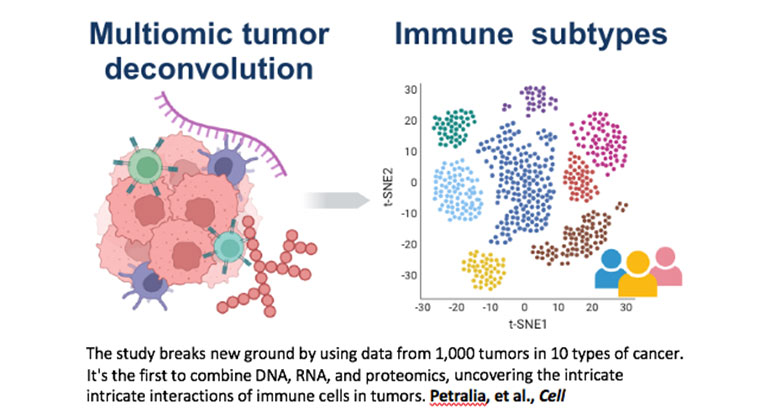
Researchers Characterize the Immune Landscape in Cancer
Feb 14, 2024 View All Press Releases