Mount Sinai and Rensselaer Team Up to Earn Prominent Role in New NIH Program in Environmental and Children’s Health
To support its groundbreaking work in the emergent field of “exposomics,” the National Institutes of Health (NIH), through the National Institute of Environmental Health Sciences, awarded two grants to research teams from the Department of Preventive Medicine at the Icahn School of Medicine at Mount Sinai, led by Professor and Chair Robert O. Wright, MD, MPH and by Susan Teitelbaum, PhD, in collaboration with Deborah McGuinness, PhD of Rensselaer Polytechnic Institute (RPI). In addition, the state of New York and Mount Sinai provided 3.2 million dollars to these grants in matching funds through the state’s NYSTAR program. These matching funds were critical in securing these grants.
“Exposomics” is the comprehensive study of environmental exposures in humans, from conception through development. The grants, totaling $20 million over four years, are from the NIH’s newly-formed Child Health Environmental Assessment Resource program, or CHEAR. Mount Sinai is the only institution to receive grants for two of CHEAR’s three components.
The first – made possible by the Icahn’s School of Medicine’s partnership with RPI – will be for a Data Repository, Analysis and Science Center, led by principal investigator Susan Teitelbaum, PhD, along with Chris Gennings, PhD, Patricia Kovatch of Mount Sinai, and RPI’s Deborah McGuinness, PhD. The Data Center will address methodology for combining data from a wide range of environmental health studies, developing precise vocabularies for semantically accelerating the exposomics field, developing statistical approaches for analyzing exposomic/chemical mixtures, and performing BIG data science, integrating exposomics with genomics and epigenomics.
The second grant is for a Mount Sinai “lab hub” that will be part of the CHEAR National Exposure Assessment Laboratory Network, led by principal investigator Robert O. Wright, MD; Manish Arora, BDS, MPH, PhD; Mary S. Wolff, PhD; and Rosalind Wright, MD. The lab hub is based in the Senator Frank Lautenberg Laboratory for Environmental Health Sciences at Mount Sinai and consists of a Targeted Chemical Analysis Resource, a Biological Response Resource, an Untargeted Chemical Analysis (i.e., “Exposomic”) Resource, and a Development Core that will generate unique biomarker measures of environmental exposure with a special emphasis on reconstructing past exposure.
“Mount Sinai’s commitment to studying the impact of environmental exposures on children’s health is unparalleled, and these major grants are a testimony to the work done by Dr. Wright and his team,” said Dennis S. Charney, MD, the Anne and Joel Ehrenkranz Dean of the Icahn School of Medicine at Mount Sinai and President, Academic Affairs, Mount Sinai Health System.
“Rensselaer’s expertise in computational science and engineering, including data science, semantics, and predictive analytics led by Deborah McGuinness within the CHEAR grants will yield transformative knowledge about the effect of environmental factors on human development and lead to strategies to improve child health”, said Jonathan S. Dordick, PhD, the Howard P. Isermann Professor of Chemical and Biological Engineering and Vice President for Research at Rensselaer.
Almost all diseases have both environmental and genetic causes. The overarching goal of CHEAR is to bring together environmental exposure measures with genomic measures of health risk. By linking environment with genetic risk we will be better able to predict, prevent and treat chronic diseases. CHEAR is designed to develop new methodologies and provide state of the art tools and methodologies for researchers to assess a full array of environmental exposures which affect children’s health. CHEAR will also lead the extramural community in defining and developing the nascent science of exposomics—a comprehensive look at the health impact of chemical, physical and biological stressors, as well as lifestyle and social environments, from conception through development stages.
The national CHEAR Program comprises three distinct units: the National Exposure Assessment Laboratory Network, providing access to state-of-the-art infrastructure for analysis of biological samples, as well as understanding biological responses associated with those exposures; a Data Repository, Analysis, and Science Center, which provides a repository for all data and support for statistical analysis and interpretation, and which will also lead the development of community-based data standards and support the development of technologies, ontology, and metadata standards; and a Coordinating Center, which will provides administrative management of these national resources, including an interface to the research community and an index of additional exposure analysis tools not included within the CHEAR infrastructure.
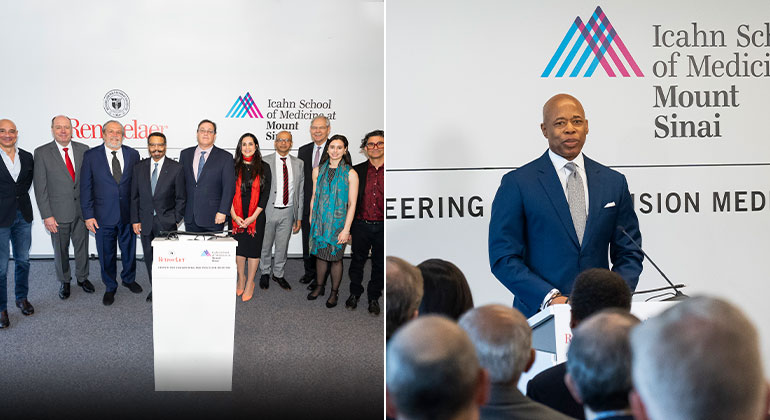
The Icahn School of Medicine at Mount Sinai and Rensselaer Polytechnic Institute partnership combines the institutions’ complementary interdisciplinary strengths, to engage in radical innovation, for the purpose of creating the blueprint for 21st Century science and health care delivery. Established in 2013, the education and research collaboration is focused on the development of new diagnostic tools and treatments that promote human health.
About Rensselaer Polytechnic Institute
Founded in 1824, Rensselaer is the oldest technological research university in the English-speaking world. As it approaches its bicentennial anniversary, Rensselaer continues to be a driving force behind breakthroughs in engineering and science in virtually every arena—from transportation and infrastructure to business, medicine, manufacturing, Big Data, outer space, and cyberspace.
About the Mount Sinai Health System
Mount Sinai Health System is one of the nation’s leading integrated academic health systems and one of the largest in the New York metropolitan area. Its comprehensive system includes seven hospitals, more than 400 outpatient practices, over 600 research and clinical laboratories, the Icahn School of Medicine at Mount Sinai, the Graduate School of Biomedical Sciences, and the Mount Sinai Phillips School of Nursing. Together, the Health System comprises approximately 48,000 employees, more than 9,000 physicians, and 8,600 nurses.
As a leading learning health system, Mount Sinai combines clinical expertise with scientific discovery to improve patient care while training the next generation of health care and biomedical leaders. The Health System provides care across every stage of life, from prenatal care through geriatrics, while advancing personalized medicine through artificial intelligence, data science, and biomedical research.
Mount Sinai is consistently recognized among the nation’s leading academic health systems for patient care, research, and education. The Mount Sinai Hospital is ranked No. 1 in New York by Newsweek and No. 5 on the magazine’s World’s Best Hospitals list. The Icahn School of Medicine at Mount Sinai ranks No. 11 among U.S. medical schools and No. 1 among freestanding medical schools for National Institutes of Health funding, reflecting the strength of its scientific enterprise and leadership in biomedical research.
Mount Sinai Expands Psychedelic Research Center With New Facility in Upper Manhattan
Sep 19, 2024 View All Press Releases
Mount Sinai Launches Discovery and Innovation Center in Midtown West
Oct 05, 2023 View All Press Releases



Mount Sinai Launches Institute for Regenerative Medicine
Apr 24, 2023 View All Press Releases