
New York Eye and Ear Infirmary of Mount Sinai Celebrates World Orthoptics Day
New York Eye and Ear Infirmary of Mount Sinai (NYEE) joins with the International Orthoptic Association (IOA) to observe June 1st as World Orthoptics Day.
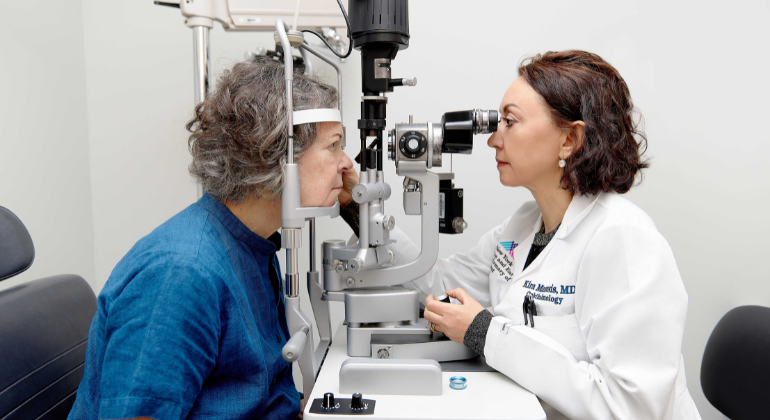
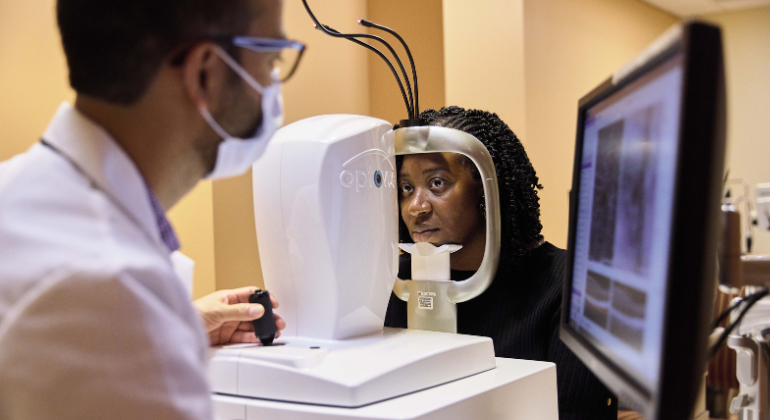
Held annually on the first Monday in June, World Orthoptics Day recognizes the clinical care provided by orthoptists, who evaluate and treat eye movement problems in both children and adults. Working in a multidisciplinary team with ophthalmologists, neuro-ophthalmologists, and pediatric ophthalmologists and using specialized examination techniques, these specialists manage non-surgical treatment of patients with eye muscle disorders, misaligned eyes, and decreased vision.
“Orthoptists are crucial members of the eye care team at NYEE and play a pivotal role in patient care and education,” said James C. Tsai, MD, MBA, President, New York Eye and Ear Infirmary of Mount Sinai, and Chair, Department of Ophthalmology, Mount Sinai Health System.
NYEE was home to the nation’s first orthoptics training program dating back to 1938 and continues to have one of largest clinical program treating more than 5,800 patients per year. The three orthoptists in the NYEE Pediatric Ophthalmology / Orthoptics/ Adult Strabismus Service work with more than 500 ophthalmologists across the Health System and the New York Metropolitan region.
For this year’s awareness event, NYEE orthoptists want to highlight the role of eye muscle disorders in adult patients. Orthoptists work with patients of all ages, but are usually recognized for their expertise in the assessment of vision in children and in the field of pediatric vision screening. However, a large percentage of adults experience an eye muscle disorder at some point in their lives that may require specialized evaluations and treatments.
“In adults, binocular vision problems, or problems seeing with both eyes, occur in conjunction with problems related to other acquired ophthalmic issues, such as cataracts,” said Sara Shippman, CO, Director, Orthoptics Service at NYEE. “Binocular/ problems) caused by systemic and neurological problems are also very prevalent in the aging adult population.”
Over the last several decades, orthoptists have also expanded their role and not only specialize in eye movement disorders but are also involved in the care of patients with other age-related eye disease such as cataracts, glaucoma, diabetic eye disease, age related macular degeneration, systemic or neurological vision disorders and low vision.
Early detection and regular monitoring eye muscle disorder is important as many conditions can be prevented from progressing and becoming a threat to the person’s sight. Adults should have regular eye checks for glaucoma, diabetic eye disease and cataract to help prevent long-term issues.
Experts Available for Interview:
- Sara Shippman, CO, Director, Orthoptics Service, New York Eye and Ear Infirmary of Mount Sinai
Patient Available for Interview:
- Jonathan Good, a Westchester County resident, had 20/20 vision all his life until a simple eye infection started a cascade of vision issues, ultimately leaving him with binocular visions (double vision). After years of treatment, he continued to be frustrated when additional surgeries and eye glass prescriptions didn’t help. After being treated at the NYEE Orthoptics Service, Mr. Good says his vision has improved and a weight has been lifted from his shoulders. He is back to enjoying leisure activities such as golfing and working with computers.
For more information on orthoptics services at NYEE, please visit http://www.nyee.edu/patient-care/ophthalmology/pediatric.
View A Patient's Perspective on Diplopia (Double Vision) video
About the Mount Sinai Health System
Mount Sinai Health System is one of the nation’s leading integrated academic health systems and one of the largest in the New York metropolitan area. Its comprehensive system includes seven hospitals, more than 400 outpatient practices, over 600 research and clinical laboratories, the Icahn School of Medicine at Mount Sinai, the Graduate School of Biomedical Sciences, and the Mount Sinai Phillips School of Nursing. Together, the Health System comprises approximately 48,000 employees, more than 9,000 physicians, and 8,600 nurses.
As a leading learning health system, Mount Sinai combines clinical expertise with scientific discovery to improve patient care while training the next generation of health care and biomedical leaders. The Health System provides care across every stage of life, from prenatal care through geriatrics, while advancing personalized medicine through artificial intelligence, data science, and biomedical research.
Mount Sinai is consistently recognized among the nation’s leading academic health systems for patient care, research, and education. The Mount Sinai Hospital is ranked No. 1 in New York by Newsweek and No. 5 on the magazine’s World’s Best Hospitals list. The Icahn School of Medicine at Mount Sinai ranks No. 11 among U.S. medical schools and No. 1 among freestanding medical schools for National Institutes of Health funding, reflecting the strength of its scientific enterprise and leadership in biomedical research.

Mount Sinai Recruits Internationally Recognized Ophthalmologists to Expand Leadership
Dec 17, 2018 View All Press ReleasesMount Sinai Establishes the Eye and Vision Research Institute
Jan 09, 2017 View All Press Releases