
Mount Sinai First in the East to Implant the WATCHMAN Device to Prevent Stroke in Atrial Fibrillation Patients
Mount Sinai experts were the first in the Eastern United States on March 23 to implant a newly FDA-approved device that prevents stroke in patients with arrhythmia.
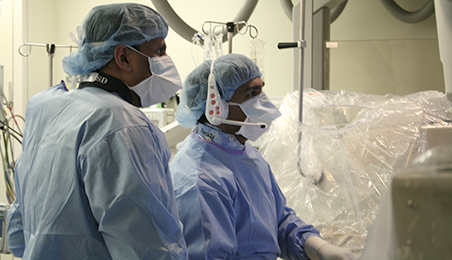
The new device is designed to address atrial fibrillation, a malfunction that throws the heart out of rhythm, causing the upper chambers to beat too quickly. Often seen in aging patients, it interferes with electrical signals that drive the heartbeat. Patients with the condition have a five times greater risk of stroke, and a greater chance of having a more serious stroke.
The WATCHMAN device, the size of a quarter and shaped like a parachute, is implanted into the heart to close off the left-atrial appendage, a blind pouch of heart tissue where blood clots form and can then break off and travel in the blood stream to the brain and cause strokes. The device is inserted into the heart through a vein in the leg during a one-time, minimally invasive, catheter-based procedure in the Electrophysiology Laboratory.
"Blood-thinning medications like warfarin or Coumadin are quite effective in reducing the risk for stroke in patients with atrial fibrillation. However, many of our patients cannot, or will not, tolerate these medications because of the incidence of bleeding. The WATCHMAN device is a solution for such atrial fibrillation patients, since it similarly reduces their stroke risk, but averts their need for a lifetime of blood-thinners," says the electrophysiologist who led the procedure, Vivek Reddy, MD, Director of Arrhythmia Services at The Mount Sinai Hospital and the Mount Sinai Health System.
Dr. Reddy served as co-principal investigator for national clinical trials testing the WATCHMAN device. The recently published results of these trials revealed that the device offers an efficient alternative to warfarin, and prevents strokes just as well. Patients with the device implanted also had a 60 percent reduction in cardiovascular mortality and 34 percent reduction in all-cause mortality.
Warfarin is the most common treatment currently used to reduce stroke risk in patients with atrial fibrillation. However, warfarin is not well-tolerated by all patients and has significant risk for bleeding complications, and patients need to be closely monitored with bi-weekly blood tests.
"This advanced technology will be truly life-changing for many atrial fibrillation patients freeing them from not only the dangers of stroke risk, but also the daily challenges of long-term blood-thinning medication therapy," says Valentin Fuster, MD, PhD, Director of Mount Sinai Heart and Physician-in-Chief of The Mount Sinai Hospital.
The newly U.S. FDA-approved WATCHMAN, made by Boston Scientific, Inc., is approved in more than 70 countries worldwide.
Dr. Reddy has served as a consultant to Boston Scientific, Inc., the manufacturer of the WATCHMAN device.
About the Mount Sinai Health System
Mount Sinai Health System is one of the nation’s leading integrated academic health systems and one of the largest in the New York metropolitan area. Its comprehensive system includes seven hospitals, more than 400 outpatient practices, over 600 research and clinical laboratories, the Icahn School of Medicine at Mount Sinai, the Graduate School of Biomedical Sciences, and the Mount Sinai Phillips School of Nursing. Together, the Health System comprises approximately 48,000 employees, more than 9,000 physicians, and 8,600 nurses.
As a leading learning health system, Mount Sinai combines clinical expertise with scientific discovery to improve patient care while training the next generation of health care and biomedical leaders. The Health System provides care across every stage of life, from prenatal care through geriatrics, while advancing personalized medicine through artificial intelligence, data science, and biomedical research.
Mount Sinai is consistently recognized among the nation’s leading academic health systems for patient care, research, and education. The Mount Sinai Hospital is ranked No. 1 in New York by Newsweek® and No. 7 in the U.S. on the magazine’s World’s Best Hospitals 2026 list. The Icahn School of Medicine at Mount Sinai ranks No. 9 among U.S. medical schools and No. 1 among freestanding medical schools for National Institutes of Health grant funding, reflecting the strength of its scientific enterprise and leadership in biomedical research.