
New York City Virus Hunters Detect H5N1 Avian Influenza in New York City Wild Birds
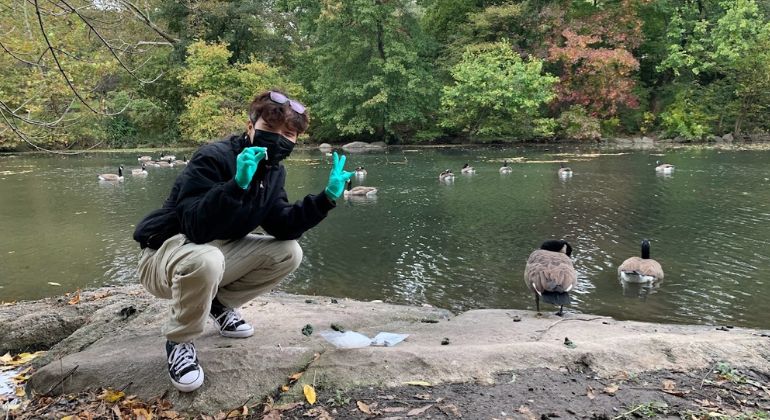
Image credit: Christine Marizzi, PhD, BioBus
The bird flu virus H5N1, which has caused outbreaks in birds and other animals across the country, is present in a small number of New York City wild birds, according to a recent study conducted by researchers from the Icahn School of Medicine at Mount Sinai in collaboration with BioBus and the Wild Bird Fund, published on May 15 in the Journal of Virology.
The finding highlights the fact that the interface between animals and humans that may give rise to zoonotic infections (infections that spread from animals to humans) is not limited to rural environments and commercial poultry operations, but extends into cities where wild animals and humans also frequently come into contact.
“We do really important work here to monitor the urban animal-human interface in one of the most populated cities in the United States and work closely with our partners to report all cases,” said Florian Krammer, PhD, Mount Sinai Professor of Vaccinology at Icahn Mount Sinai and a lead author of the paper.
Philip Meade, PhD, a postdoctoral fellow who is Mount Sinai’s lead scientist on the project, added: “People can rest assured that our finding of H5N1 in city birds does not signal the start of a human influenza pandemic. We know that H5N1 has been around in New York City for about two years and there have been no human cases reported, so as of today, the risk is low. However, we also should not ignore the urban animal-human interface, especially since urban centers have high population densities and disease can spread here more quickly than in other locales. Our team continues to stay alert and monitor for these emerging pathogens.”
The new study is a product of a program to monitor wild birds, the New York City Virus Hunters Program, which is a collaboration between virology researchers at Icahn Mount Sinai; BioBus, a science education nonprofit known for its mobile laboratories that bring science to students; and the Wild Bird Fund, a wildlife rehabilitation center. Through the program, local high school students partake in the research as paid interns under expert mentorship. Wearing appropriate protective gear, students collect bird fecal samples in urban parks and green spaces. Additional samples from wild birds are submitted to the study by local animal rehabilitation centers, including the Wild Bird Fund and Animal Care Centers of New York. Students then help screen all samples in the Krammer Laboratory at Mount Sinai to scan for viruses.
“Birds are key to finding out which influenza and other avian viruses are circulating in the New York City area as well as important for understanding which ones can be dangerous to both other birds and humans,” said study co-author Christine Marizzi, PhD, Principal Investigator of the New York City Virus Hunters Program and Director of Community Science for BioBus. “We need more eyes on the ground, which is why community involvement is critical.”
For this study, the New York City Virus Hunters collected and screened 1,927 samples between January 2022 and November 2023 and detected H5N1 in six city birds representing four different species (Canada geese, a peregrine falcon, a red-tailed hawk and a chicken). All six positive samples came from urban wildlife rehabilitation centers, highlighting the role such centers can play in viral surveillance. By comparing the genetic makeup of each positive sample to the others and to other available H5N1 viruses in a public database, the researchers found that they were slightly different and belonged to two different genotypes, which are both a mix of Eurasian H5N1 2.3.4.4.b clade virus and local, North American avian influenza viruses. New York City is a popular stopover location for migrating wild birds.
“People should stay alert and stay away from wildlife. This includes preventing your pets from getting into close contact with wildlife,” said Dr. Marizzi. “If one must handle wildlife, it is important to use safe practices when handling a sick or injured bird or other animals. Folks should wear gloves, a face mask and eye protection in addition to always washing hands with soap and water after removing protective equipment and cleaning reusable items. By staying alert and applying this knowledge, we can each do our part to protect ourselves and the animals around us from viral spread.”
The work of the New York City Virus Hunters is part of an ongoing study supported by the FluLab and a new Science Education Partnership Award grant from the National Institute of General Medical Sciences at the National Institutes of Health. The leadership team’s hope is to continue screening samples and have many more students and teachers participate over the years to come. They also hope the program will be replicated around the world as part of an international effort to map influenza virus in birds in urban areas. Reagents produced from the viral sequences found in this study will also be useful for additional H5N1 research.
About the Mount Sinai Health System
Mount Sinai Health System is one of the nation’s leading integrated academic health systems and one of the largest in the New York metropolitan area. Its comprehensive system includes seven hospitals, more than 400 outpatient practices, over 600 research and clinical laboratories, the Icahn School of Medicine at Mount Sinai, the Graduate School of Biomedical Sciences, and the Mount Sinai Phillips School of Nursing. Together, the Health System comprises approximately 48,000 employees, more than 9,000 physicians, and 8,600 nurses.
As a leading learning health system, Mount Sinai combines clinical expertise with scientific discovery to improve patient care while training the next generation of health care and biomedical leaders. The Health System provides care across every stage of life, from prenatal care through geriatrics, while advancing personalized medicine through artificial intelligence, data science, and biomedical research.
Mount Sinai is consistently recognized among the nation’s leading academic health systems for patient care, research, and education. The Mount Sinai Hospital is ranked No. 1 in New York by Newsweek and No. 5 on the magazine’s World’s Best Hospitals list. The Icahn School of Medicine at Mount Sinai ranks No. 11 among U.S. medical schools and No. 1 among freestanding medical schools for National Institutes of Health funding, reflecting the strength of its scientific enterprise and leadership in biomedical research.