Mount Sinai Researcher Receives NIH Award to Study Immune Responses of Patients With Inflammatory Skin Diseases in the Setting of COVID-19 Infection
Patients with moderate to severe atopic dermatitis (also known as eczema) who take a biologic treatment such as dupilumab seem to be protected from developing serious complications of COVID-19 and are also less likely to be hospitalized due to complications. Now, researchers from the Icahn School of Medicine at Mount Sinai have received a grant from the National Institutes of Health (NIH) on behalf of the National Institute of Allergy and Infectious Disease (NIAID) to study the immune responses of these patients in the setting of COVID-19 infection.
This two-year award is an addition to a seven-year grant also awarded by the NIH/NIAID to study mechanisms leading to variations in atopic dermatitis phenotypes. The total grant amounts to over $2 million.
The study will aim to understand whether systemic medications and biologics, such as dupilumab—a monoclonal antibody that binds to an inflammatory molecule, IL-4 receptor alfa, and inhibits the inflammatory response that leads to rashes and itching from atopic dermatitis/eczema—may have a positive or negative impact on COVID-19 responses in patients who have the disease.
“This research project has the potential to directly impact the medical care of tens of thousands of patients in the United States with atopic dermatitis on systemic medications in the setting of the COVID-19 pandemic, reducing morbidity and mortality, particularly in populations disproportionately affected, such as African Americans,” said Emma Guttman-Yassky, MD, PhD, Sol and Clara Kest Professor of Dermatology and Vice Chair of the Department of Dermatology at Icahn School of Medicine at Mount Sinai and grant recipient.
According to Dr. Guttman-Yassky, ethnic populations including African Americans are more affected by severe atopic dermatitis/eczema and also have a higher prevalence of asthma along with other risk factors such as diabetes and hypertension.
Dr. Guttman-Yassky hopes the study will help to determine whether systemic treatments, including specific monoclonal antibodies impact responses to COVID-19 infection, and whether some of these treatments can protect from deleterious COVID-19 effects.
“Understanding these immune responses in the presence of patients with atopic dermatitis is extremely important as it will help to guide how we treat patients with COVID-19 during this very critical period and help provide a possible new treatment directed towards this virus,” she said.
Mount Sinai’s dermatology practices have more than 1,200 moderate-to-severe atopic dermatitis patients who are taking dupilumab. And while the data is still preliminary, according to Dr. Guttman-Yassky, no patients have been reported in her practice as being hospitalized with COVID-19, although many have been exposed to the disease.
With such a large database of Mount Sinai patients with atopic dermatitis, Dr. Guttman-Yassky also hopes to determine ethnic differences in mounting COVID-19 responses in the setting of systemic and biologic treatments.
“Having a better understanding of differential immune responses mounted to COVID-19 may offer a basis for evaluating additional therapeutic approaches for this disease and other infections,” she said.
About the Mount Sinai Health System
Mount Sinai Health System is one of the nation’s leading integrated academic health systems and one of the largest in the New York metropolitan area. Its comprehensive system includes seven hospitals, more than 400 outpatient practices, over 600 research and clinical laboratories, the Icahn School of Medicine at Mount Sinai, the Graduate School of Biomedical Sciences, and the Mount Sinai Phillips School of Nursing. Together, the Health System comprises approximately 48,000 employees, more than 9,000 physicians, and 8,600 nurses.
As a leading learning health system, Mount Sinai combines clinical expertise with scientific discovery to improve patient care while training the next generation of health care and biomedical leaders. The Health System provides care across every stage of life, from prenatal care through geriatrics, while advancing personalized medicine through artificial intelligence, data science, and biomedical research.
Mount Sinai is consistently recognized among the nation’s leading academic health systems for patient care, research, and education. The Mount Sinai Hospital is ranked No. 1 in New York by Newsweek® and No. 7 in the U.S. on the magazine’s World’s Best Hospitals 2026 list. The Icahn School of Medicine at Mount Sinai ranks No. 9 among U.S. medical schools and No. 1 among freestanding medical schools for National Institutes of Health grant funding, reflecting the strength of its scientific enterprise and leadership in biomedical research.
New Research Sheds Light on Why Eczema So Often Begins in Childhood
Feb 25, 2026 View All Press Releases
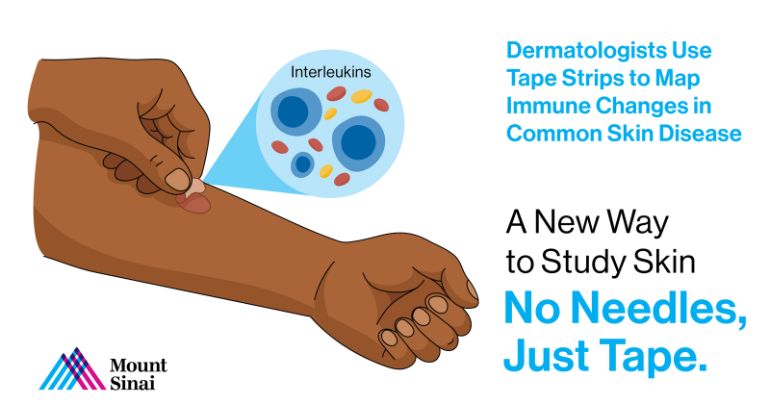
Mount Sinai Dermatologists Use Tape Strips to Map Immune Changes in Common Skin Disease
Jun 10, 2025 View All Press Releases