
Mount Sinai St. Luke’s Cardiothoracic Surgeons Successfully Perform First Closed Chest Coronary Bypass Procedure
Mount Sinai Heart is the only center in New York offering the specialized endoscopic surgery

Mount Sinai Heart has become the only center in New York State offering heart bypass surgery without major incisions or cutting through the breastbone. The procedure, known as totally endoscopic coronary arterial bypass surgery or TECAB, is performed using only micro-incisions and offers eligible patients a much quicker recovery and less pain, scarring, and risk of infection.
Two leading Mount Sinai Health System cardiothoracic heart surgeons—John Puskas, MD, and Gianluca Torregrossa, MD—performed the system’s first two TECAB procedures during the week of May 28 at Mount Sinai St. Luke’s.
TECAB is a highly technical approach to coronary artery bypass surgery, which is the most common heart surgery in the country. Its benefits also include no rib spreading and a reduced risk of stroke.
“We are proud and excited to have successfully performed this advanced coronary procedure at Mount Sinai St Luke’s,” says Dr. Puskas, Chair of Cardiovascular Surgery at Mount Sinai St. Luke’s, Mount Sinai Beth Israel, and Mount Sinai West. “We can now offer this less painful procedure with easier recovery for patients with severe coronary heart disease.”
“TECAB allows us to avoid any major chest incisions for our patients, giving them a dramatic improvement in postoperative recovery,” explains Dr. Torregrosa, Associate Director of Robotic Heart Surgery at Mount Sinai St. Luke’s. “The minimally invasive aspect of this procedure allows us to maximize the benefit of coronary artery bypass grafting even for those patients that are not ideal candidates for conventional surgery.”
Drs. Puskas and Torregrossa performed the TECAB surgeries—a single bypass and a double bypass—through four keyhole (fingertip-size) incisions less than one centimeter long. Standard bypass surgery involves a large chest incision that can be up to twelve inches long. The surgeons placed robotic instruments through the micro-incisions to harvest the mammary artery. Then, they used a highly specialized automatic device to connect the mammary artery to the coronary artery on the front wall of the heart and fired 13 tiny stainless steel clips to instantly hold the arteries together with a high degree of precision. In the traditional bypass procedure, the surgeon has to spread open the patient’s chest and sew the arteries together by hand.
With TECAB, patients can go home one to four days after surgery, and return to normal activities just one to two weeks later. Patients who have open-chest bypass are typically in the hospital for a week to 10 days and can’t go back to full activity for about three months.
“This is a very technically demanding procedure, with few bypass surgeons having enough skill or training to employ it. Our cardiac team is equipped to handle such intricate, advanced procedures and our modernized facility is outfitted with a state-of-the-art surgical robot to assist them,” says Arthur Gianelli, President of Mount Sinai St. Luke’s. “By offering this innovative bypass procedure at Mount Sinai St. Luke’s, our team leaps ahead in coronary artery bypass grafting surgery in New York and the Northeast and we are well positioned as one of the top cardiac programs in the world.”
Many bypass patients may qualify for TECAB. The best candidates are those with a limited number of blockages on the left side of the heart who want to avoid a traditional operation. Surgeons cannot perform TECAB on patients who have had previous heart surgery or exposure to cancer radiation therapy near the chest.
For more information on Mount Sinai Heart St. Luke’s visit this link: https://www.mountsinai.org/locations/st-lukes/care/heart
About the Mount Sinai Health System
Mount Sinai Health System is one of the nation’s leading integrated academic health systems and one of the largest in the New York metropolitan area. Its comprehensive system includes seven hospitals, more than 400 outpatient practices, over 600 research and clinical laboratories, the Icahn School of Medicine at Mount Sinai, the Graduate School of Biomedical Sciences, and the Mount Sinai Phillips School of Nursing. Together, the Health System comprises approximately 48,000 employees, more than 9,000 physicians, and 8,600 nurses.
As a leading learning health system, Mount Sinai combines clinical expertise with scientific discovery to improve patient care while training the next generation of health care and biomedical leaders. The Health System provides care across every stage of life, from prenatal care through geriatrics, while advancing personalized medicine through artificial intelligence, data science, and biomedical research.
Mount Sinai is consistently recognized among the nation’s leading academic health systems for patient care, research, and education. The Mount Sinai Hospital is ranked No. 1 in New York by Newsweek and No. 5 on the magazine’s World’s Best Hospitals list. The Icahn School of Medicine at Mount Sinai ranks No. 11 among U.S. medical schools and No. 1 among freestanding medical schools for National Institutes of Health funding, reflecting the strength of its scientific enterprise and leadership in biomedical research.
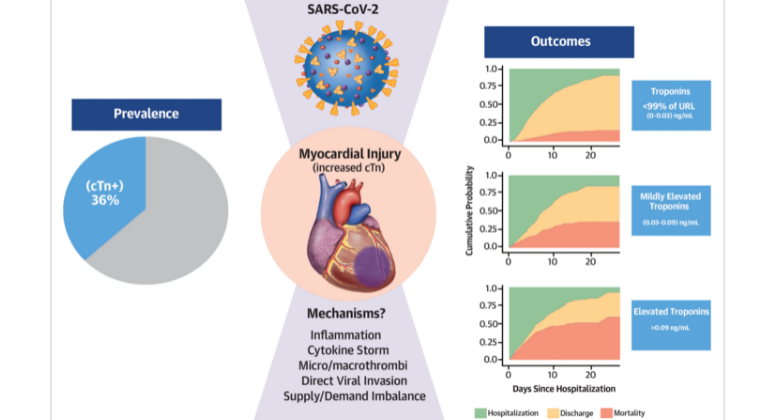
Heart Injury Among Hospitalized COVID-19 Patients Associated with Higher Risk of Death
Jun 08, 2020 View All Press Releases