
New Research Shows Children Exposed to Natural Disasters in the Womb Have Higher Rates of Developmental Psychopathology in a Sex-Specific Manner
Findings are the latest in a longitudinal study following children born to mothers impacted by Superstorm Sandy
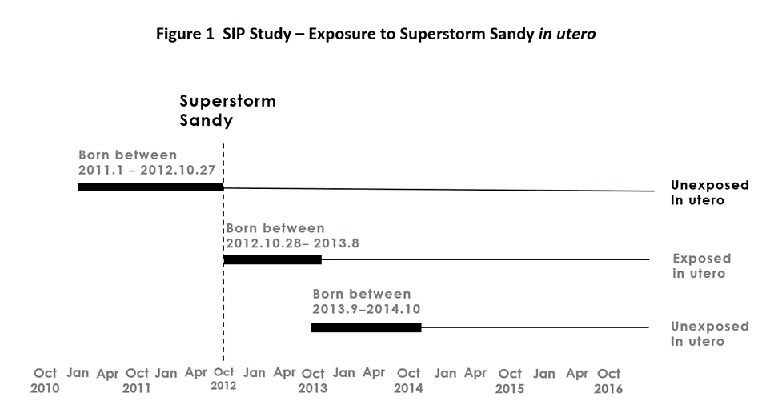

New data from the longitudinal Stress in Pregnancy Study (SIP Study) have identified earlier onset and higher rates of developmental psychopathology among children whose mothers were pregnant with them during Superstorm Sandy. In addition, the child’s biological sex determined specific patterns of elevated risks.
According to the research, conducted by researchers from the Icahn School of Medicine at Mount Sinai and the CUNY Graduate Center and published Wednesday, September 21, in the Journal of Child Psychology and Psychiatry, children prenatally exposed to the natural disaster that hit metropolitan New York in October 2012 had substantially increased risks for depression, anxiety, and attention deficit/disruptive behavior disorders compared to children who were not. Further, male children had distinctly and substantially elevated risks for attention deficit and disruptive behavioral disorders (including attention deficit/hyperactivity disorder (ADHD), conduct disorder, and oppositional defiant disorder), while female children had elevated risks for anxiety disorders, phobia, and depressive disorders (including separation anxiety disorder, generalized anxiety disorder, and dysthymia).
Researchers analyzed data collected from 163 preschool-aged children from diverse racial and economic backgrounds, 40.5 percent of whom were exposed to Superstorm Sandy in utero and 59.5 percent of whom were not, either having already been born prior to the storm or in utero following the storm. The team conducted structured clinical interviews with the children’s parents and reviewed available diagnostic health data on the participating children, whose median age at the initial clinical interview was 3.19 years.
“We’ve known for some time that maternal stress during pregnancy plays a key role in the mental health development of the child,” said the study’s Principal Investigator Yoko Nomura, PhD, a psychology professor at the CUNY Graduate Center and Queens College. “The SIP Study leveraged an unfortunate climate-related disaster and conducted a natural experiment to examine the impact of prenatal stress in utero on subsequent development and risks for developmental psychopathology during early childhood. Understanding these connections and distinctions grows more necessary every day with the increased frequency of natural disasters driven by climate change.”
The team’s recent findings, as well as those from a previous SIP Study examining underlying differences in placental transcriptomes, could help clarify the link between exposure to the effects of a natural disaster in the womb and the early risks of developmental psychopathology. Although the underlying mechanisms through which in utero exposure to a natural disaster negatively impacts early mental health development are still unclear, the growing body of research points to the important relationship between environmental and genetic effects.
“Our ongoing study elucidates the impact of environmental stress on the psychiatric development of preschool children and the elevated risks for early psychopathology in this population,” said Jeffrey Newcorn, MD, Professor of Psychiatry, and Pediatrics, and director of the Division of ADHD and Learning Disorders at Icahn Mount Sinai, a co-author on the study. “Most strikingly, the type of mental health problems very much depended on the biological sex of the child.”
Taken together, the SIP Study findings should serve as an important resiliency-strategy resource that informs health care professionals, policymakers, and educational institutions on the need for infrastructure that supports pregnant women and families exposed to climate-related natural disasters in order to mitigate early mental health risks and promote healthy childhood development.
This study was funded by the National Institute of Mental Health.
About the Mount Sinai Health System
Mount Sinai Health System is one of the nation’s leading integrated academic health systems and one of the largest in the New York metropolitan area. Its comprehensive system includes seven hospitals, more than 400 outpatient practices, over 600 research and clinical laboratories, the Icahn School of Medicine at Mount Sinai, the Graduate School of Biomedical Sciences, and the Mount Sinai Phillips School of Nursing. Together, the Health System comprises approximately 48,000 employees, more than 9,000 physicians, and 8,600 nurses.
As a leading learning health system, Mount Sinai combines clinical expertise with scientific discovery to improve patient care while training the next generation of health care and biomedical leaders. The Health System provides care across every stage of life, from prenatal care through geriatrics, while advancing personalized medicine through artificial intelligence, data science, and biomedical research.
Mount Sinai is consistently recognized among the nation’s leading academic health systems for patient care, research, and education. The Mount Sinai Hospital is ranked No. 1 in New York by Newsweek® and No. 7 in the U.S. on the magazine’s World’s Best Hospitals 2026 list. The Icahn School of Medicine at Mount Sinai ranks No. 9 among U.S. medical schools and No. 1 among freestanding medical schools for National Institutes of Health grant funding, reflecting the strength of its scientific enterprise and leadership in biomedical research.