
Could Gene Networks Resembling Air Traffic Explain Arteriosclerosis?
Mount Sinai-led study suggests that nearly 60 percent of the risk associated with coronary artery disease may be explained by the activity of multi-organ, gene networks orchestrated by fat processing hormones
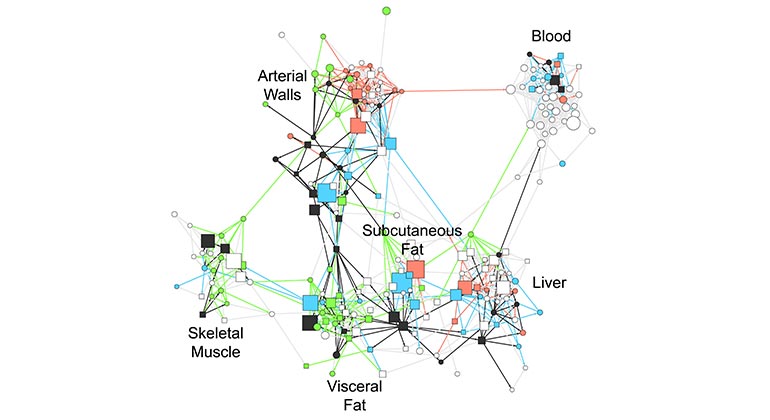
Up to 60 percent of the risk associated with coronary arteriosclerosis may be explained by changes in the activity of hundreds of genes working together in networks across several organs in the body. Moreover, fat processing hormones may play a central role in coordinating this activity. That is the primary result of a study that began nearly 20 years ago on a hunch and involved hundreds of coronary artery disease patients from Northern Europe. The study was led by researchers at the Icahn School of Medicine at Mount Sinai.
“It is well known that coronary artery diseases are driven by metabolic disorders. Our results suggest that much of this relationship is best explained by a complex series of multi-organ gene regulatory networks that are reminiscent of the hub and spoke maps used to depict global airline traffic,” said Johan L.M. Bjorkegren, MD, PhD, Professor of Genetics and Genomic Sciences, and Medicine (Cardiology), and a senior author of the study published in Nature Cardiovascular Research. “We hope these network maps will give researchers the mechanistic framework needed to combat cardiovascular disease and develop more precise and personalized therapies.”
Coronary artery disease results from a set of metabolic disorders which cause cholesterol and other factors to build up and clog a person’s coronary arteries. This may lead to heart attacks or strokes. Affecting about 18.2 million Americans, coronary artery disease is the most common cause of heart disease in the United States. Risk factors, such as high cholesterol, high blood pressure, high blood sugar, and obesity, can involve a variety of organs. Although recent studies have shown that about 20 percent of the risk associated with this disease may be linked to slight differences in a person’s DNA sequences, very little is known about how these differences may alter gene activity to produce coronary artery disease.
To address this issue, researchers studied the gene activity across seven different tissues found in the body. Tissue samples were obtained from 850 Estonian patients during open breast surgery. The patients were part of the Stockholm-Tartu Atherosclerosis Reverse Network Engineering Task (STARNET) study. Six hundred of the patients had coronary artery disease whereas the other 250 did not. Tissue samples were collected by researchers in the lab of Arno Ruusalepp, MD, PhD, who is chief vascular surgeon at the Tartu University Hospital in Estonia.
Gene activity was analyzed from the following tissue samples: blood, liver, skeletal muscle, visceral abdominal and subcutaneous fat, and two pieces of the arterial wall taken from different parts of the heart. Dr. Bjorkegren began the study more than 20 years ago when he was training as a heart surgeon.
“Back then I had a hunch. Advances in genome sequencing and the Human Genome Project offered researchers the promise to fully understand the biology behind complex disorders. Scientists were showing how these disorders can be linked to dozens of tiny DNA sequence differences, most of which are not part of any gene codes. Thus, we needed a way to understand how these tiny but numerous DNA differences may actually cause metabolic disorders and coronary artery disease. These patients provided a unique opportunity to bridge this knowledge gap by allowing my team to measure gene activity in disease-relevant organs throughout the body,” said Dr. Bjorkegren.
Gene activity was determined by measuring the levels of RNA molecules in each tissue sample. These RNA molecules essentially contain photocopies of the DNA instructions for making life-sustaining proteins and other types of RNA molecules that are encoded in our genes.
Dr. Bjorkegren’s team worked with researchers from around the world to test out the different ways that gene activity may be associated with the development of coronary artery disease. In particular, researchers in the lab of Jason Kovacic, MD, PhD, Executive Director at the Victor Chang Cardiac Research Institute in Darlinghurst, Australia, played an instrumental role.
Initial results supported previous findings that the activity of individual genes from certain tissues may be associated with a variety of cardiometabolic disorders as well as coronary artery disease. For instance, liver cells from coronary artery disease patients had greater changes in the activity of genes that control cholesterol production than those from control patients. However, these results did not fully explain how the activity of these genes worked together to cause coronary artery disease.
In contrast, most of the risk could be explained by different networks of disease-associated gene activity. Here the researchers used advanced computer programs to test out how the activity of all of the disease-related genes were grouped together in different combinations. Then, the validity of these networks were tested out using data from previously published reports.
In addition to the 20 percent identified by earlier studies, the results of the current study showed that an additional 54-60 percent of the risk associated with coronary artery disease could be explained by 224 of these gene regulatory networks and that many of these networks could help explain the status of arteriosclerosis severity in individual cases. Of those networks, 135 were located within one type of tissue whereas the remaining 89 represented coordinated gene activity across multiple tissues.
The multi-tissue networks appeared to have the greatest impact. On average they could explain three times more of the disease risk than the single-tissue ones. One example of a multi-tissue network, called GRN165, accounted for 4.1 percent of risk for coronary artery disease and involved 709 genes active in the arterial wall as well as the subcutaneous fat tissue.
“We found that gene networks work like airplane traffic patterns. Just as a delay at one airport in a key state can disrupt flights in the entire nation, we found that a slight change in the activity of key genes in one tissue can disrupt the activity of other genes throughout rest body,” said Dr. Bjorkegren.
Finally, the analysis suggested that hormones which help fat cells communicate with other organs—particularly the liver—play a critical role in coordinating the multi-organ networks. Support for this idea was, in part, based on experiments in mice when injections of some of these hormones altered blood fat and sugar levels.
Dr. Bjorkegren’s team has set up a website where researchers can test whether a candidate gene may be part of these networks (starnet.mssm.edu).
“Ultimately we hope that this study gives researchers the tools they need to reduce the burden of coronary artery disease throughout the world,” said Dr. Bjorkegren.
This work was supported by the National Institutes of Health (HL125863, HL130423, HL135093, HL148167, HL144651, HL147883, HL028481, HL138193, DK117850); the American Heart Association (A14SFRN20840000), the Swedish Research Council (2018-02529); the Heart Lung Foundation (20170265); Karolinska Institutet/AstraZeneca Integrated Cardio Metabolic Centre (Sweden); the Foundation Leducq (18CVD02, 12CVD02); the European Union (HEALTH-F2-2013-601456); the British Heart Foundation (BHF)-German Center of Cardiovasular Research (DZHK) collaboration; ERA-NET (01KL1802; European Union); the Federal German Ministries (01ZX1706C, 16GW0198K, ZF4590201BA8); and the Deutsche Forschungsgemeinschaft (CRC 1123 (B2), TRR 267 (B05), Germany); DigiMed Bayern (DBM-1805-0001, Germany); New South Wales Government (RG194194, Australia).
Article
Koplev, S..; A mechanistic framework for cardiometabolic and coronary artery disease - The Stockholm-Tartu Atherosclerosis Reverse Network Engineering Task (STARNET) study, Nature Cardiovascular Research, January 12, 2022, DOI: 10.1038/s44161-021-00009-1.
About the Mount Sinai Health System
Mount Sinai Health System is one of the nation’s leading integrated academic health systems and one of the largest in the New York metropolitan area. Its comprehensive system includes seven hospitals, more than 400 outpatient practices, over 600 research and clinical laboratories, the Icahn School of Medicine at Mount Sinai, the Graduate School of Biomedical Sciences, and the Mount Sinai Phillips School of Nursing. Together, the Health System comprises approximately 48,000 employees, more than 9,000 physicians, and 8,600 nurses.
As a leading learning health system, Mount Sinai combines clinical expertise with scientific discovery to improve patient care while training the next generation of health care and biomedical leaders. The Health System provides care across every stage of life, from prenatal care through geriatrics, while advancing personalized medicine through artificial intelligence, data science, and biomedical research.
Mount Sinai is consistently recognized among the nation’s leading academic health systems for patient care, research, and education. The Mount Sinai Hospital is ranked No. 1 in New York by Newsweek® and No. 7 in the U.S. on the magazine’s World’s Best Hospitals 2026 list. The Icahn School of Medicine at Mount Sinai ranks No. 9 among U.S. medical schools and No. 1 among freestanding medical schools for National Institutes of Health grant funding, reflecting the strength of its scientific enterprise and leadership in biomedical research.


At the Extremes, Human Traits May Have Different Genetic Basis
May 27, 2026 View All Press Releases
Study Reveals “Bet-Hedging” Strategy That Helps Gut Bacteria Survive and Recover
May 19, 2026 View All Press Releases
New Research Reveals Autism Risk Genes Are Shared Across Ancestries
Mar 30, 2026 View All Press Releases

Scientists Develop a Smarter mRNA Therapy That Knows Which Cells to Target
Dec 15, 2025 View All Press Releases
New AI Tool Identifies Not Just Genetic Mutations, But the Diseases They May Cause
Dec 15, 2025 View All Press Releases