

Lung Cancer Program
The Mount Sinai Health lung cancer specialists diagnose, treat, and manage all stages of lung cancer. We can also help with prevention and are highly skilled and experienced with tumors of the chest or thoracic area. We offer advanced and non-surgical procedures. Our doctors’ work together to provide individualized treatment that best meets your needs.
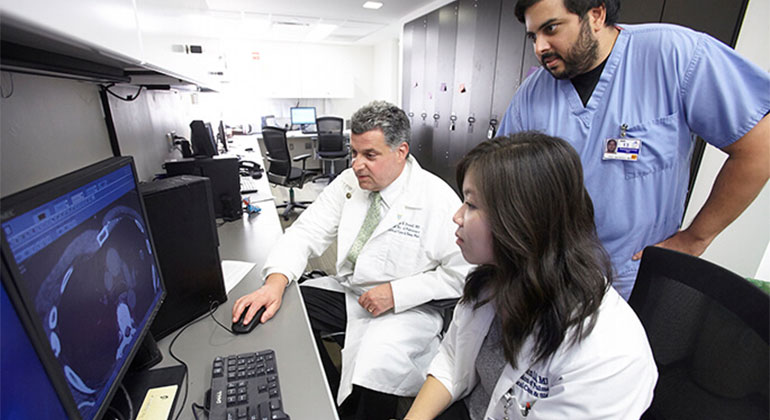
Our team approach brings together pulmonologists and other specialists for diagnosis and treatment. Our experts include cardiologists, allergists, gastroenterologists, rheumatologists, ENT (ear, nose, and throat) specialists, and thoracic surgeons.
Types of Lung Cancer
There are two particular types of lung cancer that you may be faced with: small cell cancer or non-small cell cancer.
Small cell lung cancer (SCLC) has two stages: combined small cell carcinoma and small cell carcinoma. Approximately 10% to 15% of lung cancers are SCLC.
The far more common type of lung cancer is non-small cell lung cancer (NSLC) which accounts for 85 to 90% of lung cancers. NSCLC’s include adenocarcinoma, large cell carcinoma, and squamous cell carcinoma.
Causes of Lung Cancer
There are multiple risk factors that are attributed to causing lung cancer. Some of these causes may include:
- Exposure to airborne toxins
- Family history/genetics
- Secondhand smoke
- Smoking
Symptoms of Lung Cancer
The sooner you can receive a lung cancer diagnosis, the better the chances you have at defeating the disease. Lung cancer may not cause any symptoms early in the course of the disease. Please contact one of our pulmonologists if you are experiencing a combination or all of the following symptoms:
- Chest pain that is often worse with deep breathing, coughing, or laughing.
- Chronic cough
- Coughing up blood or rust-colored sputum (spit or phlegm)
- Extreme fatigue
- Hoarseness
- Shortness of breath
- Weight loss and loss of appetite
Diagnostic Techniques for Lung Cancer
The diagnosis of lung cancer generally involves some type of biopsy. Most patients receive one of two general types of biopsy, either a needle biopsy by a radiologist while lying in a CT scanner for guidance, or by bronchoscopy. Bronchoscopies are performed by either pulmonologists or thoracic surgeons, and involve insertion of a small flexible tube into the airway under sedation. Bronchoscopic biopsy techniques include:
- Electromagnetic Navigation Guided biopsy
- Endobronchial ultrasound (EBUS) – transbronchial needle aspiration
- Transbronchial forceps biopsy
Treatments for Lung Cancer
We offer a wide variety of treatments for lung cancer. Treatments will depend on the type of lung cancer you have: small cell or non-small cell.
Small cell lung cancer
The treatment options for small cell lung cancer (SCLC) are based mainly on the stage (extent) of the cancer, but other factors, such as a person’s overall health and lung function are also important. Sometimes, more than one of type of treatment is used. If you have SCLC, you may first start your treatment with chemotherapy. If you have limited stage disease, radiation therapy and surgery may be options as well.
- Chemotherapy
- Immunotherapy
- Palliative procedures
- Radiation therapy
- Surgery
Non-Small Cell Lung Cancer
The treatment options for non-small cell lung cancer (NSCLC) are mainly dependent upon on the cancer stage or your overall health and lung function as well as certain traits of the cancer itself, are also important. In many cases, multiple types of treatment may be used.
- Chemotherapy
- Immunotherapy
- Palliative procedures
- Radiofrequency Ablation (RFA)
- Radiation therapy
- Surgery
- Targeted drug therapy
Why Mount Sinai Respiratory Institute
The Mount Sinai Respiratory Institute delivers innovative, multidisciplinary care for patients with the full spectrum of lung and respiratory diseases. The Institute unites leading specialists in pulmonology, critical care, sleep medicine, allergy/immunology, cardiology, ENT, gastroenterology, rheumatology, and thoracic surgery, to provide fully integrated, patient-centered care under one roof. Anchored by Mount Sinai’s strong research enterprise and commitment to precision medicine, The Institute drives advances in diagnostics, personalized therapies, and clinical trials to improve outcomes for every patient. The Respiratory Institute creates new options for patients in New York City and the surrounding region.