
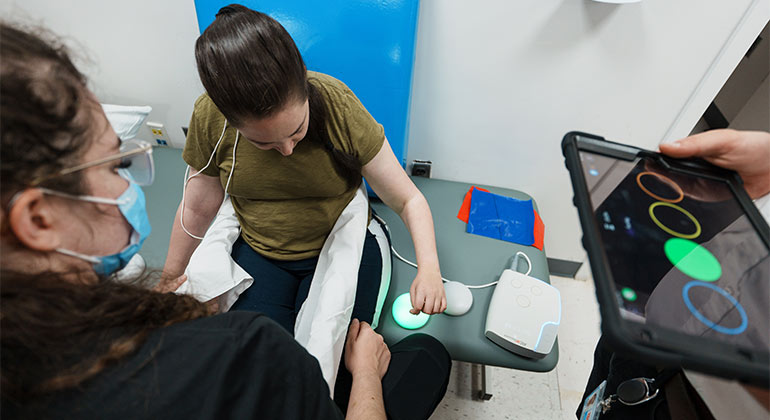
Upper Extremity Robotics
Regaining movement in the upper body is not easy. Paralysis interrupts the nerves that connect your limb (such as your arm or hand) with your brain. Since there is no connection, the brain cannot tell the limb what to do.
Fortunately, the body has built-in capability to “reprogram” itself to take a different route (use a different neuropathway) to connect the limb and the brain (called neuroplasticity). We achieve neuroplasticity by repeating the motion over and over until the body learns the new pathway. This is where physical therapy comes in.
Physical therapists work with you by moving your limbs to retrain the body. We can also use robots to perform the exercises. These robots offer a few advantages over humans: They have fewer patients so they can spend more time with each person. And they are entirely consistent, repeating the same motion in the same precise way for as long as their programming requires. These days, robotic therapy often supplements or even replaces physical therapists in some exercises. Physical therapists design the therapy routine.
Types of Upper Extremity Robotics
Your physical therapist will design the therapy to meet your individual needs. There are two types of upper extremity robotics:
- End-effector: Typically, these machines have a robotic arm that attaches to the patient’s arm, often with Velcro. The robot moves your arm through a series of specific movements. This approach is suitable for people of all body shapes and sizes.
- Exoskeleton: This is a “wearable” robot that attaches to the limb at several points. There are different types and brands of exoskeleton robotics, and each requires customization for individual patients.
Advantages of This Approach
Upper extremity robotics offers a variety of benefits: It can increase:
- Flexibility
- Range of motion
- Muscle coordination
- Sensation
- Strength
Upper extremity robotics enables you to perform the activities of daily living better and more easily. And that gives you more freedom and better quality of life.