
Nursing and AI Team Up Against Pressure Wounds
Billing Initiative Helps Patients at Adolescent Health Center Get Care Without Barriers
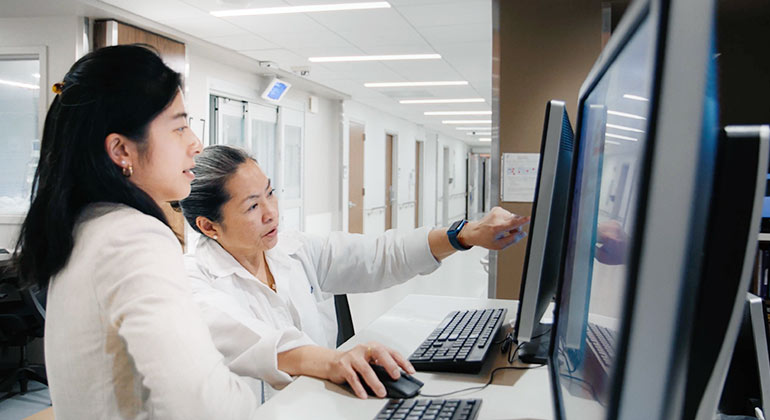
Kim-Anh-Nhi Nguyen, MSc, left, at work with Maria “Vickee” Sevillano, BSN, RN, CWCN, COCN,
Maria “Vickee” Sevillano, BSN, RN, CWCN, COCN, a wound care specialist at The Mount Sinai Hospital, had seen first-hand the toll that pressure injuries—commonly known as bedsores—can take on patients. Her compassion and drive to make things better inspired a cross-departmental collaboration that brought together nurses, software engineers, data scientists, and clinical leaders to create a machine learning model called PIPAI, short for Pressure Injury Prevention AI.
The challenge: Preventing pressure injuries
This systemwide effort began to take shape when Ms. Sevillano heard that Mount Sinai radiologists were using artificial intelligence (AI) to detect abnormalities in imaging, and began to wonder: Could nurses use AI to help prevent pressure injuries before they start?
She brought the idea to Robbie Freeman, DNP, RN, Chief Digital Transformation Officer for the Mount Sinai Health System, who assembled a multidepartmental team. “We embraced the idea, collaboratively explored its nuances through a co-design process, and partnered with our internal data scientists and software engineers to transform it into a fully realized product,” Dr. Freeman says.
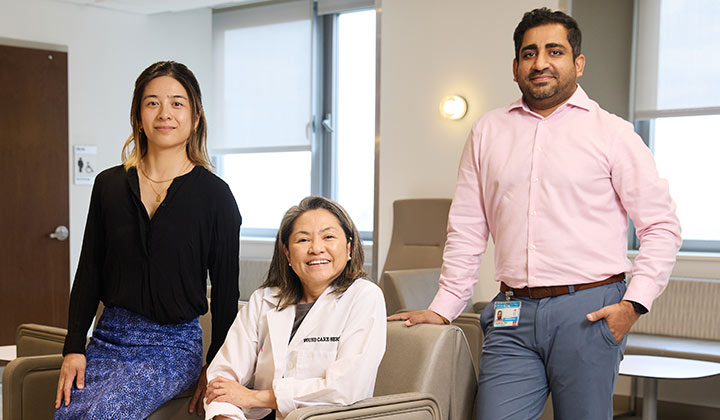
Kim-Anh-Nhi Nguyen, MSc; Maria “Vickee” Sevillano, BSN, RN, CWCN, COCN; and Dhaval Patel, MS, MBA, PA-C.
Introduced in early 2024, PIPAI has delivered promising results. The model is 50 percent more accurate than traditional risk assessments and led to a nine percent increase in patients discharged without pressure injuries in pilot units. It is now active on 15 units and being rolled out across the Mount Sinai Health System.
The solution: An AI tool, powered by nurses’ expertise
Kim-Anh-Nhi Nguyen, MSc, was the senior data scientist on the Clinical Data Science team that built the model. She notes that bedsores are a costly, often preventable challenge, leading to painful complications that prolong recovery. Each year they affect millions of patients in U.S. hospitals, she says, and traditional screening methods miss more than half of those at risk.
To develop the PIPAI technology, team members shadowed wound care nurses and mapped workflows to ensure smooth integration. They identified hundreds of clinical variables that could signal increased risk, and Ms. Sevillano helped train staff and drive adoption.
“We learn from the nurses—what’s working, what’s not—and retrain the model over time,” Ms. Nguyen says.
For Ms. Sevillano, the project has been both a professional challenge and a personal mission. “I am so excited and happy when a patient goes home with a healed pressure injury or no injury,” she says. “With this tool, maybe we can reduce pressure injuries around the world!”
We are Mount Sinai, identifying a patient care challenge, and addressing it with compassion and advanced technology.