
Power Squad Helps a Team Tackle Patients’ Wait Times
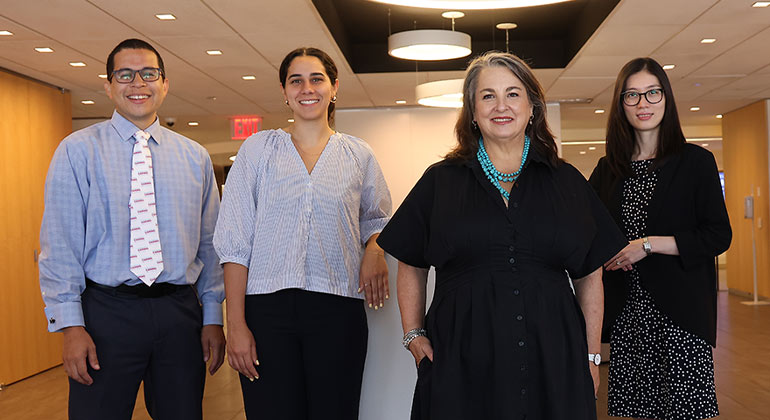
Power Squad:
From left: Edgar Benitez, MBA, SPHR; Isadora Braune, CPXP; Sabrina Segui Manniello, MS, CPXP; and Mei Yun Liu, MHA.
Long wait times—often reflected in patient surveys—are a common frustration for patients. To help create a seamless patient experience, the Commitment to Caring (C2C) Power Squad, a cross-departmental team, is exploring how communication and teamwork can help streamline the flow and minimize wait times. The team supports the Ambulatory Patient Experience Council (APEC), which promotes best practices and strategic improvements across the Mount Sinai Health System.
Guided by both data and patient comments, APEC’s Patient Experience Improvement coaches uncovered that the core issue wasn’t simply reducing wait times but also enhancing how teams communicate during delays so patients stay informed.
“Sometimes appointments take longer than expected. The key is having a consistent process to communicate updates in a timely manner so patients know what’s going on,” explains Sabrina Segui Manniello, MS, CPXP, Patient Experience Improvement Coach.
The coaches were able to identify and work on behaviors that helped improve communication about delays—both among team members and with patients—keeping everyone aware of issues. With this emphasis on inter-team communication, the teams saw “staff worked together” scores improve on patient surveys, as well as scores about informing patients about delays.
The effort exemplifies the systemwide One Mount Sinai initiative to unify people, processes, and technology to improve care and strengthen staff connections. “Our goal is to empower our staff to provide the best experience possible for patients. Ambulatory Patient Experience Coaching is one of APEC’s key initiatives that brings everyone together around that common purpose,” says Mei Yun Liu, MHA, Associate Director, Mount Sinai Doctors.
Isadora Braune, CPXP, Associate Director of Patient Experience, conducted the data analysis that highlighted opportunities to improve wait times. “When Sabrina met with the teams, she found that the key opportunity was to strengthen how teams share timely updates during delays,” Ms. Braune says.
The C2C Power Squad is focused on turning insights like these into actionable, data-driven improvements. The team equips ambulatory staff with tools, resources, and coaching to enhance patient experience. “Clear communication helps build trust,” says Edgar Benitez, MBA, SPHR, Associate Director of Training and Organizational Development, Mount Sinai Doctors. “When teams are open with each other and with patients, everyone feels more supported.”
As part of the initiative, coaches partner with departments by observing daily workflows, reviewing patient experience data, holding staff listening sessions, and analyzing insights from the Your Voice Counts survey. These findings help shape targeted strategies tailored to each department’s needs. Through this collaborative process, the coaches provide practical tools to strengthen communication and enhance teamwork across roles—all with the shared goal of improving patient experiences.
“It's not about one doctor, one nurse,” Mrs. Manniello says. “It's about what the team can do together? How can we put patients at ease? It makes them feel more welcome, more relaxed, more respected, and more heard.”
