
Billing Initiative Helps Patients at Adolescent Health Center Get Care Without Barriers
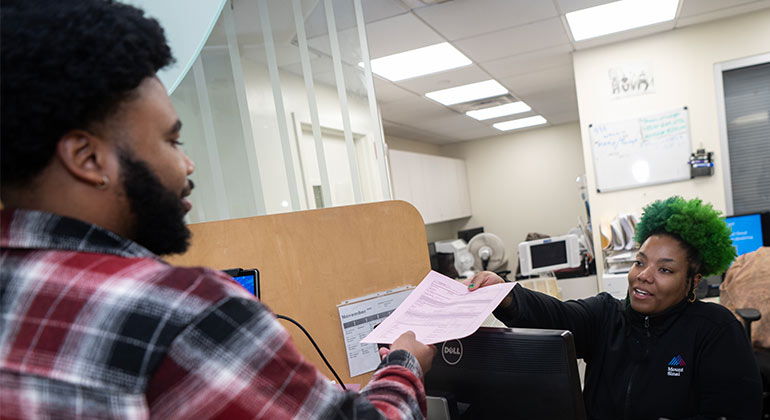
The Mount Sinai Adolescent Health Center provides health services at no direct cost to more than 8,000 patients each year.
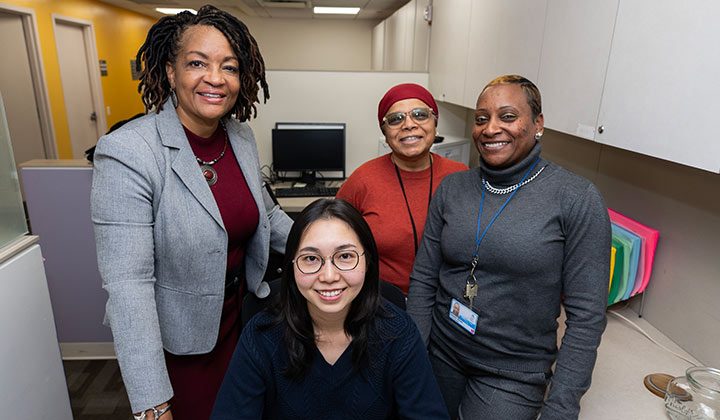
From left: Senior director Lyndia Hayden and management analyst Jiaying Zhu of the Office for Health Data, Outcomes, and Engagement Strategy, with finance director Rebecca Anapolle and practice manager Nadeisha Mcbean of the Adolescent Health Center.
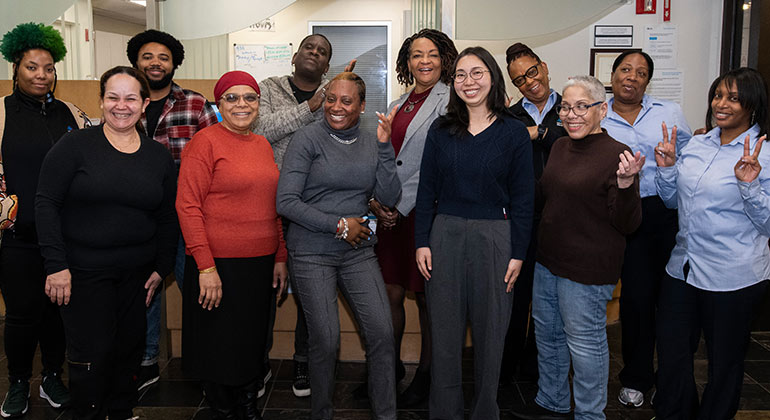
The administrative staff of the Adolescent Health Center, with project teammates from the Office for Health Data, Outcomes, and Engagement Strategy.
At the Mount Sinai Adolescent Health Center—a trusted haven for young people for more than 50 years—the finance staff noticed a troubling trend: Reports showed that patients who visited the Center and its six school-based clinics were increasingly recorded as having no insurance coverage. That left Mount Sinai unable to bill third-party payors, even when programs were available.
“When I saw in a quarterly report that nearly 44 percent of visits were showing up without coverage, I thought, ‘this isn’t right,’” says Rebecca Anapolle, director of finance at the Adolescent Health Center. “In my 18 years here, I’d never seen the percentage that high.”
Her insight led to cross-departmental teamwork that improved those numbers and has generated more than $200,000 for Mount Sinai as of the third quarter of 2025.
The Adolescent Health Center provides confidential medical, mental health, and reproductive health services at no direct cost to patients to more than 8,000 adolescents and young adults each year. Some are insured under a parent’s plan but avoid using it for privacy reasons, while others arrive without coverage. To make sure no one faces barriers, registration staff help teens secure Medicaid.
What had worked smoothly for years began to break down in 2024. During a period of staff turnover, too many visits were entered into the billing system with an internal code that bypassed available insurance options. Solving the problem required a response that reflected the One Mount Sinai spirit of collaboration. The Center partnered with Mount Sinai’s Office for Health Data, Outcomes, and Engagement Strategy (HDOES) to analyze the issue and identify its source.
HDOES created quarterly data summaries that made the problem clear and led to retraining across registration, finance, and operations teams. “We were able to turn insights into action,” says Jiaying Zhu, a management analyst at HDOES. “This project shows how data can be more than analysis—it can be a tool for change.” The teams also introduced new protocols, and with an expansion of Epic, Mount Sinai’s electronic medical record, staff gained stronger capabilities to track visits and resolve issues as they arose.
The results have been dramatic. In just three quarters, the proportion of visits coded without coverage dropped from 44 percent to 22 percent.
For Mount Sinai, the recovered revenue means greater ability to sustain and strengthen this nationally recognized program, which delivers more than 30,000 visits each year to young people ages 10 to 26 from across New York City and beyond.
“Fixing this problem, and joining forces across departments, means we can keep strengthening the mission of the Adolescent Health Center and make sure every young person who walks through our doors gets the care they need without barriers,” says Sarah Wood, MD, Director of the Adolescent Health Center.