
Teamwork Keeps Sleep-Study Patients on Track
Teamwork Keeps Sleep-Study Patients on Track:
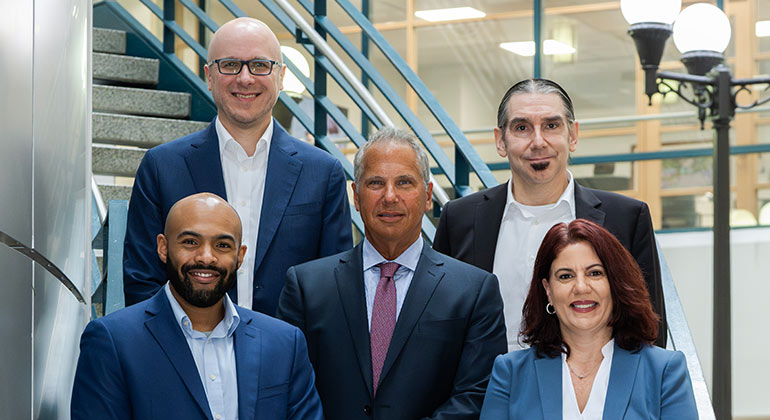
Front row: Sean Matthews, MPH, Paul Zucker, MBA, MS, and Gina Pezza, MPA. Back row: Paul Francaviglia and Vincent Grbach, MD.
At Mount Sinai-Union Square, clinicians noticed a troubling pattern—too many patients who needed home sleep studies weren’t completing them. Delays in insurance approvals, confusion about device pickup, and limited understanding of sleep apnea, a disorder in which breathing repeatedly stops and starts, were driving the drop-off. The result: missed diagnoses and delayed care.
“Home testing is far more convenient than an overnight stay in the hospital, but too often, patients were lost between the referral and return of the monitoring device,” says Paul Zucker, MBA, MS, Vice President of Ambulatory Operations. “We needed to keep them engaged from the moment the test was ordered through the final step.”
To close that gap, a multidisciplinary team launched a pilot in March 2024 at Mount Sinai-Union Square and Mount Sinai West. Their solution combined better workflow coordination with patient-friendly text communications. These included insurance updates, device instructions, and a short video featuring Charles A. Powell, MD, MBA, Chief of the Division of Pulmonary, Critical Care and Sleep Medicine, explaining the importance of the test in clear, accessible language.
Sean Matthews, MPH, Manager of Strategic Ambulatory Operations, helped lead the initiative, from implementation through sustainability. “We set out to improve and simplify the communication process, for patients and staff,” he says. Before the pilot, 50 to 60 percent of referred patients completed their sleep studies. Overall completion rose to 85 percent in the first month at Mount Sinai-Union Square and Mount Sinai West.
This collaborative effort exemplifies One Mount Sinai, a systemwide initiative that aligns people, processes, and technology to improve care and strengthen teamwork across departments.
The sleep study pilot emerged from the Patient Engagement and Interactions Subcommittee, co-chaired by John Davey, Vice President of Marketing, and Paul Francaviglia, Senior Director, Digital and Technology Partners. The planning group brought together representatives from Ambulatory Operations, Sleep Medicine, Digital Technology, Marketing, and the Access Center to develop a coordinated, patient-centered solution.
To carry out the intervention, the team mapped the patient journey and used a platform that was already connected to MyMountSinai and the Health System’s electronic medical record system to send messages to patients.
“We worked with the systems we had and made them smarter,” Mr. Francaviglia says. “The goal was to create something seamless for patients, efficient for staff, and cost-effective.” With the automated messaging in place, staff no longer need to track and contact sleep study patients individually, formerly a time-consuming task. Mr. Zucker says the results reflect the strength of a unified effort. “No one group could have done it alone,” he says. “This shows what’s possible when we all work toward a common goal.”
