
Triple Transplant Is the ‘Ultimate’ in Teamwork
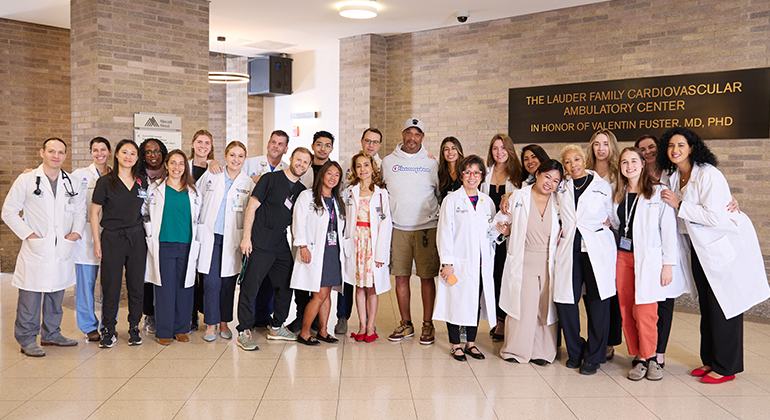
Triple transplant patient Mack Godbee, center, with members of the liver and heart teams. By his side is Noah Moss, MD, who has cared for Mr. Godbee for nearly a decade.
At The Mount Sinai Hospital, a cross-disciplinary team came together to achieve something never before accomplished in New York State: the transplantation of a heart, liver, and kidney into a single patient.
The marathon operation, lasting nearly 22 hours, was the result of careful planning and close collaboration across specialties. Surgeons, anesthesiologists, nurses, transplant coordinators, and intensive care teams each played vital roles, demonstrating the spirit of One Mount Sinai and the power of teamwork to solve medicine’s most complex challenges.
“These procedures don’t start in the operating room,” says Sander Florman, MD, Director of the Recanati/Miller Transplantation Institute. “They start with committees weighing the medical, surgical, and ethical aspects, anesthesiologists planning how to manage three different organs intraoperatively, and nurses coordinating every detail. It was the ultimate team sport.”
The patient, 64-year-old Mack Godbee, had undergone a heart transplant more than two decades earlier and had been under the care of Noah Moss, MD, an advanced heart failure cardiologist at Mount Sinai, for many years. Over time, the medications that kept Mr. Godbee’s heart functioning damaged his kidneys, while his failing heart put dangerous strain on his liver. When he collapsed in his driveway, his only hope of survival was an extraordinary three-organ transplant. On January 10, 2025, Mount Sinai surgeons performed the milestone procedure.
Anelechi Anyanwu, MD, Vice Chair of Cardiovascular Surgery, led the heart portion of the operation, and Dr. Florman performed the liver and kidney transplants. “What stood out was the orchestration,” Dr. Anyanwu says. “We might focus intensely in the OR for 24 hours, but it’s the ICU physicians and nurses who get the patient through the critical days that follow. Without them, the surgery would mean nothing.”
Dr. Florman and Dr. Anyanwu have long worked together on dual-organ transplants, where abdominal and thoracic medical and surgical teams already rely on close coordination. A triple procedure tested that partnership in the extreme. “His success is mine, and his failure would be mine,” Dr. Florman says. “I could sleep well knowing Dr. Anyanwu was there, and he could do the same with me.”
The excellence of Mount Sinai’s nurses is key to the entire process, the surgeons stressed: Transplant coordinators managed logistics, operating room nurses anticipated instruments for each stage, and critical care nurses guided recovery. “None of this is possible without them,” Dr. Florman says. “They run the show.”
The outcome was remarkable. Mr. Godbee returned home to Peekskill, New York, and within weeks resumed his role with the Peekskill Volunteer Ambulance Corps, where he has served for 40 years. “All the doctors were great. There were a lot of them looking after me, and they all took the time to introduce themselves and get my opinion on everything,” he says. “And I can't say enough about the nurses. They were awesome.”
Less than two months later, Mount Sinai teams successfully performed a second triple-organ transplant, and in November 2025, they performed a third—underscoring the depth of expertise that made such achievements possible.
“Seeing someone who was literally at death’s door walk out of the hospital and return to his family, that never gets old,” Dr. Florman says. “It’s a privilege, and it reminds us why we do what we do.”
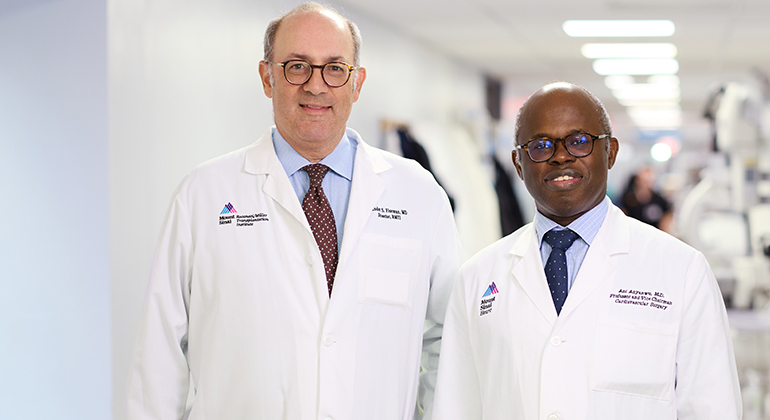
Sander Florman, MD, left, Director of the Recanati/Miller Transplantation Institute, and Anelechi Anyanwu, MD, System Vice Chair of Cardiovascular Surgery, just outside the OR where they performed the triple transplants.