
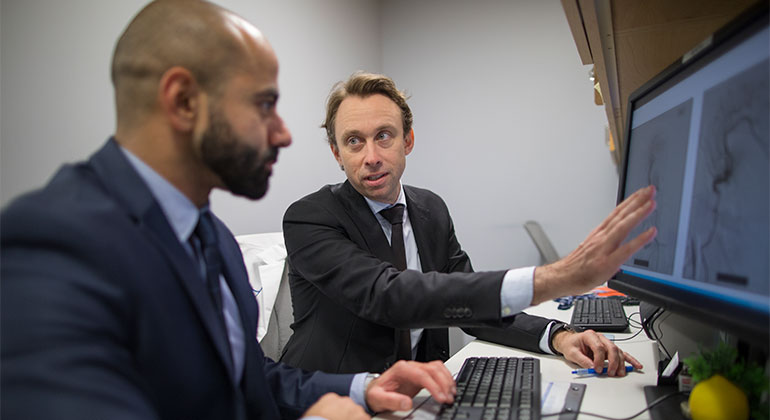
Interventional Spine and Pain Management
At Mount Sinai, we treat many spinal conditions that cause pain, dizziness, or weakness. Our advanced tools help us find the exact source of your symptoms. Then we treat that spot to relieve pain, restore function, and help you recover quickly.
Reade De Leacy, MD, leads our spine team of expert doctors and nurses. We offer personal, compassionate care at every stage of your treatment. We use the latest technology and approaches. Our staff works as a team to help you feel better. From the minute you arrive through follow-up care, we are here for you.
We treat many spine conditions. These include:
- Back and nerve pain (degenerative spine disease): You may have more back pain as you get older. This is because our spines change as we age. You may develop arthritis of the joints or degeneration of the discs. Some people have a disc hernia—when part of the soft center of a spinal disc pushes out of its normal place and irritates nearby nerves. This may cause pain along your arms or legs.
We use the latest imaging and surgery to find the exact point where your pain begins. Then we treat that spot to reduce swelling and help you move better. - Vertebral compression fractures: These occur when the bones of the spine weaken and collapse. It is often due to osteoporosis, a condition where your bones become less dense and weaker over time. It can also come from an accident, cancer, or another condition.
This can be very painful and make it hard to do your day-to-day life. Our team uses minimally invasive surgery to stabilize the spine, relieve pain, and help you return to daily living quickly.
Treatments for Back and Spine Pain
There are many causes of back pain. These include problems with the spinal nerves and discs, and arthritis in the spine. We use imaging to find where your pain begins. Imaging tests include computed tomography and magnetic resonance imaging.
When we find the problem spot, we make a treatment plan. Many of our treatments are minimally invasive and performed using advanced image guidance to provide precise and safe care.
Treatments for Nerve Irritation and Degenerative Spine Conditions
We use several types of treatments. These include:
- Epidural and selective nerve root injections: These shots help with pain and swelling caused by irritated spinal nerves. We may use steroids and numbing medicine, as well.
- Medial branch blocks and facet joint injections: These procedures help with pain from arthritic or injured joints in the spine. We numb the small nerves by injecting medicine directly into the joint. This lets us find out what is causing your pain and treat it.
- Radiofrequency ablation: If medial branch blocks work for you, radiofrequency ablation may help for longer. We use a special tool to stop your small nerves from sending pain messages to your brain.
- Sacroiliac joint injections: When your pain starts in the joint between the spine and pelvis (called the sacroiliac), shots can help. They reduce swelling and help you feel better right away and for the long term.
Persistent or Complex Pain
For people with ongoing or more complex pain, we offer several advanced therapies. These include:
- Spinal cord stimulation (neuromodulation): IIf your pain starts with your spinal cord nerves, this might help. We put a small device under your skin. The device delivers gentle electrical signals to the spinal cord. It “hides” pain signals before they reach the brain. We often do a trial run first to make sure it works for you.
- Sacroiliac joint fusion: If you have severe pain from the joint that connects your spine and pelvis (called the sacroiliac joint), we may need to fuse it. This means we connect the joints permanently. We use small implants placed through a tiny incision. Imaging helps us see what is going on. By reducing abnormal motion in the joint, this fusion can help you feel and move better long-term.
- Intradiscal therapies (disc-based treatments): You might feel pain from a damaged spinal disc. This disc is a sort of cushion that fits between the bones in your spine. We can use medicine, biologic therapies, or a procedure to reduce the swelling and your pain.
- Intrathecal drug delivery (pain pump therapy): If medicine isn’t helping your pain, we can put a small pump under your skin. This pump delivers pain medicine right where you need it, in the fluid around the spinal cord. This way, you get less medicine and fewer side effects than you would from a pill.
Advanced Treatment of Vertebral Compression Fractures
When a bone in your spine breaks, we call it a vertebral compression fracture. These are usually caused by osteoporosis or cancer. They can lead to back pain, changes in the shape of your spine, and difficulty moving. They can also make it hard for you to exercise or even leave your home. This can lead to social isolation or cause other medical problems.
Sometimes all you need is pain medicine, rest, and physical therapy. But many people need surgery. It can relieve pain, restore function, and help you return to your normal life. We do several types of procedures, including:
- Vertebroplasty and kyphoplasty (vertebral augmentation): We inject bone cement into the broken bone. This stabilizes the bone and relieves pain. In kyphoplasty, we insert a small device to create space between the bones in your spine. This can give you back any height you may have lost and helps the cement work better.
- Implant-based vertebral augmentation: For a more complicated break, we can place a small device between the spine bones to give them more support. This approach may last longer.
- Tumor ablation for cancer-related fractures: Cancer can make a bone weak and break. If this happens, we remove the tumor (called ablation). We can do this with radio waves (called radiofrequency ablation), freezing cold (called cryoablation), or intense heat (called microwave ablation). These methods help with pain and make other treatments work better.
- Complete cancer care: If you have cancer that involves the spine, you often need help from several experts. Our spine doctors work with cancer doctors, radiologists, and spine surgical teams. This way, we give you the care you need when you need it.