
Mount Sinai Unveils Emergency Department Transformation After Extensive Upgrades and Renovations
Completion of this multi-phase project will enhance patient experience and emergency care
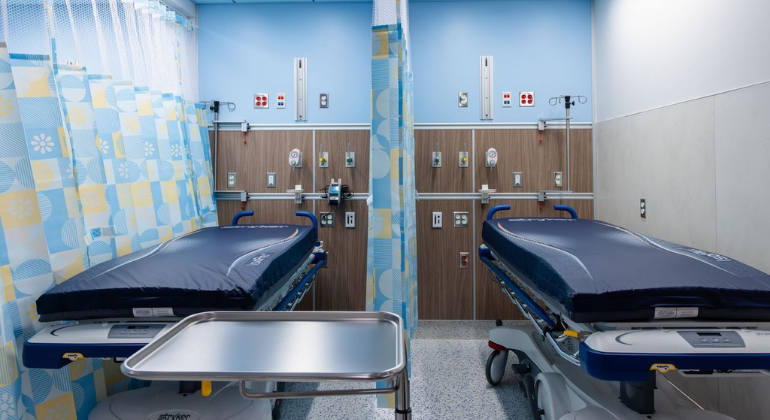
The Mount Sinai Hospital has announced the completion of a major six-phase redesign project of its Emergency Department (ED) that provides more clinical space, a completely renovated observation unit, and a more private and comfortable experience for patients. This transformation features innovative, state-of-the-art advancements to enhance access to life-saving, high-quality care and improved experience for the 100,000 patients who visit the ED each year. Construction began in the summer of 2020.
“This exciting work represents the culmination of five years of planning and effort,” says Benjamin S. Abella, MD, MPhil, Chair of the Department of Emergency Medicine for the Mount Sinai Health System. “We are proud to serve acutely ill patients in our communities, and this major ED renovation will greatly enhance our ability to effectively provide emergency services to those in need.”
The new Saul Family Emergency Department is substantially larger, expanding the clinical area by 10,000 square feet and increasing patient capacity and room size. It is equipped with the latest technology and tools to help staff best treat patients, work more efficiently, and provide a quicker stay for patients.

One of the newest phases of completion is an adult critical care space. This separate area is dedicated to resuscitating and caring for patients during life-threatening medical emergencies including cardiac arrest, septic shock, cardiogenic shock, and respiratory failure. Large, private treatment areas allow for enhanced patient monitoring and are capable of supporting advanced therapies such as bedside cardiopulmonary bypass, continuous dialysis, and other life-saving technologies.
“We are committed to providing excellent and equitable care for all of our patients, and our new critical care space was designed with our sickest patients in mind to ensure high-quality care and the most efficient and effective use of our space to optimize both patient and staff experience,” says Kristen M. Kelly, MD, Medical Director of the Emergency Department at The Mount Sinai Hospital.
The final phase also will encompass a new combined triage area for patients who arrive on their own and by ambulance. The triage area design will greatly enhance the process of patient registration and flow into a number of treatment areas, as well as increase privacy for patients and families. As soon as patients are registered at the front desk, staff will assess their condition and take them back to the triage area to limit their time in the waiting room. Within minutes, a provider will assess patients, gather medical history, and order any indicated lab work, imaging and medications. The newly designed space allows for better workflow, enabling rapid diagnosis and treatment.

“By combining our triage areas and optimizing our workflows, we will be able to ensure that the sickest patients get identified and treated more quickly,” explains Ashley Caceres, MSN, RN, Director of Nursing, and Emergency Services, at The Mount Sinai Hospital.
“This is a major milestone for emergency care in New York City and solidifies Mount Sinai’s commitment to enhancing patient care for our communities,” says David L. Reich, MD, Chief Clinical Officer of the Mount Sinai Health System and President of The Mount Sinai Hospital and Mount Sinai Queens. “This incredible new space is an example of how Mount Sinai continues to innovate and find new ways to improve our services to ensure positive outcomes and a positive experience while allowing our staff to more easily and efficiently provide life-saving care.”
Another initial phase of the redesign is the Mount Sinai Children’s Emergency Department at The Mount Sinai Hospital, which opened in 2022. This is tailored to the needs of children and their families, with a separate space from the adult ED, and is connected to all services within Mount Sinai Kravis Children's Hospital. It is nearly double the size of the previous space and has increased bed capacity. The design elements used throughout the environment, including colorful lighting and an interactive video feature wall, provide a calming atmosphere to put the youngest and most vulnerable patients at ease and help them feel comfortable. The location also houses a newly established special “resuscitation space” for critical care cases to enhance treatment for the sickest children, and a low-stimulation room—a quieter and calmer area for children with autism or other sensory challenges—which is unique among New York-area emergency departments.

Most of the project was paid for by hospital capital.
Part of the funding for this transformation was made possible by generous donations from Andrew and Denise Saul.
About the Mount Sinai Health System
Mount Sinai Health System is one of the nation’s leading integrated academic health systems and one of the largest in the New York metropolitan area. Its comprehensive system includes seven hospitals, more than 400 outpatient practices, over 600 research and clinical laboratories, the Icahn School of Medicine at Mount Sinai, the Graduate School of Biomedical Sciences, and the Mount Sinai Phillips School of Nursing. Together, the Health System comprises approximately 48,000 employees, more than 9,000 physicians, and 8,600 nurses.
As a leading learning health system, Mount Sinai combines clinical expertise with scientific discovery to improve patient care while training the next generation of health care and biomedical leaders. The Health System provides care across every stage of life, from prenatal care through geriatrics, while advancing personalized medicine through artificial intelligence, data science, and biomedical research.
Mount Sinai is consistently recognized among the nation’s leading academic health systems for patient care, research, and education. The Mount Sinai Hospital is ranked No. 1 in New York by Newsweek and No. 5 on the magazine’s World’s Best Hospitals list. The Icahn School of Medicine at Mount Sinai ranks No. 11 among U.S. medical schools and No. 1 among freestanding medical schools for National Institutes of Health funding, reflecting the strength of its scientific enterprise and leadership in biomedical research.