
Epilepsy
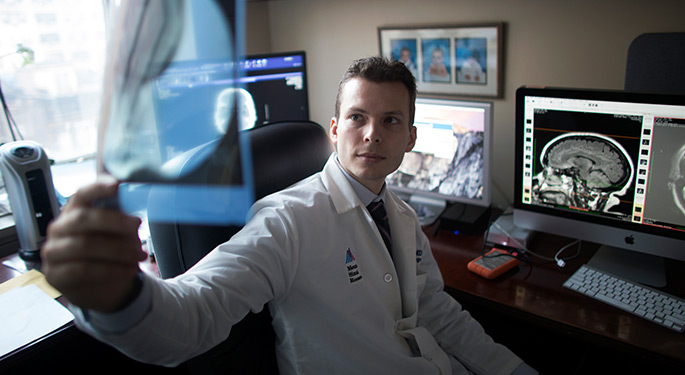

Epilepsy is a medical condition in which a person has reoccurring seizures, often with no identifiable cause. Often, doctors can manage epilepsy with medication alone. But for about a third of people with seizures require surgery; the risks of a procedure are lower than the risks of living with uncontrolled epilepsy.
If you are one of those people who require epilepsy surgery, Mount Sinai’s Epileptic Neurosurgery Service delivers world-class treatments, providing outstanding state-of-the-art diagnosis and treatment. Our experienced team understands the difficulties in treating this disease and provides the best possible care, so you can lead as normal a life as possible.
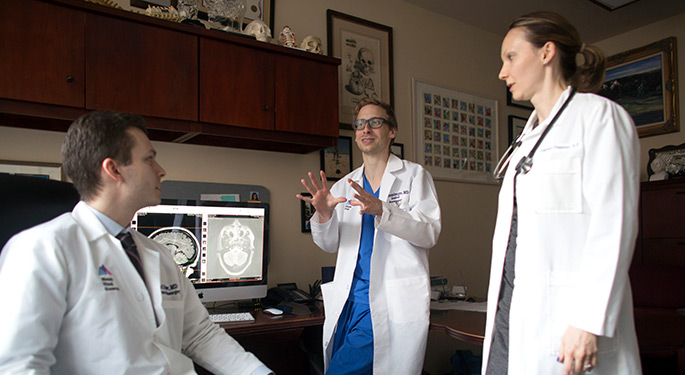
We work as a multidisciplinary team to analyze your situation and determine the most effective and safest approach to treatment. We make sure that you understand what we are doing at all times and are fully up to date on your progress. You will meet with our neurosurgeons as a group because we feel that it helps build relationships and increase communication.
Pre-Surgery Preparation
Most patients meet with their primary care doctors before the surgery. Your doctor will probably check your heart and lungs and may adjust your current medications. Depending on the situation, you may need to stop taking your medications for a few weeks before surgery; you will be able to take them again after the procedure.
You will also meet with your neurosurgeon, to discuss all details of the procedure including the goals, potential benefits, risks, and expected outcomes. We may need to do the surgery in stages.
Diagnostic Surgical Options
We do a thorough pre-surgical screening to make sure that we can perform a procedure without affecting your brain function. We also “map” your seizures to find out the seizure source, using electrodes in your brain (called stereoelectroencephalography or SEEG). To perform this minimally invasive procedure, we temporarily place small electrodes inside your skull to detect the seizure. We make two-millimeter incisions (the width of a fine pencil lead) under general anesthesia.
At Mount Sinai, we use a state-of-the-art robotic surgical assistive device called ROSA™ robotic assistance for this screening process, to decrease human error as much as possible. The ROSA robotic arm replicates human movement and empowers Mount Sinai West neurosurgeons with enhanced dexterity, flexibility and precision, with a 360-degree range of motion.
Benefits of ROSA for epilepsy surgery:
- Less invasive for mapping procedure and lesion removal
- Greater accuracy in identifying seizure source in the brain
- Allows an accurate pre-planned surgical path
- Contactless laser registration system
- Much shorter operation time
- Less time under anesthesia
You stay in the hospital for several days following the procedure, as our team continuously listens to you brain and maps out the way the seizures originate and spread. Once we know everything we need to do, we remove the electrodes in a very short procedure with you asleep for comfort.
Surgical Options
At Mount Sinai, we tailor epilepsy surgery to your individual needs. The most common surgical options are:
Responsive neurostimulation (RNS) is effective if the area of your brain that causes your seizures is responsible for speech or movement (which we call eloquent), In such cases resection or deactivation of the area is too risky and implanting a neurostimulator that can ‘listen’ to your brain can be a great option. Our treatment team can program the neurostimulator to ‘learn’ to recognize the onset of your seizures and send a miniscule electric impulse to short-circuit the seizure before it spreads. Responsive neurostimulation is the first device that the U.S. Food and Drug Administration has approved for use in the brain to listen, learn, and respond to seizures. Mount Sinai performs one of the highest volumes of RNS implantations in the world, with extensive experience in optimizing long-term outcomes through individualized device programming and advanced intracranial monitoring strategies.
Vagus nerve stimulation (VNS) is designed to decrease seizure activity. It involves placing a small wire around a nerve in your neck. The wire is attached to a small battery that we insert under the skin of your chest. Studies have shown that periodic stimulation of this nerve reduces seizure frequency and severity.
Laser Interstitial Thermal Therapy (LITT) is a stereotactic laser ablation that involves a careful deactivation of an area cauisng seziures. Studies show that such a deactivation of a part of the temporal lobe of the brain can help control epilepsy seizures. While you are under anesthesia, we make a two-millimeter incision in your skull. We then place a small laser fiber into the seizure focus, precisely guided by magnetic resonance imaging. This way, we can spare the surrounding parts of the brain, even if they are millimeters away.
Deep brain stimulation (DBS) uses implanted electrodes to deliver controlled electrical pulses to specific brain regions involved in seizure activity. The electrodes are connected to a small neurostimulator implanted in the chest, similar to a pacemaker, which helps regulate abnormal brain signals driving the brain curcuits away from pathologic acrivity back to normal function without seizures.
Craniotomy for a resection of the seizure focus remains the cornerstone of epilepsy surgery. It is a proceudre during which we carefullyremove the brain tissue that is causing the seizures. We usually do this procedure when the affected area of your brain is so hurt by epilepsy, it loses its function. Typically, other areas of your brain “pick up the slack” (which we call brain plasticity). As a result, removing the damaged part of the brain does not cause deficits; in fact, it actually improves your overall brain network, because it allows the healthy areas to work without constant electrical interference from the seizure ‘hot spot’. We perform this procedure when patients are awake or under anesthesia (asleep).
Meet Our Faculty
Saadi Ghatan, MD
Site Chair of Neurosurgery at Mount Sinai West and Mount Sinai Morningside
Director, Pediatric Neurosurgery at Mount Sinai Health System
Fedor E. Panov, MD
Associate Director, Adult Epilepsy Program