
Reducing Energy and Our Carbon Footprint
Since 2009, Mount Sinai has made substantiative reductions in energy intensity and carbon emissions from our Health System through energy efficiency and decarbonization projects. We have focused on reducing overall energy consumption, key electrification projects, and innovative approaches to heating and cooling, as well as increasing the use of renewable energy.
Energy Consumption Reductions
Mount Sinai continues to advance energy-efficient and sustainable infrastructure across our campuses, reducing emissions while supporting state-of-the-art research and patient care. Through targeted upgrades and long-term planning, we are building a foundation for a fully electrified, renewable-energy future.
Key sustainability and infrastructure initiatives include:
- Upgrading HVAC systems with modernized controls in multiple buildings, including the Hess Center for Science and Medicine, the Icahn School of Medicine at Mount Sinai, and the Mount Sinai West campus. In 2024, Mount Sinai received a $2 million award from the New York State Energy Research and Development Authority (NYSERDA) supporting infrastructure upgrades for the Hess Center for Science and Medicine’s datacenter heat recovery project demonstrating how cutting-edge science and clinical care can align with environmental stewardship.
- LED lighting retrofit projects across our facilities to reduce energy consumption and improve operational efficiency.
- A fully electrified facility at 787 11th Avenue, converting a former parking garage into research laboratory and outpatient clinical care space.
- Energy-efficient design at the Hamilton and Amabel James Center for Artificial Intelligence and Human Health, which incorporates a variable refrigerant flow (VRF) HVAC system to minimize fossil fuel usage and heating and cooling waste by delivering energy only where and when needed.
We will continue to conduct energy studies and prioritize electrification initiatives that prepare Mount Sinai for a cleaner, more sustainable future as the electric grid transitions to renewable energy. Future-focused electrification upgrades may include heat recovery systems at various locations throughout our major hospital campuses.
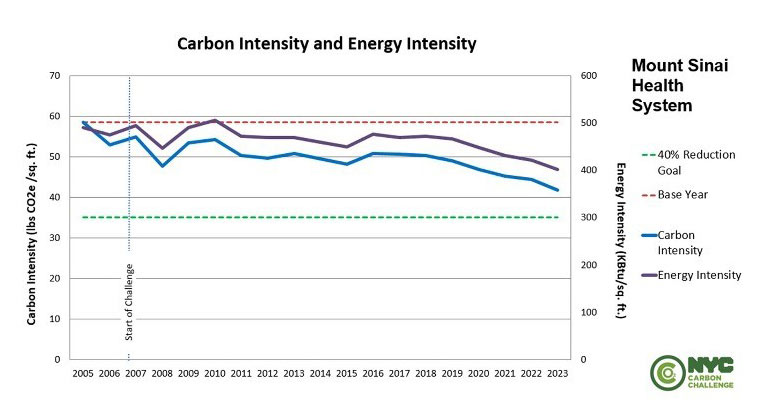
The chart shows Mount Sinai’s annual progress in reducing carbon and energy intensity since 2012.
Anesthetic Gas Decarbonization
Inhaled agents are used for maintaining general anesthesia, but their environmental impacts differ greatly based on each agent’s global warming potential (GWP) and associated atmospheric lifetime. While all inhaled agents are safe and clinically effective, some contribute more to climate change. Mount Sinai’s decarbonization strategy with inhaled anesthetics was to target the highest carbon footprint agents for reduction first and then decrease waste from unused medications, including:
- Desflurane, one of the most environmentally toxic anesthetic gases with a GWP 2540 times higher than carbon dioxide that persists in the atmosphere for 14 years.
- Nitrous oxide, the second most environmentally impactful agent with a GWP of nearly 300 and lasts in the atmosphere for more than 100 years.
The Department of Anesthesiology at Mount Sinai has made significant efforts and achieved meaningful reductions from a series of initiatives.
- Desflurane—Beginning in 2022, we implemented a dashboard quality improvement project study that provided personalized report cards comparing fresh-gas flows, anesthetic gas choice, and resulting carbon footprint to departmental benchmarks. Staff were offered practical strategies on how they could reduce their own emissions. As a result of this quality improvement initiative, culture change and changes in workflow desflurane use decreased greatly. By 2023, desflurane was completely removed from formulary across the Health System.
- Nitrous oxide—While nitrous oxide is less potent on a per kilogram basis, it depletes the ozone layer and lasts more than a century, meaning that even small inefficiencies leading to waste have significant impact. By comparing purchasing and clinical use data, we found significant losses from central pipelines that bring nitrous into the operating rooms. In response to this, the Health System decommissioned the central nitrous piping system and converted to direct delivery portable tanks located in the operating room across campuses. This intervention eliminated ongoing waste from delivery of this medication.
- Anesthetic gas—We have seen a 22 percent reduction in anesthetic gas use since 2021. From 2019 through 2024, the Health System reduced its use of anesthetics across the board, including reductions of isoflurane by 52.7 percent and sevoflurane by 27.2 percent.
In summary, by targeting the highest carbon agents first, and addressing hidden sources of ongoing waste, we can significantly shrink our carbon emissions. Looking ahead, we intend to maintain these reductions and investigate other initiatives to ensure long-term success.