

Treatment Process
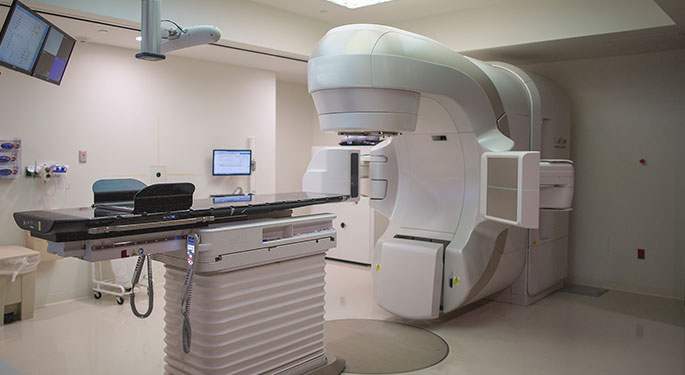
Radiation oncology is one of several tools we often use to treat cancer. It uses high doses of radiation to kill cancer cells or slow their growth.
Radiation therapy works by destroying the cancer cells' ability to reproduce. It leaves the cells unable to divide and grow. Radiation treatment does not kill cancer cells right away, though. It can take days or weeks of treatment to destroy the cells. Radiation works best on cells that are actively dividing.
At Mount Sinai, we offer the most advanced technology provided by some of the most experienced professionals in medicine. We use a total of five external-beam radiation therapy treatment machines and two simulators.
Typically, you receive multiple treatments over days or weeks. While you are in treatment, we strive to make you as physically and emotionally comfortable as possible. We understand that the journey back to good health can be difficult. We ensure that you will be well-informed about your condition, options, and possible outcomes.
Access our site specific patient education videos and Respiratory Gating Breathing Tracks here.
We offer the following technologies:
- 3D conformal radiation therapy (3D CRT) treats patients with tumors that are too close to vital organs and other structures for traditional radiation therapy.
- Brachytherapy involves implanting devices next to or within a tumor. Because the administration of radiation is so precise, it helps to preserve your healthy tissue. We typically use brachytherapy o treat prostate and gynecological cancer.
- Image-guided radiotherapy (IGRT) is one of the most advanced forms for radiation therapy, guided by computerized tomography (CT) scans or X-ray imaging.
- Intensity modulated radiotherapy (IMRT) uses 3D technology to destroy tumors. IMRT delivers a high dose of radiation to the affected region of the body.
- Intracoronary brachytherapy (IB) is well suited for patients with major heart conditions. This technique prevents in-stent restenosis in patients undergoing cardiac catheterization and stent placement for coronary artery disease.
- Linear accelerators, external radiation uses a machine to aim high-energy x-rays into a cancerous tumor
- Proton Beam Therapy (PBT) uses particles called protons to aim directly at a tumor. We use this approach to target tumors that are close to vital organs. We may also combine PBT with conventional photon treatments. We also offer pencil beam proton therapy, which is the most precise method of delivering proton beam therapy available.
- Stereotactic radiotherapy/radiosurgery (SRS) is a non-invasive technique to treat cancers of the brain and spinal cord. SRS delivers a single, high-dose of radiation to the tumor to shrink or destroy it.
- Superficial Radiotherapy (SRT) is a painless and effective alternative to surgery in selected skin cancers. We use SRT where surgery could lead to a negative facially cosmetic outcome or for patients who are too high-risk for surgical procedures. Our SRT-100 machine offers advanced SRT technology, and is currently one of only a few machines available in New York City.
Benefits and Effectiveness
Radiation treatment uses carefully targeted high-energy radiation to kill cancer cells. We use it to cure or shrink early-stage cancer, to help prevent recurrence, and to treat symptoms caused by advanced cancer.
The benefits of radiation therapy include:
- Allows you to continue to receive medications that may cause complications during surgery
- Does not cause any permanent surgical scarring or cosmetic damage
- Has a very high rate of success
- Live your everyday life since it is often performed on an outpatient basis
- Minimizes exposure to surrounding healthy tissue not affected by cancer
- Sessions typically take less than an hour so you can go on with your day as soon as you are finished
The effectiveness of radiation therapy depends on the type cancer and stage of cancer you have.
Side Effects
Radiation therapy can cause side effects. These side effects depend on the type of cancer you have, where it is located, and how much radiation you have received.
Some side effects may include:
- Chest pain
- Diarrhea
- Fatigue
- Head and neck discomfort
- Nausea
- Pelvic problems
- Skin redness and soreness
- Sore throat
- Stomach and abdomen pain