
Breast enlargement in males
Gynecomastia; Breast enlargement in a male
When abnormal breast tissue develops in males, it is called gynecomastia. It is important to find out if the excess growth is breast tissue and not excess fat tissue (lipomastia).
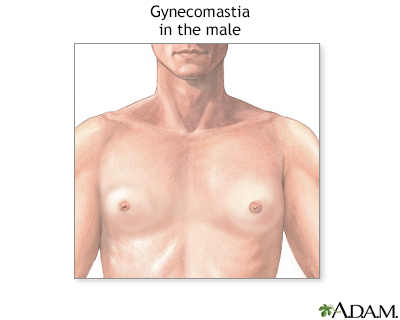
Gynecomastia is the development of prominent breast tissue in the male. The condition can develop during puberty and sometimes resolve on its own. Other causes of gynecomastia include exposure to estrogens, androgens (often taken secretly for body building), marijuana, and some medications. Rare causes include tumors, genetic defects, and chronic liver disease.
Considerations
The condition may occur in one or both breasts. It begins as a small lump beneath the nipple, which may be tender. One breast may be larger than the other. Over time the lump may become less tender and feel harder.
Enlarged breasts in males are usually harmless, but may cause men to avoid wearing certain clothing or to not want to be seen without a shirt. This can cause significant distress, particularly in young men.
Some newborns may have breast development along with a milky discharge (galactorrhea). This condition usually lasts for a couple of weeks to months. In rare cases, it may last until the child is 1 year old.
Causes
Normal hormone changes are the most common cause of breast development in newborns, boys, and men. There are other causes as well.
HORMONE CHANGES
Breast enlargement is usually caused by an imbalance of estrogen (female hormone) and testosterone (male hormone). Males have both types of hormones in their body. Changes in the levels of these hormones, or in how the body uses or responds to these hormones, can cause enlarged breasts in males.
In newborns, breast growth is caused by being exposed to estrogen from the mother. About one half of boy babies are born with enlarged breasts, called breast buds. They usually go away in 2 to 6 months, but can last longer.
In preteens and teens, breast growth is caused by normal hormone changes that occur during puberty. More than one half of boys develop some breast enlargement during puberty. Breast growth often goes away in about 6 months to 2 years.
In men, hormone changes due to aging can cause breast growth. This may occur more often in overweight or obese men and in men age 50 and older.
HEALTH CONDITIONS
Certain health problems can cause breast growth in adult men, including:
- Chronic liver disease
- Kidney failure and dialysis
- Low testosterone level
- Obesity (also the most common cause of breast growth due to fat)
Rare causes include:
- Genetic defects
- Overactive thyroid or underactive thyroid
- Tumors (including benign tumor of the pituitary gland, called prolactinoma)
MEDICINES AND MEDICAL TREATMENT
Some medicines and treatments that can cause breast growth in men include:
- Cancer chemotherapy
- Hormone treatment for prostate cancer, such as flutamide (Proscar), or for enlarged prostate, such as finasteride (Propecia) or bicalutamide
- Radiation treatment of the testicles
- HIV/AIDS medicines
- Corticosteroids and anabolic steroids
- Estrogen (including those in soy products)
- Heartburn and ulcer medicines, such as cimetidine (Tagamet) or proton pump inhibitors
- Anti-anxiety medicines, such as diazepam (Valium)
- Heart medicines, such as spironolactone (Aldactone), digoxin (Lanoxin), amiodarone, and calcium channel blockers
- Antifungal medicines, such as ketoconazole (Nizoral)
- Antibiotics such as metronidazole (Flagyl)
- Tricyclic antidepressants such as amitriptyline (Elavil)
- Herbals such as lavender, tea tree oil, and dong quai
- Opioids
DRUG AND ALCOHOL USE
Using certain substances can cause breast enlargement:
- Alcohol
- Amphetamines
- Heroin
- Marijuana
- Methadone
Gynecomastia has also been linked to exposure to endocrine disrupters. These are common chemicals often found in plastics.
Men who have enlarged breasts may have an increased risk for breast cancer. Breast cancer in men is rare. Signs that may suggest breast cancer include:
- One-sided breast growth
- Firm or hard breast lump that feels like it is attached to the tissue
- Skin sore over the breast
- Bloody discharge from the nipple
Home Care
For swollen breasts that are tender, applying cold compresses may help. Ask your health care provider if it's OK to take pain relievers.
Other tips include:
- Stop taking all recreational drugs, such as marijuana
- Stop taking all nutritional supplements or any medicines you are taking for bodybuilding
When to Contact a Medical Professional
Contact your provider if:
- You have recent swelling, pain, or enlargement in one or both breasts
- There is dark or bloody discharge from the nipples
- There is a skin sore or ulcer over the breast
- A breast lump feels hard or firm
If your son has breast growth but has not yet reached puberty, have him checked by a provider.
What to Expect at Your Office Visit
Your provider will take a medical history and perform a physical examination.
You may not need any tests, but the following tests may be done to rule out certain diseases:
- Blood hormone level tests
- Breast ultrasound
- Liver and kidney function studies
- Mammogram
TREATMENT
Often no treatment is needed. Breast growth in newborns and young boys often goes away on its own.
If a medical condition is causing the problem, your provider will treat that condition.
Your provider will talk with you about medicines or substances that may cause breast growth. Stopping their use or changing medicines will make the problem go away. Do not stop taking any medicines before talking to your provider.
Breast growth that is large, uneven, or does not go away may cause a decrease in quality of life. Treatments that may be used in this situation are:
- Hormone treatment that blocks the effects of estrogens
- Breast reduction surgery to remove the breast tissue
Gynecomastia that has been present for a long time is less likely to resolve even if the right treatment is started.
References
Ali O, Donohoue PA. Gynecomastia. In: Kliegman RM, St. Geme JW, Blum NJ, Shah SS, Tasker RC, Wilson KM, eds. Nelson Textbook of Pediatrics. 21st ed. Philadelphia, PA: Elsevier; 2020:chap 603.
Anawalt BD. Gynecomastia. In: Robertson RP, Giudice LC, Grossman AB, et al, eds. DeGroot's Endocrinology. 8th ed. Philadelphia, PA: Elsevier; 2023:chap 108.
Sansone A, Romanelli F, Sansone M, Lenzi A, Di Luigi L. Gynecomastia and hormones. Endocrine. 2017;55(1):37-44. PMID: 27145756
Version Info
Last reviewed on: 11/3/2022
Reviewed by: Sandeep K. Dhaliwal, MD, board-certified in Diabetes, Endocrinology, and Metabolism, Springfield, VA. Also reviewed by David C. Dugdale, MD, Medical Director, Brenda Conaway, Editorial Director, and the A.D.A.M. Editorial team.
