
Aarskog syndrome
Aarskog disease; Aarskog-Scott syndrome; AAS; Faciodigitogenital syndrome; Gaciogenital dysplasia
Aarskog syndrome is a very rare disease that affects a person's height, muscles, skeleton, genitals, and appearance. It can be passed down through families (inherited).
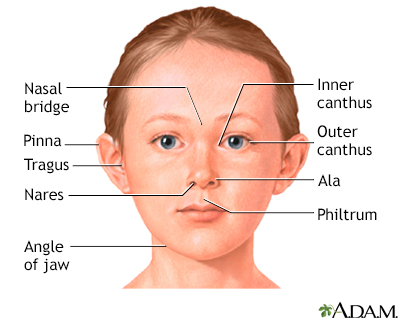
The physical landmarks of the human face are very similar from one face to another.
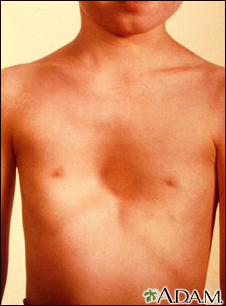
Pectus excavatum is a condition in which the breast bone (sternum) appears sunken and the chest concave. It is sometimes called funnel chest. The majority of these cases are not associated with any other condition (isolated findings). However, some genetic conditions include pectus excavatum.
Causes
Aarskog syndrome is a genetic disorder that is linked to the X chromosome. It affects mainly males, but females may have a milder form. The condition is caused by changes (mutations) in a gene called "faciogenital dysplasia" (FGD1).
Symptoms
Symptoms of this condition include:
- Belly button that sticks out
- Bulge in the groin or scrotum
- Delayed sexual maturity
- Delayed teeth
- Downward palpebral slant to eyes (palpebral slant is the direction of the slant from the inner to outer corner of the eye)
- Hairline with a "widow's peak"
- Mildly sunken chest (pectus excavatum)
- Mild to moderate cognitive problems
- Mild to moderate short height, which may not be obvious until the child is 1 to 3 years old
- Poorly developed middle section of the face
- Rounded face
- Scrotum surrounds the penis (shawl scrotum)
- Short fingers and toes with mild webbing
- Single crease in the palm of the hand
- Small, broad hands and feet with short fingers and curved-in fifth finger
- Small nose with nostrils tipped forward
- Testicles that have not come down (undescended)
- Top portion of the ear folded over slightly
- Wide groove above the upper lip, crease below the lower lip
- Wide-set eyes with droopy eyelids
Exams and Tests
These tests may be done:
- Genetic testing for mutations in the FGD1 gene
- X-rays
Treatment
Moving the teeth may be done to treat some of the abnormal dental features a person with Aarskog syndrome may have.
Support Groups
More information and support for people with Aarskog syndrome and their families can be found at:
- National Organization for Rare Disorders --
rarediseases.org/rare-diseases/aarskog-syndrome - NIH Genetic and Rare Diseases Information Center --
rarediseases.info.nih.gov/diseases/4775/aarskog-syndrome
Outlook (Prognosis)
Some people may have some mental slowness, but children with this condition often have good social skills. Some males may have problems with fertility.
Possible Complications
These complications can occur:
- Changes in the brain
- Difficulty growing in the first year of life
- Poorly aligned teeth
- Seizures
- Undescended testicles
When to Contact a Medical Professional
Contact your health care provider if your child has delayed growth or if you notice any symptoms of Aarskog syndrome. Seek genetic counseling if you have a family history of Aarskog syndrome. Contact a genetic specialist if your provider thinks you or your child may have Aarskog syndrome.
Prevention
Genetic testing may be available for people with a family history of the condition or a known mutation of the gene that causes it.
References
D'Cunha Burkardt D, Graham JM. Abnormal body size and proportion. In: Pyeritz RE, Korf BR, Grody WW, eds. Emery and Rimoin's Principles and Practice of Medical Genetics and Genomics: Clinical Principles and Applications. 7th ed. Philadelphia, PA: Elsevier; 2019:chap 4.
Haddad J. Congenital malformations of the ear. In: Kliegman RM, St. Geme JW, Blum NJ, et al, eds. Nelson Textbook of Pediatrics. 22nd ed. Philadelphia, PA: Elsevier; 2025:chap 678.
Jones KL, Jones MC, Del Campo M. Moderate short stature, facial ± genital. In: Jones KL, Jones MC, Del Campo M, eds. Smith's Recognizable Patterns of Human Malformation. 8th ed. Philadelphia, PA: Elsevier; 2022:chap D.
Version Info
Last reviewed on: 12/31/2023
Reviewed by: Anna C. Edens Hurst, MD, MS, Associate Professor in Medical Genetics, The University of Alabama at Birmingham, Birmingham, AL. Review provided by VeriMed Healthcare Network. Also reviewed by David C. Dugdale, MD, Medical Director, Brenda Conaway, Editorial Director, and the A.D.A.M. Editorial team.
