New Framework for Characterizing Traumatic Brain Injury To Reveal More Detail About Patient’s Condition and Potential for Recovery
Coalition of experts and patients from 14 countries expands assessment beyond immediate clinical symptoms, using advanced tools for improved insights
After more than half a century, assessment of traumatic brain injuries (TBI) is getting an overhaul that is expected to lead to more accurate diagnoses and more appropriate treatment and follow-up for patients.
Developed by a coalition of experts and patients from 14 countries and led by the National Institutes of Health, the new framework will include biomarkers, neuroimaging scans, and factors such as other medical conditions and how the trauma occurred. Details of the news framework appear in the May 20 issue of Lancet Neurology.
“A complete overhaul of the way we characterize and conceptualize the severity of traumatic brain injury is long overdue,” said Kristen Dams-O’Connor, PhD, Director of the Brain Injury Research Center at the Icahn School of Medicine at Mount Sinai and co-first author of the paper. “TBI is a complex injury to the most complicated organ in our bodies, and for decades we have commonly used terms like ‘mild,’ ‘moderate,’ and ‘severe’ to categorize it. These terms are not adequate for informing acute-care needs or predicting long-term outcomes, and they often do not accurately reflect the structural or physiological injuries sustained. Importantly, these crude categories have, in many cases, posed barriers to care. For example, a person with a very ‘severe’ TBI may be denied access to aggressive life-sustaining care, or the symptoms of a person with a ‘mild’ TBI may be minimized or disregarded.”
For more than 50 years, clinicians have used the Glasgow Coma Scale (GCS) to assess patients with TBI, classifying them into mild, moderate, and severe categories based on their level of consciousness and a few other clinical symptoms. That initial diagnosis determined the level of care the patients received in both the emergency department and afterwards, and did not take into account important modifiers that may influence the GCS, which will now be included.
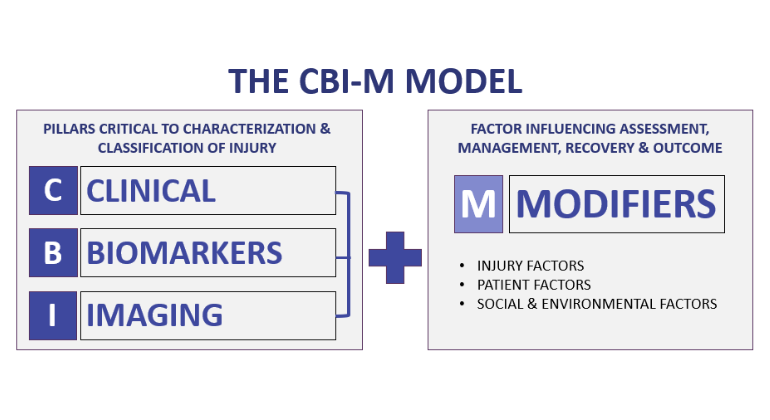
The new framework, known as CBI-M, comprises four pillars—clinical, biomarkers, imaging, and modifiers—and was developed by working groups of more than 100 TBI experts, researchers, patients, and the National Institute for Neurological Disorders and Stroke (NINDS).
“This initiative to establish a new framework reflects years of research and collaboration among scientists, clinicians, and federal agencies,” said Dr. Dams-O’Connor, who serves as a member of the NINDS steering committee on improving TBI characterization. “Federal investments in large-scale, longitudinal studies have provided the data needed to discover that the GCS is even more informative when we consider its component parts separately— – for example, eye, verbal and motor responses. Building upon the strength of this internationally used scale, while bringing in additional clinical assessments that permit more detailed severity characterization, is foundational to the first pillar (clinical) of the CBI-M model, which I think will help support adoption of the new framework into clinical practice.
The second pillar uses biomarkers identified in blood tests to provide objective indicators of tissue damage, overcoming the limitations of clinical assessment that may inadvertently include symptoms unrelated to TBI. Low levels of these biomarkers determine which patients do not require CT scans, reducing unnecessary radiation exposure and health care costs. These patients can then be discharged. In those with more severe injuries, CT and MRI imaging—the framework’s third pillar—are important for identifying blood clots, bleeding, and lesions that point to present and future symptoms.
The proposed framework is being phased in at trauma centers on a trial basis. It will be refined and validated before it is fully implemented.
About the Mount Sinai Health System
Mount Sinai Health System is one of the nation’s leading integrated academic health systems and one of the largest in the New York metropolitan area. Its comprehensive system includes seven hospitals, more than 400 outpatient practices, over 600 research and clinical laboratories, the Icahn School of Medicine at Mount Sinai, the Graduate School of Biomedical Sciences, and the Mount Sinai Phillips School of Nursing. Together, the Health System comprises approximately 48,000 employees, more than 9,000 physicians, and 8,600 nurses.
As a leading learning health system, Mount Sinai combines clinical expertise with scientific discovery to improve patient care while training the next generation of health care and biomedical leaders. The Health System provides care across every stage of life, from prenatal care through geriatrics, while advancing personalized medicine through artificial intelligence, data science, and biomedical research.
Mount Sinai is consistently recognized among the nation’s leading academic health systems for patient care, research, and education. The Mount Sinai Hospital is ranked No. 1 in New York by Newsweek and No. 5 on the magazine’s World’s Best Hospitals list. The Icahn School of Medicine at Mount Sinai ranks No. 11 among U.S. medical schools and No. 1 among freestanding medical schools for National Institutes of Health funding, reflecting the strength of its scientific enterprise and leadership in biomedical research.

Researchers Discover Rare Cortical Neurons That Can Help Put the Brain to Sleep
Sep 11, 2026 View All Press Releases
A Promising Study Suggests a Blood Test Could Spot Alzheimer’s Early in Progression
Apr 21, 2026 View All Press Releases
New Research Reveals Autism Risk Genes Are Shared Across Ancestries
Mar 30, 2026 View All Press Releases