The Mount Sinai Hospital First in the World to Offer Patients New FDA Approved Device for Severely Calcified Arteries
The Cardiac Catheterization Lab at The Mount Sinai Hospital launches United States' use of Diamondback 360® Coronary Orbital Atherectomy System to reduce severe arterial calcium prior to cardiac stents.
Leading interventional cardiologists at The Mount Sinai Hospital are the first in the world to use a newly U.S. Food and Drug Administration (FDA) approveddevicefor the treatment of severely calcified coronary arteries before the placement of a cardiac stent to open a blocked artery.
The new device being used in the Cardiac Catheterization Laboratory at The Mount Sinai Hospital is called the Diamondback 360® Coronary Orbital Atherectomy System. It's spinning electrically powered 1.25 mm diamond-coated crown is located on a thin cardiac catheterization guide wire and works within seconds to reduce the amount of hard calcium buildup in a coronary artery. The small calcium particles sanded from the artery's wall are then naturally discarded from the heart and the body.
The atherectomy system made by Cardiovascular Systems, Inc. was just FDA approved on Oct. 21. It is the first new coronary atherectomy system in more than two decades.
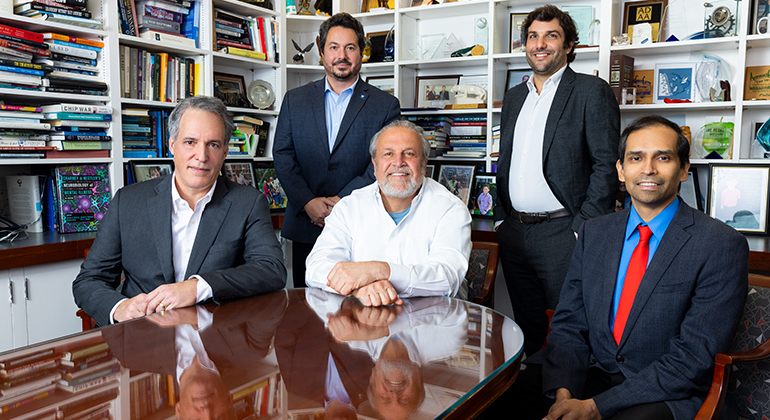
"We are excited that we are the first in the world to offer this innovation to our patients," says Samin K. Sharma, MD, Director of Clinical and Interventional Cardiology at The Mount Sinai Hospital and the Zena and Michael A. Wiener Professor of Medicine at Icahn School of Medicine at Mount Sinai. "This newly approved technology will allow us to significantly reduce our patients' heart blockage percentage for more successful cardiac stent placement. Also, we hope its use will facilitate improved outcomes for these patients with severely calcified blockages who are traditionally more challenging to treat."
Approximately 25 percent of patients with coronary artery disease in need of a percutaneous coronary intervention (PCI) to treat a heart blockage have severe levels of arterial calcium lining their arteries. However, until now there have been limited treatment options to remove it. Increased arterial calcium can lead PCI patients to experience an increased risk of poor outcomes, major adverse cardiac events (MACE), or increased mortality.
"Previous clinical trial results (ORBIT II) testing the Diamondback system have shown it to be safe and effective in treating severely calcified lesions. Also, trial results showed most patients to be free from MACE following the procedure," says Dr. Sharma. "We look forward to offering greater safety to this complex patient population at Mount Sinai."
Dr. Sharma is the national Principal Investigator of the MACE study for the newly FDA approved device which will prospectively evaluate the economic outcomes of treating varying degrees of calcified blockages in the coronary arteries.
About the Mount Sinai Health System
Mount Sinai Health System is one of the nation’s leading integrated academic health systems and one of the largest in the New York metropolitan area. Its comprehensive system includes seven hospitals, more than 400 outpatient practices, over 600 research and clinical laboratories, the Icahn School of Medicine at Mount Sinai, the Graduate School of Biomedical Sciences, and the Mount Sinai Phillips School of Nursing. Together, the Health System comprises approximately 48,000 employees, more than 9,000 physicians, and 8,600 nurses.
As a leading learning health system, Mount Sinai combines clinical expertise with scientific discovery to improve patient care while training the next generation of health care and biomedical leaders. The Health System provides care across every stage of life, from prenatal care through geriatrics, while advancing personalized medicine through artificial intelligence, data science, and biomedical research.
Mount Sinai is consistently recognized among the nation’s leading academic health systems for patient care, research, and education. The Mount Sinai Hospital is ranked No. 1 in New York by Newsweek and No. 5 on the magazine’s World’s Best Hospitals list. The Icahn School of Medicine at Mount Sinai ranks No. 11 among U.S. medical schools and No. 1 among freestanding medical schools for National Institutes of Health funding, reflecting the strength of its scientific enterprise and leadership in biomedical research.
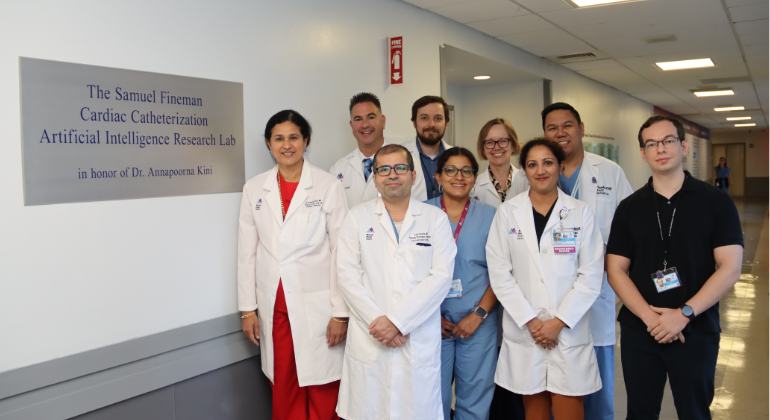
Mount Sinai Launches Cardiac Catheterization Artificial Intelligence Research Lab
Sep 15, 2025 View All Press Releases
Mount Sinai Surgeons Perform First Heart-Liver-Kidney Transplants in New York State
May 20, 2025 View All Press Releases