“Dark Matter” in Cancer Genome Prompts Immune Response
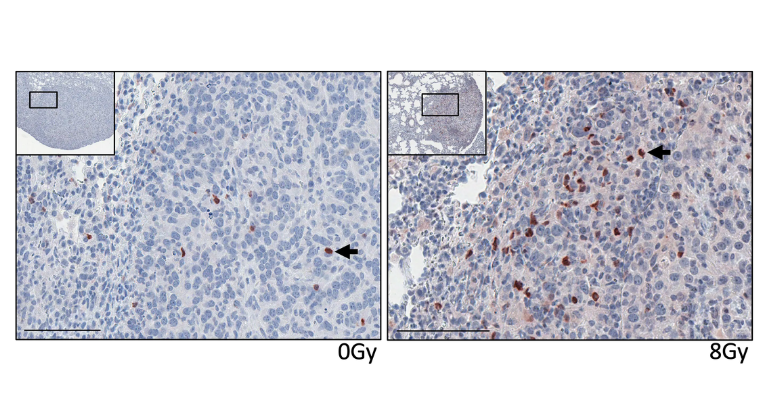
Researchers at the Icahn School of Medicine at Mount Sinai have discovered a group of non-coding RNA molecules in cancer cells that sets off an immune response because they appear to have features similar to those of pathogens. As a result of these molecules being expressed and amplified in cancer, the immune response they generate may be influencing the cancer’s growth, investigators say in their study, published in the PNAS early edition this month.
Their finding comes from probing the part of the genome’s “dark matter” — an area known as satellite DNA — which produces large quantities of non-coding RNA (ncRNA) set apart from coding genes and mRNA. These largely mysterious RNA molecules do not produce proteins, but can have important regulatory roles.
“These ncRNAs are found in both human and mice cancer cells,” said the study’s senior investigator, Benjamin Greenbaum, PhD, an assistant professor at The Tisch Cancer Institute at the Icahn School of Medicine at Mount Sinai. “These areas were called ‘junk DNA’, but over the last five years researchers have come to understand this is the home of a number of functionally important ncRNAs.”
Nina Bhardwaj, MD, PhD, Director of Immunotherapy and professor of Hematology and Medical Oncology at The Tisch Cancer Institute at the Icahn School of Medicine at Mount Sinai and co-senior investigator on this research, added, “Cancer appears to use these ncRNAs to stimulate an immune response that could encourage tumor growth and survival, although much remains unknown about their role.”
“If further research defines these molecules as helping cancer grow it may be possible to either target and inhibit these molecules or use them as a marker to look for cancer development,” she said. “On the other hand, research may show that they are mounting some sort of immune fight against cancer. In that case, we could try to boost that effort.”
The multinational team used mathematical tools derived from theoretical physics to shine some light on ncRNA dark matter.
“We searched a large database of ncRNA for patterns of nucleotides that were unusual,” said Dr. Greenbaum, a computational biologist. “Think of the genome’s sequence of nucleotides as words. In the human genome, some of the words are typically over- and under-represented. We wanted to know how these patterns differed in the RNA transcribed in cancers, such as those from satellite regions. The methods we used allowed us to analyze this big dataset much faster.”
The team found that in several cancers where odd RNAs were being activated and transcribed, these unusual RNAs were substantially amplified —that is, many copies of them existed than were found in normal cells.
“These ncRNAs had unusual patterns that were similar to some pathogens and this causes them to stimulate an innate immune response,” said Dr. Bhardwaj.
“All in all, we believe these ncRNAs may play a significant role in mediating immune responses against cancer,” said Dr. Greenbaum. “But much work remains to describe their precise interactions.”
Researcher partners on this study include the Roswell Park Institute in Buffalo, NY; Massachusetts General Hospital in Boston; the Centre National de la Recherche Scientifique and Ecole Normale Supérieure in Paris; and the Institute for Advanced Study in Princeton, NJ.
The study was supported by grants from the NIH and the Cancer Research Institute.
About The Tisch Cancer Institute at the Icahn School of Medicine at Mount Sinai
The Tisch Cancer Institute (TCI) is a world-class translational cancer institute established in December 2007. TCI has recruited more than 30 acclaimed physicians and researchers specializing in basic research, clinical research, and population science; built outstanding programs in solid tumor oncology; enhanced existing robust programs in hematological malignancies; and advanced the study of cancer immunology and vaccine therapy. The completion of the Leon and Norma Hess Center for Science and Medicine in 2012 enabled the recruitment of 25 additional cancer researchers on two full research floors, with 48,000 square feet of space dedicated to cancer research. In 2015, TCI was named a National Cancer Institute-designated cancer center. TCI joined an elite group of 69 cancer institutions nationwide that have earned this designation, which is based on scientific excellence, robust clinical research, and beneficial community impact. To learn more about clinical trials at Mount Sinai, visit http://icahn.mssm.edu/research/clinical-trials.
About the Mount Sinai Health System
Mount Sinai Health System is one of the nation’s leading integrated academic health systems and one of the largest in the New York metropolitan area. Its comprehensive system includes seven hospitals, more than 400 outpatient practices, over 600 research and clinical laboratories, the Icahn School of Medicine at Mount Sinai, the Graduate School of Biomedical Sciences, and the Mount Sinai Phillips School of Nursing. Together, the Health System comprises approximately 48,000 employees, more than 9,000 physicians, and 8,600 nurses.
As a leading learning health system, Mount Sinai combines clinical expertise with scientific discovery to improve patient care while training the next generation of health care and biomedical leaders. The Health System provides care across every stage of life, from prenatal care through geriatrics, while advancing personalized medicine through artificial intelligence, data science, and biomedical research.
Mount Sinai is consistently recognized among the nation’s leading academic health systems for patient care, research, and education. The Mount Sinai Hospital is ranked No. 1 in New York by Newsweek and No. 5 on the magazine’s World’s Best Hospitals list. The Icahn School of Medicine at Mount Sinai ranks No. 11 among U.S. medical schools and No. 1 among freestanding medical schools for National Institutes of Health funding, reflecting the strength of its scientific enterprise and leadership in biomedical research.


Loss of Radiation Therapy Clinics Could Widen Cancer Care Gaps Across the United States
Jul 10, 2026 View All Press Releases

Cancer-Associated Mutations in Brain Immune Cells May Contribute to Alzheimer's Disease
Jun 11, 2026 View All Press Releases