
Legg-Calve-Perthes disease
Coxa plana; Perthes disease
Legg-Calve-Perthes disease occurs when the ball of the thigh bone in the hip does not get enough blood, causing the bone to die.
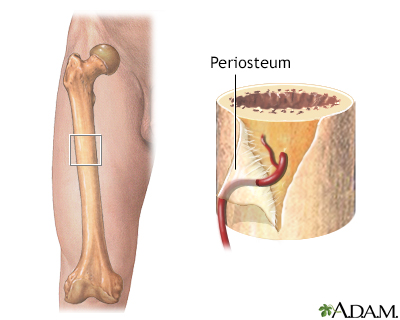
Bones require their own blood supply which travels through the periosteum to the inner bone marrow.
Causes
Legg-Calve-Perthes disease usually occurs in boys 4 through 11 years old. There are many theories about the cause of this disease, but little is actually known.
Without enough blood to the area, the bone dies. The ball of the hip collapses and becomes flat. Most often, only one hip is affected, although it can occur on both sides.
The blood supply returns over several months, bringing in new bone cells. The new cells gradually replace the dead bone over 2 to 3 years.
Symptoms
The first symptom is often limping, which is usually painless. Sometimes there may be mild pain that comes and goes.
Other symptoms may include:
- Hip stiffness that limits hip movement
- Knee pain
- Limited range of motion
- Thigh or groin pain that does not go away
- Shortening of the leg, or legs of unequal length
- Muscle loss in the upper thigh
Exams and Tests
During a physical examination, your health care provider will look for a loss in hip motion and a typical limp. A hip x-ray or pelvis x-ray may show signs of Legg-Calve-Perthes disease. An MRI scan may be needed.
Treatment
The goal of treatment is to keep the ball of the thigh bone inside the socket. The provider may call this containment. The reason for doing this is to make sure the hip continues to have good range of motion.
The treatment plan may involve:
- A short period of bed rest to help with severe pain
- Limiting the amount of weight placed on the leg by restricting activities such as running
- Physical therapy to help keep the leg and hip muscles strong
- Taking anti-inflammatory medicine, such as ibuprofen, to relieve stiffness in the hip joint
- Wearing a cast or brace to help with containment
- Using crutches or a walker
Surgery may be needed if other treatments do not work. Surgery ranges from lengthening a groin muscle to major hip surgery, called an osteotomy, to reshape the pelvis. The exact type of surgery depends on the severity of the problem and the shape of the ball of the hip joint.
It is important for the child to have regular follow-up visits with the provider and an orthopedic specialist.
Outlook (Prognosis)
Outlook depends on the child's age and the severity of the disease.
Children younger than 6 years old who receive treatment are more likely to end up with a normal hip joint. Children older than age 6 are more likely to end up with a deformed hip joint, despite treatment, and may later develop arthritis in that joint.
When to Contact a Medical Professional
Contact your provider for an appointment if a child develops any symptoms of this disorder.
References
McClincy MP, Olgun ZD, Dede O. Orthopedics. In: Zitelli BJ, McIntire SC, Nowalk AJ, eds. Zitelli and Davis' Atlas of Pediatric Physical Diagnosis. 8th ed. Philadelphia, PA: Elsevier; 2023:chap 22.
Sheffer BW. Osteochondrosis or epiphysitis and other miscellaneous affections. In: Azar FM, Beaty JH, eds. Campbell's Operative Orthopaedics. 14th ed. Philadelphia, PA: Elsevier; 2021:chap 32.
Version Info
Last reviewed on: 8/5/2023
Reviewed by: Neil K. Kaneshiro, MD, MHA, Clinical Professor of Pediatrics, University of Washington School of Medicine, Seattle, WA. Also reviewed by David C. Dugdale, MD, Medical Director, Brenda Conaway, Editorial Director, and the A.D.A.M. Editorial team.
