
Anterior vaginal wall repair
Vaginal wall repair; Colporrhaphy - repair of vaginal wall; Cystocele repair - vaginal wall repair
Anterior vaginal wall repair is a surgical procedure. This surgery tightens the front (anterior) wall of the vagina.
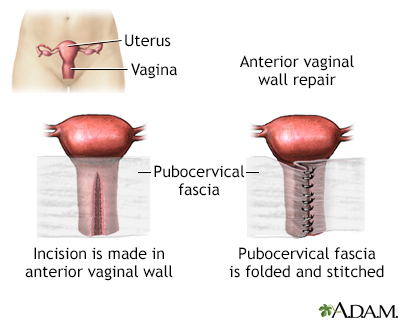
Anterior vaginal wall repair is a procedure performed to improve urinary continence. The pubocervical fascia is folded and stitched to bring the bladder and urethra into the proper position.
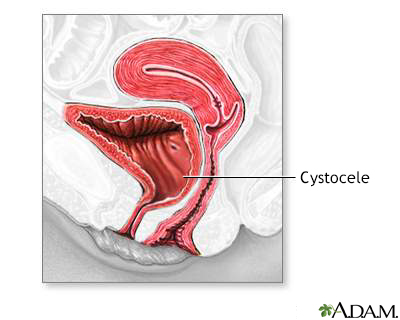
A cystocele is an downward outpocketing or hernia of the bladder towards the vaginal opening. The weakening of the muscular wall in this condition can cause urine to leak from the bladder when there is an increase in internal abdominal pressure such as in sneezing or coughing. Surgery such as an anterior vaginal wall repair may help this condition.
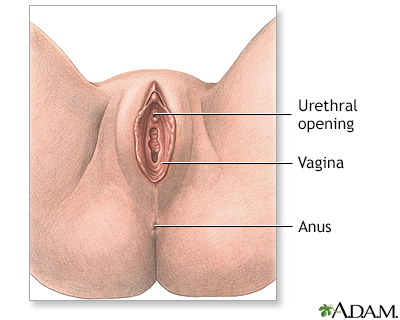
The vaginal opening lies just below the urethral opening, and just above the anal opening. The urethral opening, through which urine passes, leads to the bladder. The anus leads to the rectum. The vaginal opening leads to the vaginal canal, which leads to the uterus.
Description
The anterior vaginal wall can sink (prolapse) or bulge. This occurs when the bladder or the urethra sink into the vagina.
The repair may be done while you are under:
- General anesthesia: You will be asleep and unable to feel pain.
- Spinal anesthesia: You will be awake, but you will be numb from the waist down and you will not feel pain. You will be given medicines to help you relax.
Your surgeon will:
- Make a surgical cut through the front wall of your vagina.
- Move your bladder back to its normal location.
- May fold your vagina, or cut away part of it.
- Put sutures (stitches) in the tissue between your vagina and bladder. These will hold the walls of your vagina in the correct position.
- Place a patch between your bladder and vagina. This patch can be made of commercially available biological material (cadaveric tissue). The FDA has banned use of synthetic material and animal tissue in the vagina to treat anterior vaginal wall prolapse.
- Attach sutures to the walls of the vagina to the tissue on the side of your pelvis.
Why the Procedure Is Performed
This procedure is used to repair sinking or bulging of the anterior vaginal wall.
Symptoms of anterior vaginal wall prolapse include:
- You may not be able to empty your bladder completely.
- Your bladder may feel full all the time.
- You may feel pressure in your vagina.
- You may be able to feel or see a bulging at the opening of the vagina.
- You may have pain when you have sex.
- You may leak urine when you cough, sneeze, or lift something.
- You may get bladder infections.
This surgery by itself does not treat stress incontinence. Stress incontinence is the leaking of urine when you cough, sneeze, or lift. Surgery to correct stress urinary incontinence may be performed along with other surgeries.
Before doing this surgery, your health care provider may have you:
- Learn pelvic floor muscle exercises (Kegel exercises)
- Use estrogen cream in your vagina
- Try a device called a pessary in your vagina to strengthen the muscle around the vagina
Risks
Risks for anesthesia and surgery in general are:
- Reactions to medicines
- Breathing problems
- Bleeding, blood clots
- Infection
Risks for this procedure include:
- Damage to the urethra, bladder, or vagina
- Irritable bladder
- Changes in the vagina (prolapsed vagina)
- Urine leakage from the vagina or to the skin (fistula)
- Worsening urinary incontinence
- Lasting pain
- Complications from the material used during surgery (mesh/grafts)
Before the Procedure
Always tell your provider what drugs you are taking. Also tell the provider about the drugs, supplements, or herbs you bought without a prescription that you are taking.
During the days before the surgery:
- You may be asked to stop taking aspirin, ibuprofen (Advil, Motrin), warfarin (Coumadin), and any other drugs that make it hard for your blood to clot.
- Ask your provider which drugs you should still take on the day of your surgery.
On the day of your surgery:
- You very often will be asked not to drink or eat anything for 6 to 12 hours before the surgery.
- Take the medicines your provider told you to take with a small sip of water.
- Your provider will tell you when to arrive at the hospital.
After the Procedure
You may have a catheter to drain urine for 1 or 2 days after surgery.
You will be on a liquid diet right after surgery. When your normal bowel function returns, you can return to your regular diet.
You should not insert anything in the vagina, lift heavy items, or have sex until your surgeon says it is OK.
Outlook (Prognosis)
This surgery will very often repair the prolapse and the symptoms will go away. This improvement will often last for years.
References
Kirby AC, Lentz GM. Pelvic organ prolapse, abdominal hernias, and inguinal hernias: diagnosis and management. In: Gershenson DM, Lentz GM, Valea FA, Lobo RA, eds. Comprehensive Gynecology. 8th ed. Philadelphia, PA: Elsevier; 2022:chap 20.
Winters JC, Krlin RM, Hallner B. Vaginal and abdominal reconstructive surgery for pelvic organ prolapse. In: Partin AW, Dmochowski RR, Kavoussi LR, Peters CA, eds. Campbell-Walsh-Wein Urology. 12th ed. Philadelphia, PA: Elsevier; 2021:chap 124.
Wolff GF, Winters JC, Krlin RM. Anterior pelvic organ prolapse repair. In: Smith JA Jr, Howards SS, Preminger GM, Dmochowski RR, eds. Hinman's Atlas of Urologic Surgery. 4th ed. Philadelphia, PA: Elsevier; 2019:chap 89.
Version Info
Last reviewed on: 4/10/2022
Reviewed by: Kelly L. Stratton, MD, FACS, Associate Professor, Department of Urology, University of Oklahoma Health Sciences Center, Oklahoma City, OK. Also reviewed by David C. Dugdale, MD, Medical Director, Brenda Conaway, Editorial Director, and the A.D.A.M. Editorial team.
